
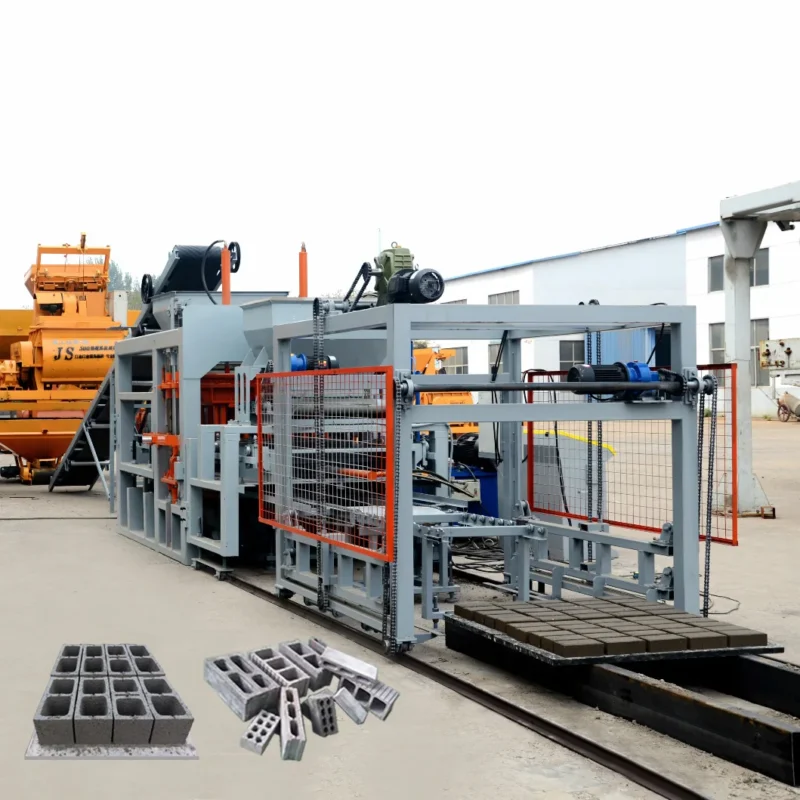
Matched Line Integration — Every station around the QT8-15 is specified against the same cycle time and pallet format, so the press never waits on upstream or downstream equipment.
Technical Specifications
| Parameter | Value |
|---|---|
| Model | QT8-15 |
| Product Type | Fully Automatic Hydraulic Block Making Machine |
| Overall Dimensions (L×W×H) | 8300×1860×3000 mm |
| Rated Pressure | 21 MPa |
| Main Vibration Form | Platform vibration |
| Vibration Frequency | 2800–4500 r/min |
| Vibration Force | 45 kN |
| Pallet Size | 950×900 mm |
| Molding Cycle | 15–25 s (basis not stated in source — confirm block format / material / thickness) |
| Overall Power | 55.5 kW |
| Total Mass | 9 T |
| Demolding Method | Hydraulic |
| Control System | Computer controlled, fully automatic (PLC type and language configurable) |
| Automation Level | Fully automatic |
| Applied Products | Hollow/solid blocks, pavers, interlocking blocks, curbstone, colored pavers |
| Raw Materials | Crushed stone, sand, cement, fly ash, gravel, slag, dust |
| Factory Area | 500 m² |
| Warranty | 1-year guarantee for the whole machine |
| Certification | CE, ISO 9001 |
Application Suitability
| Application | Material or Output |
|---|---|
| Hollow block production for residential and commercial masonry | Crushed stone, sand, cement, fly ash blends |
| Solid block manufacturing for load-bearing walls | Gravel, sand, cement with high-density compaction |
| Interlocking paver production for driveways and walkways | Colored pigments, fine aggregate, cement |
| Curbstone forming for road and infrastructure projects | Coarse aggregate, cement, slag |
| Porous and permeable paver runs for drainage applications | Open-graded aggregate, cement, limited fines |
What "15 Seconds Per Cycle" Actually Means on the Floor
A cycle number without a block format attached is meaningless for line planning.
Suppliers often quote a single cycle time across all formats. In reality, a 150 mm hollow block, a 60 mm paver, and an interlocking brick each demand different vibration durations, pressure hold times, and feed strokes on the QT8-15 block machine production line. When the line is configured around one assumed format and the buyer runs another, the press either sits idle waiting for the mixer or the stacker cannot keep up. [NEED_CITE: cycle time variation across block formats in hydraulic block making]
I have watched lines in Latin America where the mixer discharged every 40 seconds but the press cycled in 20, leaving the hopper starving half the shift. The owner blamed the press when the real mismatch was two stations upstream.
Feeding and Mixing Stations That Match Press Demand
The QT8-15 block machine production line draws from a batching station where raw material ratios are set against the buyer’s actual aggregate grading. The mixer must discharge a full batch into the press hopper within the window the press empties its previous charge. When the mixer capacity is undersized, the vibration station pauses mid-cycle and block density drops on the next pallet because the mix sits too long in the hopper, losing workability.
Pallet Circulation and Curing Rack Alignment
Every pallet leaving the QT8-15 carries a freshly pressed block that must reach the curing area before the next cycle deposits another. The 950×900 mm pallet dimension is the reference that the curing rack spacing, forklift tine width, and stacker arm reach must all align with. A mismatch here means pallets pile up at the end of the line and operators start pulling them off by hand, defeating the automation the buyer paid for. [NEED_CITE: pallet handling bottlenecks in automated block plants]
Reading the Specs That Govern Line Balance
The 21 MPa rated pressure and 45 kN vibration force together determine how tightly aggregate particles are compacted before the hydraulic demold lifts the mould box. Platform vibration at 2800–4500 r/min pushes energy through the pallet rather than through the mould walls, which means pallet flatness and rigidity directly affect block strength consistency. The 55.5 kW overall power is distributed across the mixer drive, hydraulic pump, vibration motors, and handling conveyors, so each station’s individual motor rating must be checked against the local supply capacity. A 9 T total mass on a 500 m² factory footprint means the foundation must carry point loads from the vibration table and hydraulic columns without deflection, or the platform will drift out of level over the first months of operation.
What Happens When Line Stations Are Quoted Separately
Buyers who source the press from one supplier and the mixer, pallet feeder, and stacker from others often discover that the control systems do not communicate. The QT8-15 block machine production line may pause because the pallet feeder sensor uses a different signal protocol than the press PLC, leaving an operator to trigger each pallet manually. The result is a fully automatic machine running at semi-automatic speed, and the buyer cannot point to a single supplier for the fix. [NEED_CITE: PLC signal integration challenges across mixed-equipment block lines]
Why Buyers Choose a Single-Source Line Build
Block machinery is our single focus, so the press, mould, pallet, and handling stations are specified as one system rather than assembled from separate vendors. Configuration is set against the buyer’s mix design and local aggregate, not pulled from a catalogue default. Mould design covers the formats the buyer’s market actually sells, and custom drawings are accepted when standard formats do not fit. Automation level is selectable so a plant can start with the QT8-15 in semi-automatic mode and add the stacking and cubing stations later without replacing the press. Installation support includes operator training on the exact line layout delivered, not a generic manual.
Documentation & Verification
- Line layout showing every station with cycle time per block format assumed
- Pallet specification matched to your curing rack spacing and forklift capacity
- Voltage, frequency, and PLC display language confirmed before production starts
- Factory test record run on your target block format before dispatch
- Hydraulic and electrical schematics for local maintenance teams
- Wear parts and mould list with part numbers for reordering
Installation, Commissioning & Support
- Foundation plan sized for 9 T machine mass and vibration table point loads
- Dedicated circuit for 55.5 kW total draw with voltage and frequency matched to site supply
- Assembly sequence from shipment state to first press cycle with supervisory support
- PLC parameter tuning on your actual mix and block format during commissioning
- Operator training covering mould change, pallet loading, and daily startup checks
- Wear parts catalogue with hydraulic seals and vibration motor bearings listed
Before You Request a Quote
Provide your target block formats with daily volume, the local aggregate and cement types available, and the curing area dimensions you have on site. Confirm the voltage and frequency at your plant along with the preferred PLC display language so the control panel is built correctly before the QT8-15 block machine production line leaves the factory.
Frequently Asked Questions
Q: How is the QT8-15 cycle time verified against each block format rather than quoted as a single number?
A: The 15–25 second range shifts depending on block height, wall thickness, and aggregate grading. We run a factory test on the buyer’s specified format and record the actual press cycle, feed time, and vibration duration. That recorded cycle becomes the baseline for sizing the mixer discharge rate and stacker speed so every station on the line matches.
Q: Which supporting stations are included in the line and which are optional?
A: Raw material feeding, mixing, pallet feeding, and basic stacking are standard line stations. Curing rack handling and automatic cubing can be added or deferred depending on the buyer’s automation level choice. Each station is listed in the line layout so the scope is clear before the order is placed.
Q: How do pallet size and material choices affect curing rack design and forklift compatibility?
A: The 950×900 mm pallet sets the curing rack bay width and the spacing between pallet layers. Bamboo, PVC, and steel pallets each have different weights and flex characteristics that change how many layers a rack can hold and which forklift capacity is needed to move a full rack safely.
Q: What is the station-by-station power breakdown across mixer, press, and handling equipment?
A: The 55.5 kW overall draw is split among the vibration motors, hydraulic pump, mixer drive, and conveyor or stacker motors. A detailed power schedule in the electrical schematic shows each motor rating so the buyer can size breakers, cables, and any backup generator for the site.
Q: How does the line layout adapt when the buyer already has a mixer or stacking system?
A: We map the existing equipment’s cycle rate and pallet interface against the QT8-15 press output. If the buyer’s mixer discharges fast enough and the stacker accepts 950×900 mm pallets, those stations are retained and the line layout is drawn around them, with signal integration confirmed before shipment.


