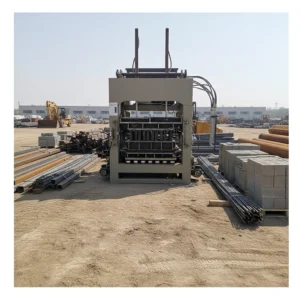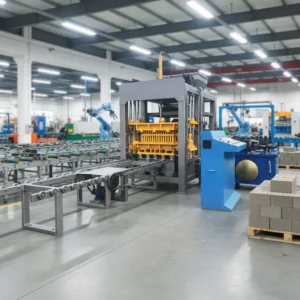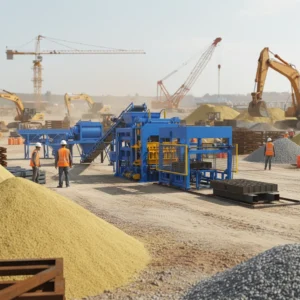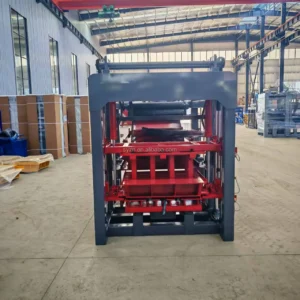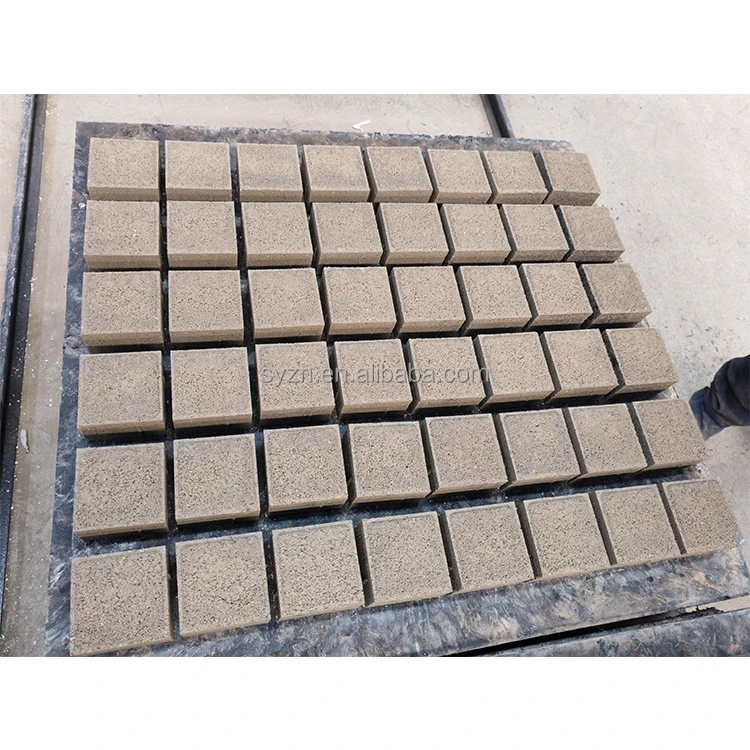
Integrated System Design — The QT8-15 block making machine production line is specified as a complete loop from batching through stacking, with each station’s cycle time calculated against the press cycle so the host machine is never left waiting.
Technical Specifications
| Parameter | Value |
|---|---|
| Model | QT8-15 |
| Product Type | Full Automatic Hydraulic Block Making Machine |
| Overall Dimensions (L×W×H) | 8300 × 1860 × 3000 mm |
| Rated Hydraulic Pressure | 21 MPa |
| Main Vibration Form | Platform Vibration |
| Vibration Frequency | 2800 – 4500 r/min |
| Vibration Force | 45 kN |
| Pallet Size | 950 × 900 mm |
| Molding Cycle | 15 – 20 s (basis not stated in source — confirm block format, material, thickness) |
| Overall Power | 55.5 kW |
| Total Mass | 8 T |
| Demolding Method | Hydraulic |
| Recommended Factory Area | 300 m² |
| Automation Level | Full Automatic |
| Control System | PLC based (language and voltage to be confirmed with buyer) |
| Standards | CE declaration available |
Application Suitability
| Application | Material or Output |
|---|---|
| Hollow block production for load-bearing walls | Crushed stone, sand, cement, fly ash |
| Solid block production for partition walls | Sand, gravel, cement, slag |
| Paving block and colored paver production | Crushed stone, cement, pigment, dust |
| Interlocking block and curbstone manufacturing | Gravel, sand, cement, fly ash |
What the Press Cycle Ignores in a Block Line
A 15-second host cycle means nothing when the mixer discharges too slowly or the pallet feeder cannot keep pace.
When evaluating a QT8-15 block making machine production line, buyers often focus exclusively on the molding cycle. Yet I have watched high-speed hosts in Latin America sit idle for large portions of the shift because upstream or downstream stations were mismatched. The feeder could not deliver material in time, or the pallet return loop created a bottleneck that the PLC could not resolve on its own [NEED_CITE: production line synchronization in concrete block plants]. The result is a machine rated for high throughput but delivering a fraction of it on the factory floor.
Synchronizing Every Station Around the Press
The QT8-15 block making machine production line treats the press as one station within a continuous loop. Raw material feeding, mixing, pallet circulation, stacking, and curing rack handling are each timed so that the host never waits for a pallet or a batch. This synchronization is the real determinant of daily output, not the press cycle in isolation.
Designing the Pallet Loop Around Your Curing Area
Pallet size at 950 × 900 mm must align with the buyer’s existing curing racks and forklift capacity. If the pallet dimensions do not match, the entire downstream handling chain — stacking, transfer, and retrieval — breaks down. The QT8-15 block making machine production line configuration starts with the buyer’s site conditions and works backward to the press, not the other way around [NEED_CITE: pallet handling standards in block manufacturing].
Pressure, Vibration, and Block Density
The 21 MPa hydraulic pressure combined with 45 kN vibration force at 2800–4500 r/min determines the compaction density of each block. On platform vibration systems, the frequency range allows adjustment to different mix designs — coarser aggregates typically require lower frequencies with higher amplitude, while fine sand mixes benefit from higher frequencies. The hydraulic demolding method ensures the green block is released without cracking, which is critical for hollow and interlocking formats where wall thickness is minimal. A mismatch between vibration settings and the local aggregate profile leads to inconsistent strength from batch to batch.
The Cost of a Mismatched Line Configuration
When the mixer discharge speed is slower than the press cycle, every delay compounds across the shift. I have seen operations where the host was ready but the pallet return system lagged, forcing operators to manually intervene. The QT8-15 block making machine production line addresses this by specifying each upstream and downstream component against the press timing. A quotation that lists only the press without its supporting stations leaves the buyer to source and integrate them independently, often at a higher total cost and with no single point of accountability [NEED_CITE: equipment integration challenges in block production].
Why Buyers Source the Complete Line Here
Configuration is set against the buyer’s actual mix design and target block format rather than a default catalog entry. Pallet size, material, and return loop are matched to the curing area and forklift already on site. Voltage, frequency, and PLC display language are confirmed before production, reducing commissioning delays. Mould options cover hollow, solid, paving, interlocking, and curbstone formats with custom design available. The line layout includes capacity calculations that state the assumed block format at every station, so there is no ambiguity about real output.
Documentation & Verification
- Line layout drawing showing each station from batching to stacking with cycle time annotations
- Machine specification sheet covering hydraulic pressure, vibration frequency, and pallet dimensions
- Mould drawing and format list for all block types in your production plan
- Voltage, frequency, and PLC language confirmation form signed before production
- Factory test record run on your specified mix design and block format
- Hydraulic and electrical schematic for integration with plant infrastructure
Installation, Commissioning & Support
- Foundation requirements mapped to the 8300 × 1860 mm footprint and 8 T operating mass
- Dedicated power circuit specified for the 55.5 kW total load at buyer’s confirmed voltage and frequency
- Machine arrives in dismantled modules with reassembly supervised on site
- First-run parameter tuning matched to your local aggregate and cement grade
- Operator training covering PLC interface, mould change procedure, and daily maintenance checkpoints
- Wear parts list and hydraulic seal kit supplied with initial spare inventory
Preparing Your Line Inquiry
Provide the block formats you intend to produce and the daily volume target for each. Include your site’s curing area dimensions and the forklift model currently in use so pallet handling can be matched. Confirm local voltage and frequency along with the preferred PLC display language to avoid delays during commissioning.
Frequently Asked Questions
Q: How is line capacity calculated and which block format does each station assume?
A: Capacity is calculated from the slowest station in the loop, not the press alone. Each station’s cycle time is stated against a specific block format, wall thickness, and mix density. The line layout document lists the assumed format so you can compare the quoted output against your actual product mix before placing the order.
Q: How do pallet feeding and stacking stations synchronize with the QT8-15 press cycle?
A: The pallet feeder and stacker are timed to deliver and retrieve pallets within the 15–20 second molding window. If either station lags, the PLC flags the delay and the press holds. We specify pallet return speed, stacker cycle, and feeder capacity to eliminate these hold conditions under normal operating conditions.
Q: What supporting equipment is included versus what the buyer must provide?
A: The quotation covers the press, mixer, pallet feeder, stacker, and control system as one package. The buyer typically provides the curing racks, forklift, raw material storage silos, and utility connections. We list every included and excluded item in the line layout so there are no surprises at installation.
Q: How is pallet size selected to match the curing area and handling equipment?
A: The 950 × 900 mm pallet is confirmed against your curing rack spacing and forklift fork width. If your existing racks are built for a different dimension, we adjust the pallet specification and corresponding mould layout so the entire handling chain remains compatible without requiring site modifications.