
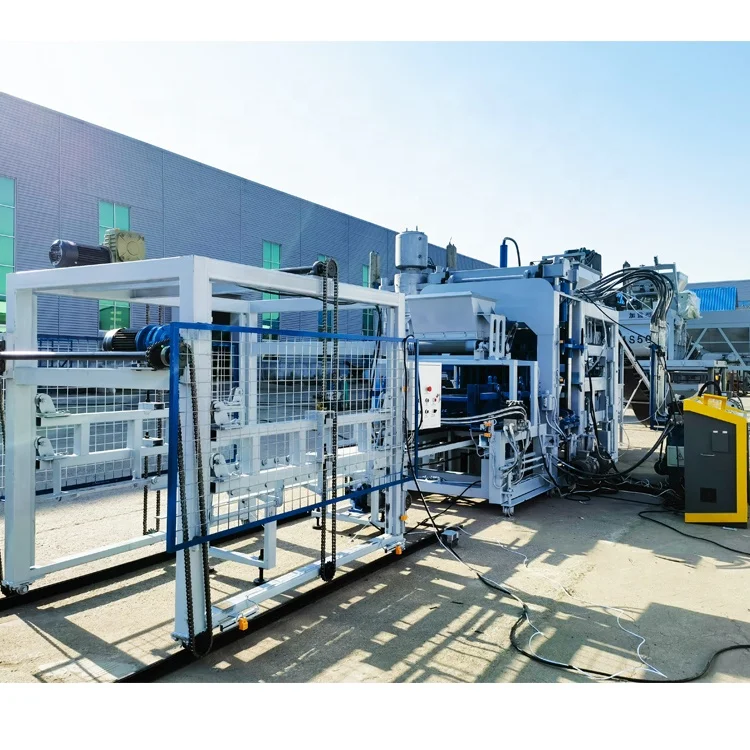
Synchronized Line Flow — Every station from raw material feeding to curing rack handling is cycle-matched to the QT8-15 press so the host machine never idles while upstream or downstream equipment catches up.
Technical Specifications
| Parameter | Value |
|---|---|
| Model | QT8-15 |
| Product Type | Concrete Block Making Machine |
| Overall Dimensions (L×W×H) | 8300 × 1860 × 3000 mm |
| Total Mass | 9 T |
| Rated Pressure | 21 MPa |
| Main Vibration Form | Platform Vibration |
| Vibration Frequency | 2800–4500 r/min |
| Vibration Force | 60 KN |
| Overall Power | 55.5 kW |
| Pallet Size | 950 × 900 mm |
| Molding Cycle | 15–25 s (basis to be confirmed per block format) |
| Demolding Method | Hydraulic |
| General Water Consumption | 12 T/Day |
| Factory Area | 600 m² |
| Control System | PLC aptitude control with human-machine interface dialogue system |
| Cloth System | Semi-closed screen reticular rotational feeding unit |
| Loading Unit | Hydraulic |
| Raw Materials | Crushed stone, sand, cement, dust, fly ash, gravel, slag |
| Applied Products | Concrete blocks, hollow/solid blocks, pavers, interlocking blocks, curbstone, colored pavers |
Application Suitability
| Application | Material or Output |
|---|---|
| Hollow block production plants | Crushed stone and cement blends for load-bearing and non-load-bearing wall units |
| Solid block manufacturing | Sand, fly ash, and cement mixes for structural masonry |
| Paver and interlocking brick lines | Fine aggregate and cement for pedestrian and vehicular paving surfaces |
| Curbstone and kerb production | Coarse gravel and cement for road edge and drainage channel elements |
| Colored paver output | Pigmented cement and fine sand for decorative hardscape formats |
Why "15–25 Seconds per Cycle" Does Not Equal Daily Output
A press cycle time only becomes real daily output when every upstream and downstream station keeps pace.
Buyers routinely receive quotations that quote the concrete block making machine production line capacity in cycles per hour without specifying which block format that figure assumes. When the batching mixer discharges slower than the press consumes, or the pallet return conveyor cannot clear finished blocks fast enough, the host machine sits idle for seconds that compound across a shift. The gap between catalogue cycle time and actual pallets produced widens further when mould changes consume most of a morning. Line-level synchronization is what separates a quoted number from blocks stacked in the curing yard [NEED_CITE: typical cycle loss from unsynchronized upstream feeding in block plants].
How Each Station Connects to the QT8-15 Press Cycle
The QT8-15 operates on a platform vibration system with a frequency range of 2800 to 4500 r/min, meaning the press completes its compaction phase in a matter of seconds. For a turnkey block plant to sustain that rhythm, the raw material batching station must deliver a consistent mix volume to the semi-closed screen reticular rotational feeding unit before each press stroke begins. If the mixer discharge gate or the belt conveyor introduces a delay of even a few seconds per batch, the press cycle extends well beyond the 15–25 second moulding window, and daily output drifts downward accordingly.
Pallet Flow as the Hidden Bottleneck in the Line
The 950 × 900 mm pallet size on this concrete block making machine production line determines not only how many blocks sit on each board but also how the pallets travel through the stacking and curing stages. Pallets that do not match the curing rack spacing force manual restacking at the rack entrance, creating a queue that backs up through the stacker and into the press discharge area. Forklift capacity at the curing yard must also align with loaded pallet weight; an undersized forklift slows rack loading and stalls the entire return loop [NEED_CITE: pallet dimension and curing rack compatibility standards in block manufacturing].
Reading the Specs Through a Line-Planning Lens
The 21 MPa rated pressure and 60 KN vibration force together determine the green strength of each block as it leaves the mould. Higher vibration frequency compacts fine aggregates effectively, but if the hydraulic pressure is insufficient for the buyer’s specific mix design, blocks may crack during pallet transfer. The 55.5 kW overall power rating covers the press, hydraulic pump, and vibration motors; upstream mixers and downstream stackers draw additional power, so the plant’s total connected load must be calculated at the line level. The PLC with human-machine interface allows the operator to monitor press cycle status alongside feeder and stacker signals from a single screen, which is critical when troubleshooting a stoppage that originated two stations upstream.
The Cost of Treating the Press as a Standalone Purchase
When the concrete block making machine production line is specified as a press-only quotation, the buyer is left to source pallets, mixers, and stackers independently. Mismatched pallet dimensions mean the curing racks already on site cannot accept the new boards, forcing a capital outlay for replacement racks. An undersized mixer starves the press between cycles, and a manually operated stacker limits shift output regardless of how fast the press itself can mould. These downstream costs rarely appear in the initial comparison between supplier quotations [NEED_CITE: hidden line integration costs in block plant procurement].
Why Line-Level Specification Matters Here
Block machinery is the single engineering focus at this facility, so the QT8-15 is never quoted without confirming that pallet handling, stacking, and curing equipment are specified as one matched system. Configuration is set against the buyer’s actual mix design, local aggregate grading, and target block format rather than pulled from a catalogue default. Mould design covers the specific formats the buyer’s market demands, including custom drawings when standard options do not apply. Automation level is selectable, allowing a plant to begin with semi-automatic pallet handling and add automatic stacking stations later. Installation support covers the entire line from mixer foundation through to stacker commissioning, with operator training on the integrated PLC interface.
Documentation & Verification
- Line layout drawing showing station spacing and pallet flow path for the QT8-15 configuration
- Capacity calculation sheet stating the exact block format assumed for each cycle time figure
- Pallet specification matched to curing rack dimensions and forklift load rating
- Hydraulic and electrical schematics covering press, feeder, and stacker as one system
- Factory test record demonstrating synchronized operation across all line stations before dispatch
- Voltage, frequency, and PLC display language confirmation for every motorized station
Installation, Commissioning & Support
- Foundation plan accounts for the 9 T machine mass and vibration isolation requirements
- Electrical supply sized for 55.5 kW press load plus all upstream and downstream motors
- Machine arrives dismantled with reassembly sequence aligned to plant crane capacity
- PLC parameters calibrated on-site against the buyer’s confirmed mix and block format
- Operator training covers fault tracing across feeder, press, and stacker from the HMI screen
- Wear parts list identifies hydraulic seals and vibration springs with replacement intervals
What to Include with Your Inquiry
Provide the target block format and dimensions, expected daily output in finished units, and the raw materials available at your site including aggregate grading. Confirm the voltage and frequency standard, preferred PLC display language, and the curing rack dimensions and forklift capacity already in place. If existing upstream equipment such as mixers or conveyors will remain in the line, share their specifications so the concrete block making machine production line proposal accounts for their cycle contribution.
Frequently Asked Questions
Q: How is daily output calculated when the press cycle must wait for pallet feeding and batching?
A: Daily output is calculated from the slowest station in the line, not the press alone. The batching station discharge time, pallet return conveyor speed, and stacker cycle are each compared against the QT8-15 moulding cycle to identify the governing bottleneck, and the realistic pallets-per-shift figure is derived from that rate.
Q: What supporting equipment is included in the line quotation versus sourced separately?
A: The quotation covers the press, pallet feeding, stacking, and return conveyor as standard. Raw material silos, mixers, and curing racks can be included or excluded based on what the buyer already has on site. Each item is listed separately so the scope is clear before production begins.
Q: How do pallet size and curing rack configuration affect continuous operation?
A: The 950 × 900 mm pallet must match the curing rack slot spacing and the forklift tine width at the plant. A mismatch forces manual restacking, which slows pallet return and causes the press to idle. Pallet material and thickness are also confirmed to withstand the vibration force without premature warping.
Q: Can the QT8-15 line be expanded with additional automation after initial installation?
A: Yes. The PLC architecture supports adding automatic pallet feeding, robotic stacking, or cubing stations after the initial setup. Electrical and pneumatic connection points are pre-routed during the original build so that expansion stations can be integrated without rewiring the main control cabinet.
Q: How is the line commissioned as a complete system rather than individual machines?
A: Commissioning begins with the mixer discharge rate and runs through each station in sequence, verifying that cycle times match at every handoff point. The factory test record documents synchronized operation of feeder, press, stacker, and pallet return before the line is approved for shipment.


