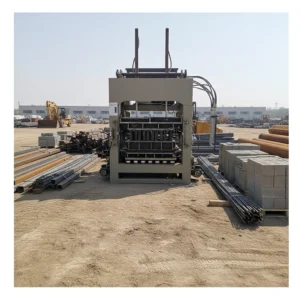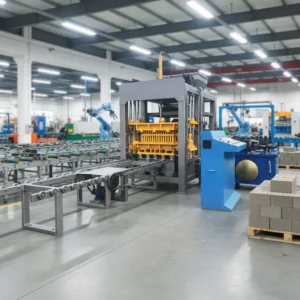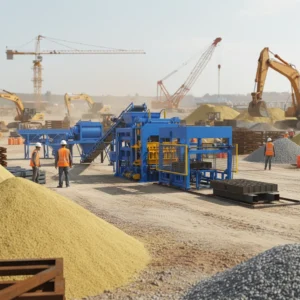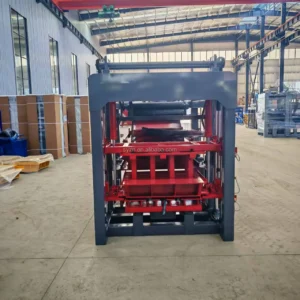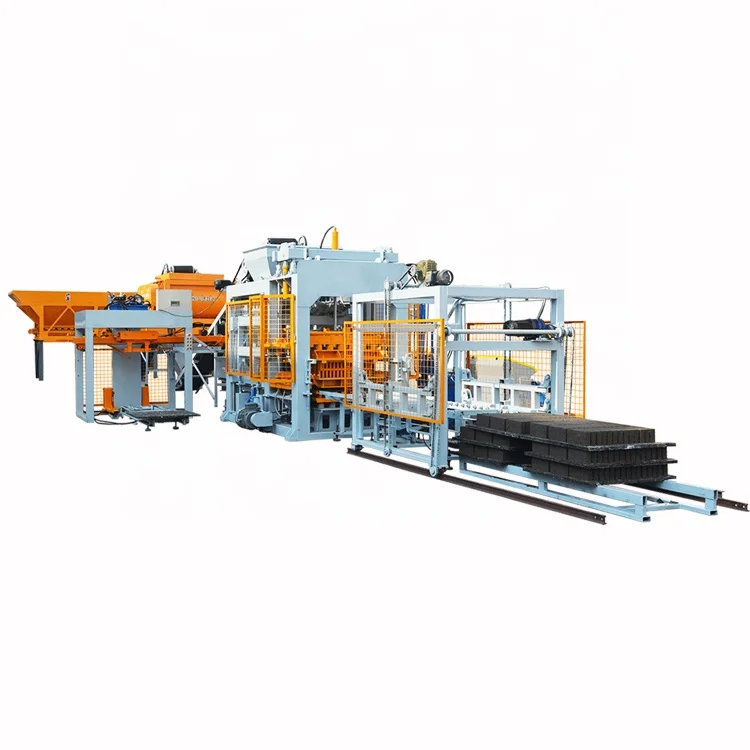
Complete System Integration — Raw material feeding, mixing, pallet circulation, automatic stacking, and curing rack handling are specified as one matched line around the QT8-15, not assembled from separate suppliers.
Technical Specifications
| Parameter | Value |
|---|---|
| Model | QT8-15 |
| Product Type | Hydraulic Full Automatic Concrete Block Making Machine with Stacker |
| Overall Dimensions (L×W×H) | 8300 × 1860 × 3000 mm |
| Rated Pressure | 21 MPa |
| Main Vibration Form | Platform Vibration |
| Vibration Frequency | 2800–4500 r/min |
| Vibration Force | 45 kN |
| Pallet Size | 950 × 900 mm |
| Molding Cycle | 15–20 s (basis to be confirmed against block format) |
| Overall Power | 55.5 kW |
| Total Mass | 8 T |
| Demolding Method | Hydraulic |
| Factory Area | 300 m² |
| Automation Level | Full Automatic with Stacker |
| Applied Products | Hollow blocks, solid blocks, pavers, interlocking blocks, curbstone, colored pavers |
Application Suitability
| Application | Material or Output |
|---|---|
| Hollow block production for wall construction | Crushed stone, sand, cement, fly ash |
| Solid block manufacturing | Gravel, sand, cement, slag |
| Paving block and colored paver runs | Fine aggregate, cement, pigment additives |
| Interlocking block production | Crushed stone, sand, cement |
| Curbstone and kerb production | Coarse aggregate, cement, sand |
What "Full Automatic" Actually Means for Your Block Production Line Equipment
A stacker on the press does not make the line automatic — every station upstream and downstream must keep pace.
I have watched a plant install a high-cycle press only to find the pallet return conveyor could not keep up, so wet blocks sat on the press table while operators manually cleared them. The quoted cycle rate became meaningless within the first week. A turnkey block making line only earns its name when the pallet feeder, stacker, and curing rack handler are timed to the press, not simply bolted beside it. [NEED_CITE: common causes of block line throughput loss in automated plants]
Matching Every Station to the Press Cycle
The QT8-15 runs a 15–20 second molding cycle, which means the pallet feeder must deliver a fresh pallet inside that window and the stacker must clear the finished pallet before the next demold. When any station lags, the press idles and the block production line equipment loses effective output. We calculate each station’s duty time against the slowest block format you plan to run, not the fastest, so the line holds its rate across mould changes.
Pallet Circulation and Curing Rack Alignment
Pallets leaving the stacker travel to the curing area, and the return loop must account for curing rack dimensions and forklift capacity already on site. A 950 × 900 mm pallet that does not fit an existing rack wastes floor space and forces double handling. The line layout we supply states the rack spacing, pallet count, and return conveyor path so the curing station never becomes the hidden bottleneck in the block production line equipment. [NEED_CITE: pallet size and curing rack compatibility standards]
Reading the Specs That Matter Beyond the Press
The 21 MPa rated pressure and 45 kN vibration force together determine block density — pressure alone compresses, but vibration settles the aggregate into voids, and the 2800–4500 r/min adjustable frequency lets the operator tune for local sand gradation. The 55.5 kW overall power covers the press, hydraulic pack, and vibration motors; the mixer and batcher draw additional load that must be factored into the site’s total connected capacity. Mould change is hydraulic, reducing format changeover time compared to manual bolt systems and keeping the line flexible across hollow block, paver, and interlocking formats.
The Hidden Cost of Ignoring Line-Wide Timing
When the batcher delivers mix slower than the press consumes it, the hopper runs empty mid-cycle and blocks come out underfilled. When the stacker rate is set for a different pallet size than what the press actually uses, pallets jam at the transfer point and operators intervene manually. These mismatches rarely appear in a press-only quotation, but they surface on the first production day and shut the line down repeatedly. [NEED_CITE: impact of station mismatch on block line downtime]
Why Source the Full Line from One Supplier
Every component in the QT8-15 line — from raw material batcher through the stacker and curing rack handler — is specified against the same block format and cycle time, removing the integration gap that appears when stations come from different vendors. Mould drawings are produced in-house for the exact formats your market sells, and the pallet specification is confirmed against your curing area before the line layout is finalised. Voltage, frequency, and PLC display language are locked in before production begins, preventing commissioning delays after arrival. Factory test records cover the full line, not just the press, and operator training addresses the stacker and pallet circulation system alongside the press controls.
Documentation & Verification
- Line layout with capacity calculation stating the block format assumed for each cycle figure
- Machine specification sheet covering press, stacker, and pallet circulation together
- Mould drawing and format list matching the buyer’s market requirements
- Pallet specification confirmed against curing rack dimensions and forklift rating
- Hydraulic and electrical schematic for the complete line, not the press alone
- Factory test record on the full line before dispatch
Installation, Commissioning & Support
- 300 m² factory area requirement with level concrete foundation for the 8300 mm press length
- 55.5 kW total connected load on the press circuit, plus dedicated supply for mixer and batcher
- Press, stacker, and pallet return conveyor shipped dismantled for container loading and reassembled on site
- Full line commissioning including cycle timing verification across every station
- Operator training on PLC controls, mould change procedure, and stacker fault recovery
- Wear parts list covering hydraulic seals, vibration motor bearings, and mould liners
Before You Request a Quote
Tell us which block formats you plan to produce and the daily volume you need for each, so we can calculate the line capacity around the slowest format. Confirm your site voltage, frequency, and preferred PLC display language, along with the curing area dimensions and forklift capacity already in place, so the pallet and stacker configuration fits your existing setup.
Frequently Asked Questions
Q: How is the block production line equipment capacity calculated, and which block format does each figure assume?
A: Each capacity figure is tied to a specific block format, mould cavity count, and cycle time. We state the format assumed for every output number so you can compare against your actual product mix rather than a single best-case scenario.
Q: How do the press, pallet feeder, and stacker stay matched so the press never waits?
A: We time every station against the slowest cycle in your format list. The pallet feeder delivery rate, stacker lift speed, and return conveyor pace are all set to that baseline, preventing any single station from becoming the bottleneck.
Q: What pallet size and material are specified, and how do they relate to my curing setup?
A: The standard 950 × 900 mm pallet is confirmed against your curing rack spacing and forklift rating before the line layout is finalised. If your existing racks require a different dimension, the pallet spec and return conveyor are adjusted accordingly.
Q: Is the voltage, frequency, and PLC language confirmed before the turnkey block making line ships?
A: Yes. We lock in the electrical specification and control language during the proposal stage so the PLC display, motor wiring, and heater ratings match your site supply, avoiding commissioning delays when the line arrives.
Q: What supporting equipment is included in the quotation, and what is left to the buyer?
A: The quotation covers the press, stacker, pallet circulation, and curing rack handler as a matched set. The mixer, batcher, and cement silo are listed separately so you can see exactly which stations are included and which you may already have on site.