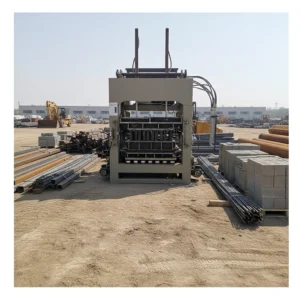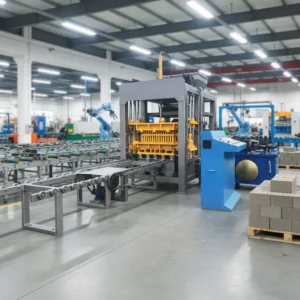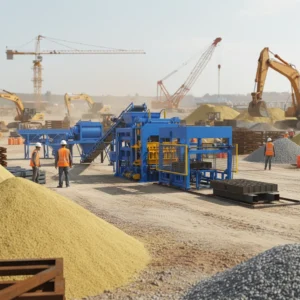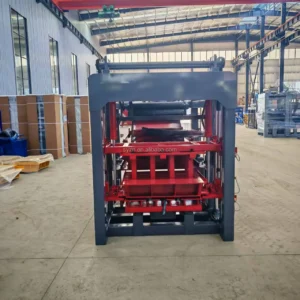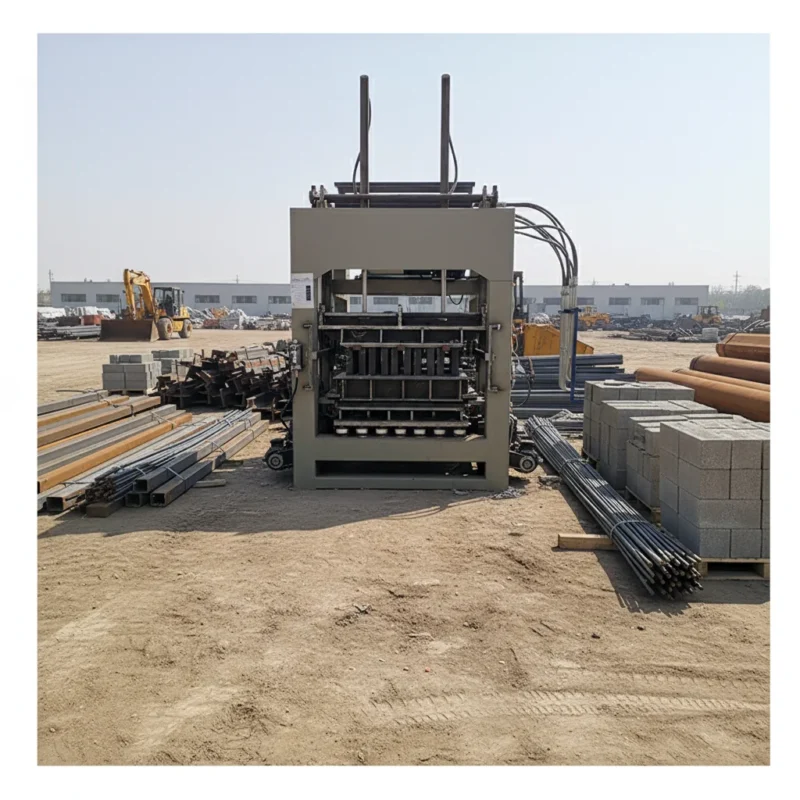
Synchronized Line Design — Every station from the raw material feeder to the curing rack handler is timed against the QT8-15 press cycle so the main unit never idles waiting for the next pallet or mix batch.
Technical Specifications
| Parameter | Value |
|---|---|
| Model | QT8-15 |
| Product Type | Hydraulic Concrete Block Making Machine |
| Overall Dimension | 8300 × 1860 × 3000 mm |
| Rated Pressure | 21 MPa |
| Main Vibration Form | Platform Vibration |
| Vibration Frequency | 2800–4500 r/min |
| Vibration Force | 45 kN |
| Pallet Size | 950 × 900 mm |
| Molding Cycle | 15–20 s (basis not stated in source — confirm block format / material / thickness) |
| Overall Power | 55.5 kW |
| Total Mass | 8 T |
| Demolding Method | Hydraulic |
| Factory Area | 300 m² |
| Automation Level | Automatic |
| Control System | PLC (language options to be confirmed) |
| Voltage & Frequency | Configurable to site supply (to be confirmed) |
| Warranty | 1 year (excluding spare parts) |
| Assembly State | Dismantled for shipment, loaded in 1×40HQ (basic equipment) |
Application Suitability
| Application | Material or Output |
|---|---|
| Hollow and solid block production plants | Crushed stone, sand, cement, fly ash, gravel, slag |
| Paving block and colored paver manufacturing | Fine aggregate blends with pigment additives |
| Interlocking brick and kerbstone production | Coarse aggregate and cementitious mixes |
| On-site production for housing and development projects | Locally sourced aggregate and cement |
| Concrete product manufacturers adding new formats | Versatile raw material compatibility across block types |
What a "15-20 Second Cycle" Actually Means for Your Daily Output
The cycle time stamped on the nameplate assumes a specific block format, and swapping moulds changes that number entirely.
I have watched plant owners in Southeast Asia celebrate a fast cycle figure on paper, only to find their daily pallet count falling far short once they switched from hollow blocks to thin pavers. The 15–20 s molding cycle listed for this QT8-15 hydraulic block making machine is a starting reference, not a guarantee across every format you plan to run. A block making machine production line that quotes output without naming the assumed format leaves the buyer holding a number that only works for one product. Real throughput depends on the block height, the vibration dwell required for your local aggregate, and how fast the pallet feeder can return a fresh board [NEED_CITE: realistic cycle time variation by block format and material density].
How the Upstream Stations Must Keep Pace
The QT8-15 press completes its cycle in seconds, but the mixer, belt conveyor, and raw material feeder must deliver a measured batch to the hopper before the next press stroke begins. If the mixer discharges slower than the press consumes, the main unit sits idle and the entire turnkey block plant loses output proportionally. Sizing the mixer drum and conveyor belt speed against the press demand is the first step in line layout, and it is the step most incomplete quotations skip.
Why the Downstream Handling Decides Real Shift Output
Once the QT8-15 releases a finished pallet, that board must travel to the curing rack before the next one arrives. If the stacker or elevator cannot clear the exit conveyor in time, the press halts. The 300 m² factory area figure in the specification reflects the footprint needed for the full block making machine production line — press, pallet return, stacking, and curing racks — not the press alone. Buyers who plan a tighter floor layout should verify rack height and forklift turning radius before confirming the pallet size [NEED_CITE: curing rack and forklift clearance planning for block plants].
Reading the Core Specs Through a Line-Synchronization Lens
The 21 MPa rated hydraulic pressure and 45 kN platform vibration force work together: pressure compacts the mix from above while vibration settles aggregate from below, and both must be tuned to the buyer’s specific aggregate grading and cement content. Running a lightweight fly ash mix at the same settings as a dense crushed-stone blend produces weak blocks or mould damage. The 950 × 900 mm pallet size must match the curing racks and forklift already on site, because re-racking an entire yard costs more than adjusting the spec before production. The 55.5 kW overall power rating covers the press motor and hydraulic pump; the mixer, feeder, and stacker draw additional current, so total connected load for the turnkey block plant must be calculated at the panel level. PLC control language and voltage frequency should be locked in before the wiring harness is assembled, not after the container arrives at port [NEED_CITE: electrical supply standards for industrial machinery in export markets].
The Cost of Skipping Line-Level Specification
When a buyer orders only the QT8-15 press and sources the mixer, pallet feeder, and stacker locally, the interfaces rarely match on the first try. Conveyor belts arrive too narrow for the pallet, stacker grippers do not align with the board slots, and the PLC has no signal to pause the press when the downstream elevator is full. The resulting downtime is not a warranty issue — it is a specification gap, and it falls entirely on the buyer. I have seen entire first shifts lost to rewiring and repositioning equipment that should have been dimensioned together from the start.
Why Specifying the Full Line Here Changes the Outcome
Block machinery is our single focus, which means the QT8-15 is never quoted as an island. The machine, mould, pallet, and every handling station are specified as one matched system against the buyer’s actual mix design and local aggregate, not pulled from a catalogue default. Mould design covers the formats the buyer’s market sells, including custom drawings for non-standard pavers or kerbstones. Automation level is selectable, so a plant can start with semi-automatic pallet handling and add a stacker later without replacing the press. Factory testing runs the complete block making machine production line through a full pallet cycle before dismantling, so the dispatch record shows synchronization, not just press movement [NEED_CITE: factory acceptance testing standards for integrated production lines].
Documentation & Verification
- Line layout drawing with capacity calculation stating the exact block format assumed
- Machine specification sheet covering hydraulic pressure, vibration force, and pallet dimensions
- Mould drawing and format list for every block type included in the order
- Pallet specification confirming material, size, and curing rack compatibility
- Hydraulic and electrical schematic with voltage and control language confirmation
- Factory test record demonstrating full line operation across at least one complete pallet cycle
Installation, Commissioning & Support
- Foundation plan sized to the 8300 × 1860 mm press footprint plus pallet return conveyor length
- Dedicated power circuit for the 55.5 kW press load plus separate feeders for mixer and stacker
- Machine arrives dismantled in a 40HQ container with labeled assembly sequence for on-site reassembly
- Commissioning includes PLC parameter setting, hydraulic pressure calibration, and vibration frequency tuning
- Operator training covers mould change procedure, daily lubrication points, and pallet inspection routine
- Wear parts list identifying hydraulic seals, vibration springs, and mould liner replacement intervals
What to Include in Your First Inquiry
To size the complete line around the QT8-15, share the block formats you plan to produce with their dimensions, your target daily output in blocks rather than cycles, and the raw materials available locally including aggregate type and cement grade. Confirm the voltage and frequency at your site, the PLC display language your operators need, and the curing rack system or forklift you already have on the floor so the 950 × 900 mm pallet can be matched from day one.
Frequently Asked Questions
Q: How do I verify the real daily output when capacity is quoted in cycles per hour?
A: Ask the supplier to state which exact block format, wall thickness, and aggregate mix the cycle time assumes. Then request a line layout showing how many pallets per hour each upstream and downstream station can handle. If any station runs slower than the QT8-15 press, that station sets the real daily output, not the press cycle.
Q: What supporting equipment should be included in the line quotation?
A: A complete block making machine production line quotation should cover the raw material feeder, mixer, belt conveyor, pallet feeder, the QT8-15 press, exit conveyor, stacker, and curing rack handling. If any station is excluded, the buyer must source it separately and verify that dimensions, speeds, and control signals match the rest of the line.
Q: How do I make sure the pallet size works with my existing curing area and forklift?
A: Confirm the 950 × 900 mm pallet dimension against your curing rack slot width and your forklift fork spread. If racks were built for a different pallet size, either the pallet spec or the rack layout must change before production starts. Pallet material — timber, bamboo, or composite — also affects weight capacity and forklift handling.
Q: What electrical and control details must be confirmed before the machine is built?
A: Voltage, frequency, and plug or terminal type must match the buyer’s site supply. PLC display language should be confirmed so operators can read menus and alarms on day one. These details are locked into the wiring harness during assembly, so changes after production begins cause delays and rework costs.
Q: How is the machine shipped and what does on-site reassembly involve?
A: The QT8-15 basic equipment ships dismantled in a single 40HQ container. On-site reassembly requires a prepared foundation, a crane for lifting the main frame and hydraulic unit, and electrical connections to the rated power supply. Commissioning then covers pressure calibration, vibration tuning, and a test run through one full pallet cycle.