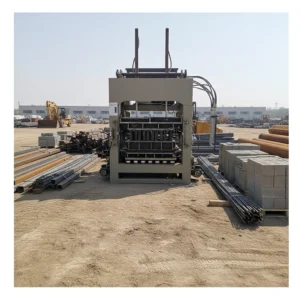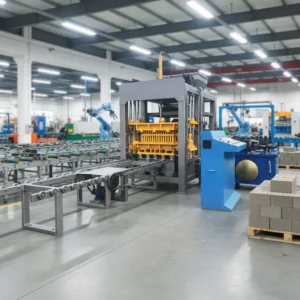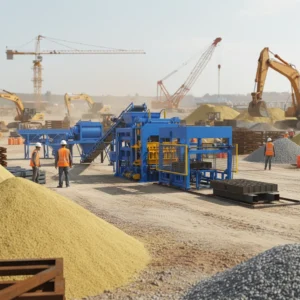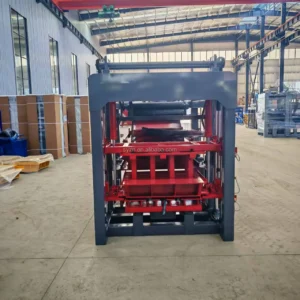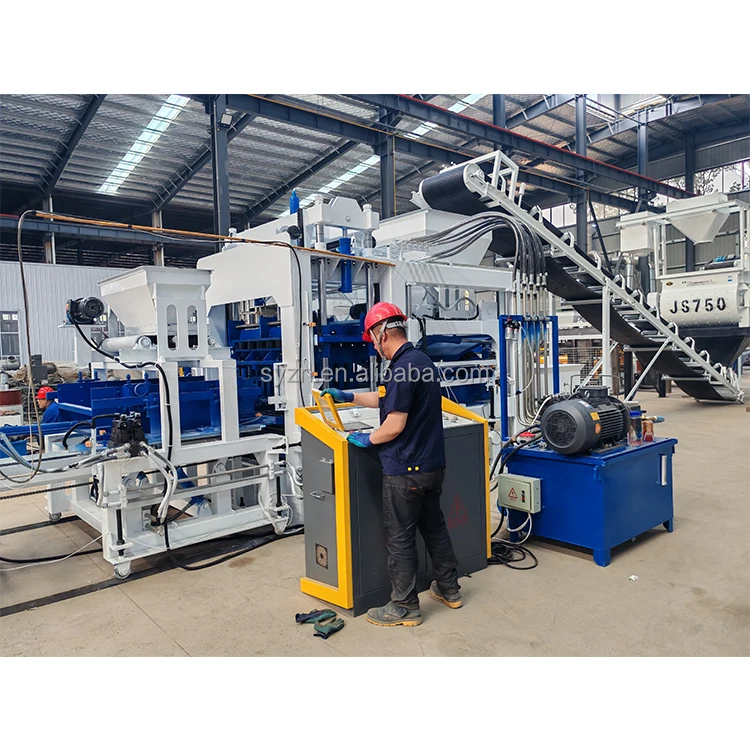
Matched Line Throughput — the QT8-15 is positioned as the cycle-time anchor for upstream mixers and downstream stackers, so no station idles while another catches up.
Technical Specifications
| Parameter | Value |
|---|---|
| Product Type | Hydraulic Concrete Block Making Machine |
| Model | QT8-15 |
| Overall Dimensions (L×W×H) | 8300 × 1860 × 3000 mm |
| Rated Pressure | 21 MPa |
| Main Vibration Form | Platform Vibration |
| Vibration Frequency | 2800–4500 r/min |
| Vibration Force | 45 kN |
| Pallet Size | 950 × 900 mm |
| Molding Cycle | 15–20 s |
| Overall Power | 55.5 kW |
| Total Mass | 8 T |
| Demolding Method | Hydraulic |
| Factory Area | 300 m² |
| Loading | 1 × 40HQ container (basic equipment) |
| Output Capacity | (basis not stated in source — confirm block format / material / thickness) |
| Warranty | 1 year (whole machine, excluding spare parts) |
Application Suitability
| Application | Material or Output |
|---|---|
| Hollow block production for load-bearing walls | Crushed stone, sand, cement, fly ash |
| Solid block manufacturing for partition and structural work | Gravel, sand, cement, slag |
| Interlocking paver and colored paver runs | Fine aggregate, cement, pigment |
| Kerbstone and curb production for road and site works | Coarse aggregate, cement, dust |
| Porous permeable block for drainage applications | Graded aggregate, cement |
Why "Cycles per Hour" Tells Only Half the Story
A press rated at 15–20 seconds per cycle only holds that pace when the mixer, pallet feeder, and stacker are timed to the same beat.
Buyers often receive quotations listing the QT8-15 block production line equipment by itself, with no mention of how long the mixer takes to discharge a batch or how fast the pallet feeder returns an empty board. The result is a press that sits idle for seconds between cycles, erasing the theoretical output. I have watched a line where the mixer discharged eight seconds slower than the press cycle, and the daily tally dropped by a third. Specifying block machine supporting equipment as one matched set prevents that gap [NEED_CITE: block production line cycle-time matching principles].
How the QT8-15 Anchors the Line Cycle
The press completes a mold cycle in 15–20 seconds, which sets the tempo every other station must meet. Raw material feeding, mixing, pallet circulation, and stacking are all configured around that window. When block production line equipment is quoted as a package, each station’s throughput is stated against the same block format, so the buyer sees realistic daily output rather than a catalogue figure.
Keeping Pallet Circulation in Step
A 950 × 900 mm pallet must travel from the press to the curing rack and back within the molding cycle. If the curing area is undersized or the forklift cannot turn fast enough, pallets queue at the stacker and the press waits. Block machine supporting equipment selection therefore includes pallet quantity, material, and rack layout calculated from the QT8-15 cycle time and the buyer’s available floor space [NEED_CITE: pallet circulation and curing area planning].
Reading the Numbers That Matter
Platform vibration at 2800–4500 r/min combined with 45 kN force and 21 MPa hydraulic pressure determines how tightly aggregate particles pack inside the mold. Higher frequency suits fine sand mixes, while lower frequency with sustained pressure works better with coarse gravel. The 55.5 kW overall power covers the press station only; adding a mixer, pallet return conveyor, and stacker raises the connected load, so the buyer’s transformer and switchgear must be sized for the full line draw. A 300 m² factory area accommodates the press and immediate pallet circulation, but curing racks and raw material storage push the total footprint well beyond that figure.
When One Unquoted Station Breaks the Budget
Leaving stacking and curing out of the quotation forces the buyer to hire extra labor or improvise rack systems after installation. Pallets pile up on the floor, blocks cure unevenly, and strength values scatter. Voltage and control language left unconfirmed can delay commissioning by weeks while panels are rewired or PLC screens are reprogrammed on site [NEED_CITE: common delays in block plant commissioning].
What Makes This Line Scope Different
Block machinery is the only product category here, so the QT8-15, its molds, pallets, and handling equipment are specified as one system rather than assembled from separate suppliers. Configuration starts from the buyer’s actual mix design and local aggregate, not a default recipe. Molds are designed for the formats the buyer’s market moves, and custom drawings are accepted. Automation level is selectable, allowing a semi-automatic start with a later upgrade to full stacking and cubing. Installation includes operator training and ongoing mold and wear parts support.
Documentation & Verification
- Line layout showing QT8-15 station positions and pallet flow paths
- Capacity calculation sheet stating the block format assumed for each throughput figure
- Mold drawing and format list matching the buyer’s product range
- Pallet specification covering size, material, and quantity tied to curing area dimensions
- Hydraulic and electrical schematic for the full line, not the press alone
- Factory test record running the QT8-15 through a complete sequence with upstream and downstream stations
Installation, Commissioning & Support
- Foundation drawing for 8300 × 1860 mm footprint with anchor bolt plan
- 55.5 kW press load plus auxiliary stations requires dedicated breaker sizing
- Dismantling into 1 × 40HQ for shipment and reassembly sequence on site
- Voltage and PLC display language confirmed before production begins
- Operator training covering mold change, vibration tuning, and pallet handling
- Wear parts list with hydraulic seals and vibration motor bearings identified
Before You Send the Inquiry
Share the block formats you plan to run, the daily volume target, and the raw materials available locally so the line can be balanced around your actual mix. Confirm your site voltage, frequency, and preferred PLC language to avoid rewiring after arrival. If you already own a mixer, forklift, or curing racks, provide their specifications so block machine supporting equipment is selected to fit what you have.
Frequently Asked Questions
Q: How is line capacity calculated and which block format is it based on?
A: Capacity is stated per block format, not as a single headline number. The calculation uses the QT8-15 molding cycle of 15–20 seconds, then checks whether the mixer discharge rate, pallet return speed, and stacker index time can sustain that cycle without pauses. The buyer receives a table showing output for each format they intend to produce.
Q: What supporting equipment is included and what is left to the buyer?
A: The scope covers raw material feeding, mixing, pallet circulation, stacking, and curing rack handling matched to the press cycle. Items outside the line, such as the curing yard surface, forklift, and raw material stockpile area, remain with the buyer. A clear boundary list is provided before order confirmation.
Q: How are cycle times matched between stations to prevent bottlenecks?
A: Each station’s cycle is timed against the QT8-15 press window of 15–20 seconds. If the mixer takes 25 seconds to discharge, a larger mixer or a buffer hopper is specified so the press never waits. Pallet return conveyor speed and stacker index rate are set to the same tempo.
Q: What pallet size is specified and how does it relate to my curing area?
A: The standard pallet is 950 × 900 mm. Quantity and material are chosen based on the curing rack dimensions and forklift capacity the buyer already has, ensuring pallets circulate without queuing and blocks reach the stacking station on schedule.
Q: What is the factory area requirement and how does the full line footprint change?
A: The QT8-15 press station fits within 300 m², but adding raw material storage, curing racks, and finished block lanes extends the total footprint. A line layout drawing shows the combined area so the buyer can plan the building envelope before foundation work starts.