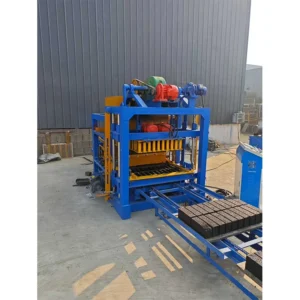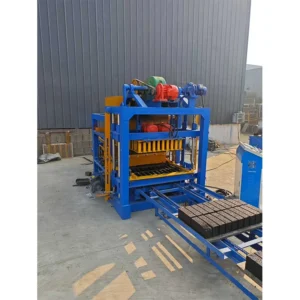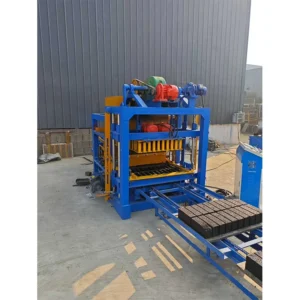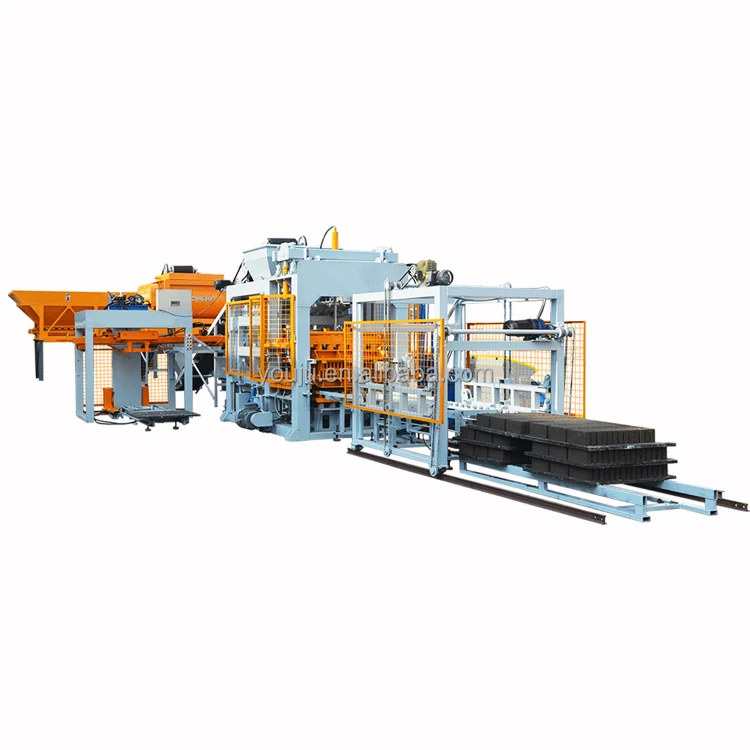
Matched System Specifying — The QT8-15 automatic block making machine production line is configured as a connected system where raw material feeding, mixing, pallet circulation, stacking, and curing handling are specified together so cycle times align across every station and the press is never left waiting for upstream input.
Technical Specifications
| Parameter | Value |
|---|---|
| Model | QT8-15 |
| Product Type | Automatic Concrete Block Making Machine |
| Hydraulic Pressure | Advanced hydraulic pressure technology (basis to be confirmed) |
| Vibration System | Latest vibration system (basis to be confirmed) |
| Cycle Time | 15–20 s per mould |
| Output: Hollow Block (400×200×200 mm) | 8 pcs/mould, 1,600–1,900 pcs/h, 12,800–15,000 pcs/8 hr |
| Output: Solid Brick (240×115×53 mm) | 45 pcs/mould, 8,000–10,000 pcs/h, 64,000–80,000 pcs/8 hr |
| Output: Paver (200×160×60 mm) | 15 pcs/mould, 3,000–3,600 pcs/h, 24,000–28,800 pcs/8 hr |
| Output: Interlocking/Paver (225×112.5×60 mm) | 24 pcs/mould, 4,000–5,000 pcs/h, 32,000–40,000 pcs/8 hr |
| Mould Formats | Hollow block, solid brick, paver brick, curbs |
| Mould Heat Treatment | Yes |
| Automation Level | Automatic (PLC brand, stacking, batching scope to be confirmed) |
| Warranty | 1 year |
Application Suitability
| Application | Material or Output |
|---|---|
| Concrete hollow block plants | Crushed stone, cement, sand, and fly ash aggregates for 400×200×200 mm structural blocks |
| Solid brick manufacturing | Cement and fine aggregate blends for 240×115×53 mm masonry bricks |
| Paving block production | High-density concrete mixes for 200×160×60 mm interlocking pavers |
| Kerbstone and curb forming | Coarse aggregate concrete for standard kerb profiles via dedicated mould |
| On-site contractor block yards | Locally sourced aggregate for project-specific hollow and solid formats |
What the Headline Capacity Number Leaves Out on an Automatic Block Making Machine Production Line
A single pcs/hour figure means nothing until you know which block format and mould cavity count it assumes.
Buyers often receive quotations showing one impressive hourly output number, only to discover after commissioning that the figure was based on a small solid brick format their market does not buy. The actual daily production of the hollow block or paver they need falls far short of what they planned around. This mismatch is one of the most common reasons block plants underperform in their first year [NEED_CITE: common causes of block plant underperformance in the first operating year]. With the QT8-15, capacity is stated per format so the buyer can plan against the product they actually sell, not a catalogue highlight.
Matching Upstream Feeding and Mixing to the Press Cycle
The QT8-15 completes a mould cycle every 15–20 seconds. That means the mixer must discharge a full batch into the hopper within that same window, or the press sits idle waiting for material. An automatic block making machine production line only reaches its rated output when the feeder, mixer, and press cycle times are calculated against each other. If the mixer takes 25 seconds to discharge what the press needs in 18, the entire line slows to the mixer’s pace. Line layout drawings should show the discharge time at every station so bottlenecks are visible before equipment ships.
Pallet Circulation and Stacking: Where Lines Actually Lose Output
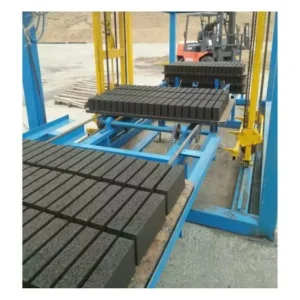
Freshly pressed blocks travel on pallets through the curing area and return empty to the press. If pallet return is slower than the press cycle, the machine stops. If stacking is manual, labour becomes the constraint and broken blocks rise noticeably. The downstream side of this automatic block making machine production line — pallet feeding, automatic stacking, curing rack handling, and cubing — must be specified to match the press speed. Quotations that cover only the press leave the buyer to solve these stations separately, often at higher cost and with misaligned timing [NEED_CITE: impact of downstream handling on block plant daily output].
Reading the Capacity Table Against Your Actual Product Mix
The specs list four distinct formats, each with its own pcs/mould count and resulting hourly output. A plant producing 400×200×200 mm hollow blocks will see 1,600–1,900 pieces per hour, while the same machine producing 240×115×53 mm solid bricks reaches 8,000–10,000 pieces per hour. The difference is driven entirely by cavity count, not by any change in the press itself. Buyers should calculate their daily revenue against the format they sell most, not the highest number on the sheet. Heat-treated moulds extend service life across frequent format changes, keeping cavity integrity intact over thousands of cycles.
How Hydraulic Pressure and Vibration Shape Block Density
Hydraulic pressure compresses the concrete mix from above while the vibration system consolidates it from below. The balance between these two forces determines whether a hollow block reaches the compressive strength the local building code requires. If vibration is too strong relative to pressure, the block surface becomes rough and edges chip during pallet handling. If pressure dominates without enough vibration, voids remain inside the block wall and strength drops. The QT8-15 uses an advanced hydraulic pressure system paired with a latest vibration system, but the exact settings must be matched to the buyer’s aggregate gradation and cement ratio for consistent results across every batch.
The Cost of Underspecifying the Pallet and Curing Layout
A buyer who selects pallet size without checking their existing curing rack dimensions will find that pallets do not fit the rack slots, forcing a full curing area rebuild. Similarly, choosing a pallet material without considering the forklift tine spacing leads to pallets that cannot be moved once loaded with wet blocks. These downstream mismatches do not show up in the press quotation but can stall production for weeks while replacements are sourced [NEED_CITE: pallet specification errors and their impact on block plant commissioning]. Every pallet in the QT8-15 line should be specified against the buyer’s curing area footprint and existing material handling equipment before the order is confirmed.
Why Sourcing the Full Line from One Supplier Matters
Block machinery is our single focus, which means the press, mould, pallet, and every handling station are specified as one matched system rather than assembled from separate suppliers. The configuration is set against the buyer’s actual mix design, local aggregate, and target block format — not a catalogue default. Mould design covers the formats the buyer’s market actually sells, with custom drawings available when standard formats do not match. Automation level is selectable, so a buyer can start with semi-automatic pallet handling and add stacking later. Installation support includes operator training so the line runs at its planned cycle time from day one.
Documentation & Verification
- Line layout drawing showing every station from raw material feeder to cubing with cycle time noted at each stage
- Capacity calculation document stating the exact block format, mould cavity count, and cycle time assumed
- Mould drawing and format list covering hollow, solid, paver, and kerb profiles specified for your order
- Pallet specification sheet matched to your curing rack dimensions and forklift tine spacing
- Hydraulic and electrical schematic with confirmed voltage, frequency, and PLC display language
- Factory test record on your specified block format before dispatch
Installation, Commissioning & Support
- Foundation plan sized to the QT8-15 press footprint and vibration isolation requirements
- Power supply confirmation for rated voltage and frequency before the line is wired at the factory
- On-site assembly sequence covering press, mixer, feeder, pallet return, and stacking stations
- First-run commissioning with cycle time verification at every station against the line layout
- Operator training covering mould change procedure and PLC parameter adjustment for different block formats
- Wear parts and mould maintenance list with recommended replacement intervals for hydraulic seals and vibration components
Preparing Your Line Inquiry
To size the automatic block making machine production line correctly, share the block formats your market buys most, the daily output you need for each, and the local aggregate you plan to use. Include your available workshop area, curing yard dimensions, and existing forklift specifications. Confirm the local voltage, frequency, and the language you need on the PLC display so the control system is configured before production begins.
Frequently Asked Questions
Q: How is the capacity figure calculated and which block format does it assume?
A: Each capacity number in the specification table is tied to a specific block format, mould cavity count, and cycle time range. For example, 1,600–1,900 hollow blocks per hour assumes the 400×200×200 mm format with 8 cavities per mould. We provide a written capacity calculation for whichever format you plan to produce most, so your daily output projection matches your actual product mix.
Q: How do upstream and downstream stations match the press cycle time?
A: We calculate the discharge time of the mixer, the feed rate of the material hopper, and the return speed of the pallet circulation against the 15–20 second press cycle. The line layout drawing shows the timing at every station so no single point bottlenecks the press. Stations that fall short are resized or upgraded before the line ships.
Q: What pallet size and material are specified for this line and how does it fit my curing area?
A: Pallet dimensions are selected based on the mould size and the buyer’s curing rack slot dimensions. Material — bamboo, steel, or composite — is chosen against expected pallet lifespan and forklift compatibility. We confirm pallet specification against your existing curing yard layout before the order enters production.
Q: Which stations are included in the quotation and which are optional?
A: The standard quotation covers the press, mould, pallet, raw material feeder, and mixer. Automatic stacking, curing rack handling, and cubing systems are configured based on the buyer’s automation preference and added as line items. Every station included or excluded is listed clearly so there are no gaps between what is quoted and what arrives on site.
Q: How are voltage, frequency, and control language confirmed before shipment?
A: During the order confirmation stage, we collect the buyer’s local power supply specifications and preferred PLC display language. These are written into the production order and verified during the factory test. The electrical schematic delivered with the machine reflects the confirmed configuration.