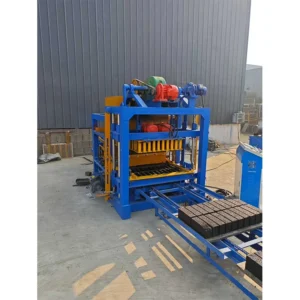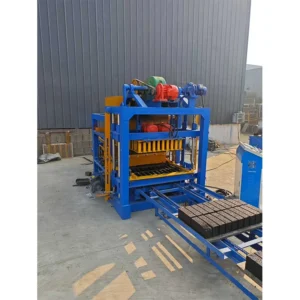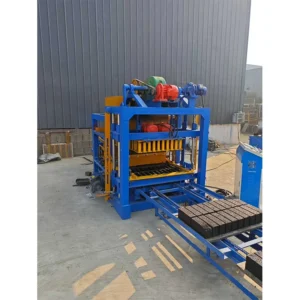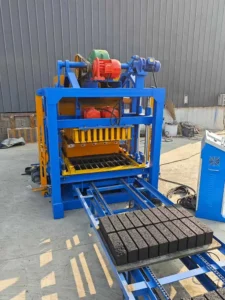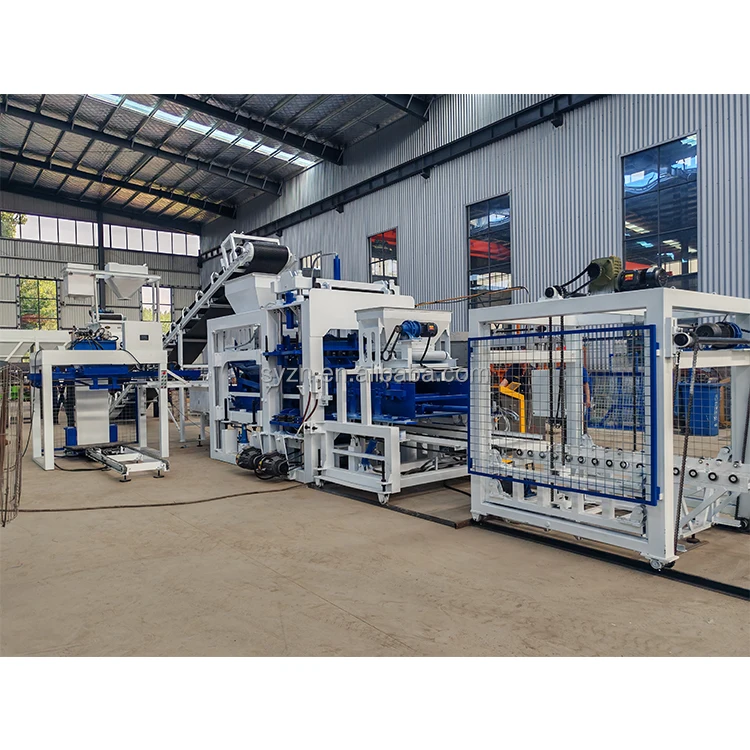
Matched Line Integration — every station from the JS750 mixer through the 8-metre belt conveyor to the dual-pallet stacker is timed against the QT8-15 host cycle so the press never idles waiting for feed or pallets.
Technical Specifications
| Parameter | Value |
|---|---|
| Model | QT8-15 |
| Product Type | Hydraulic Automatic Block Making Machine |
| Overall Dimensions (L×W×H) | 8300 × 1860 × 3000 mm |
| Rated Pressure | 32 MPa |
| Vibration Form | Platform Vibration |
| Vibration Frequency | 2800–4500 RPM |
| Pallet Size | 950 × 900 mm |
| Molding Cycle | 15–25 s (basis not stated in source — confirm block format / material / thickness) |
| Overall Power | 47 kW |
| Control System | PLC with touch screen interface |
| Hydraulic System | Independent integrated hydraulic station |
| Block Comprehensive Strength | up to 15 MPa |
| Mixer | JS750 |
| Belt Conveyor | 8 m |
| Automatic Stacker | Two pallets per cycle, 3–6 layers depending on block height |
| Included Mould | One hollow mould (additional formats available on request) |
| Voltage & Frequency | Configurable to target market (basis to be confirmed) |
| PLC Display Language | Configurable (basis to be confirmed) |
Application Suitability
| Application | Material or Output |
|---|---|
| Hollow block production plants | Crushed stone, sand, cement, fly ash blends |
| Solid block manufacturing | Dense aggregate and cement mixes |
| Paving block and kerbstone lines | High-strength concrete with fine aggregate |
| On-site housing project production | Locally sourced aggregate with site-adapted mix designs |
| Building material distributors adding formats | Interlocking brick, porous brick, and custom profiles via mould swap |
Why "Cycle Time per Hour" Misleads Block Plant Buyers
Capacity only means something when the block format and mix behind the number are named.
Too many automatic block making machine production line quotations lead with a single cycles-per-hour figure derived from a small, thin paver the buyer never intends to produce. Once a taller hollow block enters the mould box, the feed time stretches, the vibration dwell lengthens, and the real hourly count drops sharply. I have stood on sites in West Africa where the plant owner counted output on the first production day and found the line running well below the brochure promise — not because the press was undersized, but because the mixer discharge, conveyor travel, and stacker lift had been specified against a format the buyer did not sell. That mismatch cost the owner two thousand blocks per shift before we rebalanced the stations [NEED_CITE: typical block format assumptions in capacity quotations].
Line-Level Timing from Mixer to Stacker
The QT8-15 sits inside an automatic block making machine production line where each upstream and downstream station must clear its task within the press cycle. The JS750 mixer is sized so that a full batch discharges before the host completes its current mould fill, and the 8-metre belt conveyor delivers raw material at a rate matched to the hopper refill window. When the press table rises, the dual-pallet stacker lifts two loaded pallets simultaneously and places them onto the curing rack in three to six layers depending on block height, keeping the exit conveyor free for the next pair.
Where Mismatches Hide in a Block Line
Bottlenecks rarely appear on paper because every station is rated independently. The press may complete a cycle in fifteen to twenty-five seconds, but if the mixer needs an extra eight seconds to discharge a stiff, low-slump mix, the host waits. If the stacker fork retracts slowly on a tall hollow block layer, the pallet conveyor backs up. I now calculate every transfer interval — mixer gate to conveyor, conveyor to hopper, hopper fill to press close, press open to stacker engage — and only then confirm the line layout [NEED_CITE: station cycle alignment in concrete block lines].
Reading the Specs That Actually Matter on Site
The 32 MPa rated pressure works together with the 2800–4500 RPM platform vibration to compact concrete into dense, uniform blocks reaching up to 15 MPa comprehensive strength. Vibration frequency is adjustable on the PLC touch screen, letting operators shorten dwell on thin pavers and extend it on tall hollow blocks without swapping mechanical components. The independent integrated hydraulic station sits apart from the main frame, isolating valves and seals from press vibration and cement dust, which extends service intervals. The 950 × 900 mm pallet size defines the curing rack spacing and forklift fork width the buyer must have in place before the line arrives, making early confirmation of pallet material and rack geometry essential.
The Cost of Skipping Line-Level Configuration
A buyer who orders the press alone and sources the mixer, conveyor, and stacker locally often discovers that the third-party stacker cannot accept two pallets per cycle, cutting stacking speed in half and forcing a manual pallet handler onto the floor. Similarly, if the pallet dimensions do not match the buyer’s existing curing racks, the entire rack inventory must be rebuilt or replaced. Voltage and frequency mismatches discovered after arrival delay commissioning by weeks while transformers or motor replacements are shipped [NEED_CITE: commissioning delays from unconfirmed electrical specifications].
Why the QT8-15 Line Is Specified as One System
Block machinery is our single focus, so the host press, mould, pallet, and handling equipment are selected as a matched set rather than assembled from separate catalogues. Configuration starts with the buyer’s actual mix design and local aggregate, not a default recipe. Moulds are designed for the formats the buyer’s market demands, and custom drawings are accepted. Automation is selectable — a buyer can begin with semi-automatic pallet handling and add the full stacker later. Installation includes on-site commissioning and operator training so the line runs at verified capacity before the technician leaves.
Documentation & Verification
- Line layout drawing with capacity stated per target block format
- Machine specification sheet confirming 32 MPa pressure and 47 kW total power
- Mould drawing and format list for included hollow mould plus optional extras
- Hydraulic and electrical schematic with confirmed voltage and frequency
- Factory test record run on buyer’s chosen block format before dispatch
- CE declaration included where applicable to target market
Installation, Commissioning & Support
- Foundation plan sized to the 8300 × 1860 mm machine footprint and 47 kW load
- Dedicated circuit confirmation for rated voltage and frequency before energisation
- Hydraulic station pre-filled and pressure-set to 32 MPa at the factory
- PLC touch screen language loaded in operator’s preferred language before shipment
- Mould change procedure trained on site using the included hollow block mould
- Wear parts list covering hydraulic seals, vibration springs, and pallet guides
What to Send with Your Inquiry
To size the QT8-15 line accurately, share the block formats your market sells most, your target daily output per format, and the local aggregate you plan to use. Include your site voltage and frequency, the curing rack dimensions you already have or plan to build, and your preferred PLC display language so the line arrives ready for day-one production.
Frequently Asked Questions
Q: How is daily output calculated for the QT8-15 line?
A: Output is stated per block format, not as a single line-wide number. The moulding cycle of 15–25 seconds varies with block height and mix stiffness, so we calculate daily capacity against the specific hollow, solid, or paving block you intend to produce, then verify that the JS750 mixer and stacker can sustain that pace across a full shift.
Q: How do the mixer, conveyor, and stacker avoid bottlenecks with the press?
A: Each station’s cycle is calculated against the press timing. The JS750 batch volume matches one press fill, the 8-metre conveyor delivers within the hopper refill window, and the stacker clears two pallets per lift before the next pair arrives, so no station waits on another during continuous running.
Q: Does the 950 × 900 mm pallet fit my existing curing area?
A: Pallet size determines curing rack spacing, forklift fork width, and rack load capacity. We confirm these dimensions against your current infrastructure before production so the pallets, racks, and handling equipment align without site modifications after delivery.
Q: Can the line use my local aggregate instead of a standard mix?
A: Yes. The vibration frequency, hydraulic pressure, and feed time are adjusted on the PLC touch screen to suit your local crushed stone, sand, or fly ash blend. We run a factory test with your specified mix to verify block strength before the line ships.
Q: What documentation supports commissioning and local compliance?
A: You receive a line layout with per-format capacity, hydraulic and electrical schematics, a factory test record, the mould drawing and format list, and a CE declaration where applicable. Operation and maintenance manuals plus a wear parts list are included in the shipment package.