
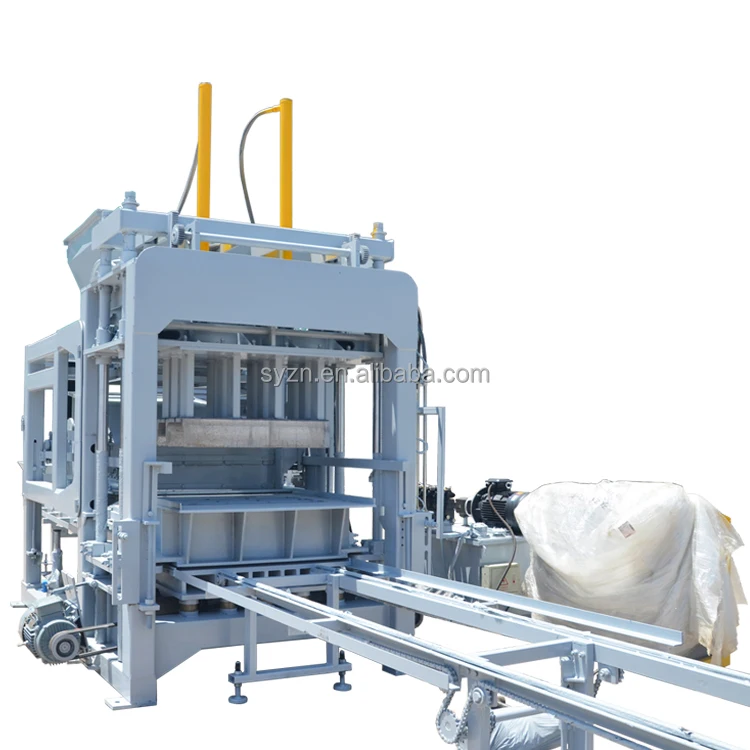
Line synchronization — The QT7-15 is specified alongside its raw material feeding, mixing, pallet handling, and stacking stations so cycle times match across every node.
Technical Specifications
| Parameter | Value |
|---|---|
| Model | QT7-15 |
| Product Type | Stationary Concrete Block Making Machine |
| Pallet Size | 1150 x 700 mm |
| Molding Cycle | 15-20s (basis not stated in source) |
| Overall Power | 45 kW |
| Vibration Force | 100 kN |
| Vibration Frequency | 0-60 Hz |
| Vibration Form | Platform Vibration |
| Demolding Method | Hydraulic |
| Control System | PLC with touch screen interface |
| Total Mass | 8 T |
| Output Capacity (Hollow block 400x200x200mm) | 1260-1680 pcs/hour |
| Output Capacity (Hollow block 400x150x200mm) | 1440-1920 pcs/hour |
| Output Capacity (Rectangular brick 200x100x60mm) | 3888-4860 pcs/hour |
Application Suitability
| Application | Material or Output |
|---|---|
| Load-bearing hollow blocks | Crushed stone, cement, and sand blends |
| Multi-cellular bricks | Lightweight aggregates and fly ash |
| Interlocking pavers | High-density aggregate mixes with pigment |
| Standard rectangular bricks | River sand and cement slurries |
Why Nameplate Capacity Rarely Matches Site Output
The press is only as fast as the slowest station feeding or clearing it.
A stationary block making machine production line often quotes a cycle time that assumes a steady supply of mixed material and a clear path for finished pallets to leave the press area. In reality, hand-loading pallets or waiting for a batch mixer to finish a charge forces the QT7-15 to idle, dropping daily volume well below the rated figures. I have walked sites where the mixer capacity was half what the press consumed, leaving operators staring at an empty hopper for minutes at a time [NEED_CITE: line balance calculations for block plants].
Matching Upstream Feed Rates to the Press Cycle
Every stationary block making machine production line must solve the math of upstream supply. The QT7-15 molding cycle requires that the storage hopper holds enough material for the next charge before the current mold closes. When the batch mixer and conveyor belt are sized correctly, the press runs continuously; when they fall short, the PLC logs a feed-fault alarm and the line halts. Specifying the mixer volume and conveyor speed against the 15-20 second cycle window is the first step to keeping vibration tables running.
Downstream Pallet Flow and Curing Rack Coordination
Once the hydraulic demolding system ejects a wet block onto its pallet, that pallet must move to a curing rack before the next cycle begins. The pallet feed machine integrated with the QT7-15 cycles a fresh board into position, but if the automatic stacker or curing rack handler cannot accept the outgoing pallet, the entire line backs up. Buyers who skip specifying the downstream conveyor speed and rack capacity often find their operators hand-stacking output by mid-shift [NEED_CITE: pallet handling bottlenecks in block production].
Vibration Force, Mix Design, and Block Density
The 100 kN platform vibration force works in tandem with hydraulic pressure to compact the concrete mix. Achieving consistent block strength depends on matching that force to the buyer’s specific aggregate size and cement ratio. A mix that is too dry will not consolidate under the adjustable 0-60 Hz frequency, while a mix that is too wet will slump after demolding. The PLC touch screen stores process parameters, allowing the operator to dial in frequency and vibration duration until the target density is reached and maintained across batches.
The Cost of Skipping Line-Level Specification
Ordering the press alone and sourcing upstream or downstream equipment from separate suppliers invites mismatched cycle times and incompatible pallet sizes. A pallet dimension that differs by a few millimeters can jam the feed mechanism, while a conveyor running too fast can tip wet blocks before they cure. These issues typically surface after commissioning, when the cost of rework and delayed production outweighs any initial savings [NEED_CITE: total cost of ownership in block plant setup].
Engineering the Line as One System
We spec the QT7-15 alongside its raw material intake, mixer, pallet feeder, and stacking stations so that every node shares the same cycle-time target. The pallet size is confirmed against the buyer’s existing curing racks and forklift capacity before production begins. Voltage, frequency, and PLC display language are locked in during the quotation phase to prevent commissioning delays on arrival. Hydraulic and electrical schematics show exactly how the press connects to the rest of the line, removing guesswork during installation.
Documentation & Verification
- Line layout drawing showing QT7-15 placement and pallet flow path
- Capacity calculation sheet stating the block format for each output figure
- Hydraulic and electrical schematics covering all line stations
- Pallet specification matching the 1150 x 700 mm mold platform
- Factory test record on the buyer’s target block format before dispatch
- Voltage and control language confirmation document
Installation, Commissioning & Support
- Foundation plan indicating load points for the 8-tonne machine mass
- Power supply specification for the 45 kW total connected load
- Assembly sequence for dismantled shipment and on-site reconnection
- PLC parameter loading and first-run cycle tuning on your mix design
- Operator training covering mold change, fault diagnosis, and daily greasing
- Wear parts list identifying hydraulic seals and vibration table bearings
Preparing Your Line Inquiry
To size the supporting equipment around the QT7-15, we need the target block format and daily volume, the local aggregate type and cement source, and the dimensions of your planned curing area. Please also confirm the site voltage and frequency, the preferred PLC display language, and whether you intend to handle pallets manually or integrate automatic stacking. This information allows us to calculate upstream mixer volume and downstream conveyor speed so the press never waits.
Frequently Asked Questions
Q: How do I verify that upstream mixing and feeding stations can match the QT7-15’s cycle time without bottlenecking?
A: We provide a line balance sheet showing mixer charge time, conveyor transfer rate, and hopper volume calculated against the press cycle for your specific block format. This document highlights any station where material flow might lag, allowing you to adjust equipment sizing before production begins.
Q: What pallet size and material should I specify based on my existing curing area and forklift?
A: The standard 1150 x 700 mm pallet must clear your curing rack uprights and match your forklift fork width. We confirm these dimensions during the proposal stage and recommend a pallet material—bamboo, steel, or PVC—based on the block weight and your local humidity conditions.
Q: How does the PLC control coordinate pallet feeding, block ejection, stacking, and curing rack loading across the line?
A: The touch screen interface stores timing parameters for each station. Sensors on the pallet feed machine and stacking unit send signals back to the main cabinet, adjusting conveyor speeds and hydraulic valve timing so that a fresh pallet arrives exactly as the mold opens.
Q: Can I start with manual pallet handling and upgrade to automatic stacking and cubing later?
A: Yes. The QT7-15 control cabinet includes reserved I/O ports and wiring channels for downstream automation. When you are ready to add an automatic stacker, the PLC program can be updated to coordinate the new station without replacing the main controller.
Q: What documentation confirms that all line stations are specified as one matched system rather than separate suppliers?
A: The single line layout drawing and integrated electrical schematic show the QT7-15, mixer, pallet feeder, and stacking unit as one circuit. The capacity calculation sheet references every station by name and cycle time, ensuring accountability for the full line’s throughput.


