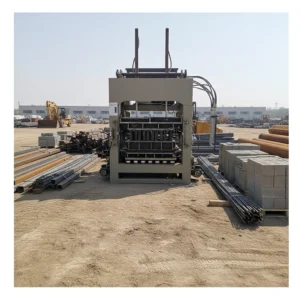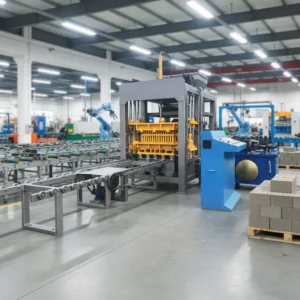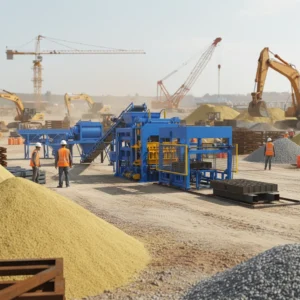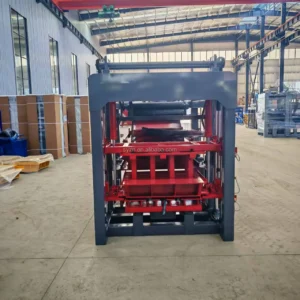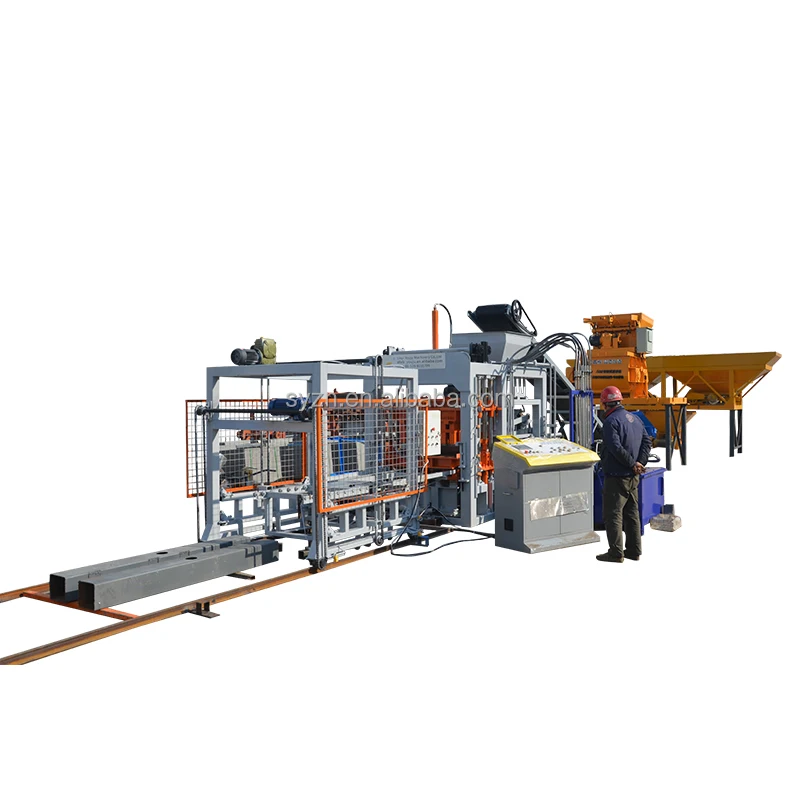
Matched System Sizing — the QT7-15 block production line connects press, pallet feed, mixer, conveyor and stacking stations so cycle times align and no station waits on another.
Technical Specifications
| Parameter | Value |
|---|---|
| Model | QT7-15 |
| Product Type | Full Automatic Hollow Block Making Machine |
| Pallet Size | 1150×700 mm |
| Molding Cycle | 15–20 s |
| Overall Power | 45 kW |
| Vibration Force | 100 kN |
| Vibration Frequency | 0–60 Hz |
| Vibration Form | Platform Vibration |
| Demolding Method | Hydraulic |
| Total Mass | 8 T |
| Control System | PLC with Touch Screen, Remote Fault Diagnostics |
| Output Capacity (Hollow block 400×200×200 mm) | 1260–1680 pcs/hour, 10080–13440 pcs/8 hr |
| Output Capacity (Hollow block 400×150×200 mm) | 1440–1920 pcs/hour, 11520–15360 pcs/8 hr |
| Output Capacity (Rectangular brick 200×100×60 mm) | 3888–4860 pcs/hour, 31104–38880 pcs/8 hr |
Application Suitability
| Application | Material or Output |
|---|---|
| Hollow block production | Crushed stone, sand, cement, fly ash aggregate blends in 400×200×200 mm and 400×150×200 mm formats |
| Rectangular paving brick | 200×100×60 mm pavers from fine aggregate and cement mixes |
| Multi-format block manufacturing | Format switch via mould change for interlocking, solid and porous brick profiles |
| On-site contractor production | Local block supply for housing and development projects with full line support |
| Plant expansion | Adding hollow block and paving formats to an existing concrete product range |
Why "Cycle Time on Paper" Doesn’t Survive the First Shift
A press that cycles in 15 seconds means nothing if the pallet feeder takes 22 seconds to deliver the next board.
On a recent project in West Africa, a plant owner ran a QT7-15 full automatic hollow block machine on paper at its quoted rate. In practice, the pallet conveyor could not return cured boards fast enough, and the press sat idle at the end of every third cycle. The block production line lost roughly a fifth of its expected daily output before anyone diagnosed the bottleneck [NEED_CITE: line balancing principles for concrete block manufacturing]. Mismatched station speeds cost more than a slower press because the buyer has already paid for capacity that never arrives.
Station-by-Station Timing Across the Line
A turnkey block making system must be calculated as a chain. Raw material feeding, mixing, pallet circulation, pressing, stacking and curing rack handling each carry a fixed cycle contribution. If the mixer batches in 90-second intervals while the press demands a fresh batch every 60 seconds, the hopper runs dry and the press pauses. We map every station interval against the QT7-15 molding cycle and adjust conveyor speed, mixer batch size and pallet return path so the press never waits.
Where the Pallet Return Path Breaks First
Pallets are the silent conveyor belt of any block production line. They leave the press wet, travel through stacking, enter the curing area, dry, and return. If the curing rack layout forces a forklift detour, the return loop stretches and the press starves. We size the pallet fleet and return conveyor against the actual curing area dimensions and the buyer’s existing forklift capacity, not a default number from a catalogue [NEED_CITE: pallet circulation and curing area planning for block plants].
Reading the Specs That Actually Matter
Platform vibration at 100 kN and a 0–60 Hz adjustable frequency let the operator tune compaction to the local aggregate. Coarse crushed stone needs a lower frequency with longer dwell, while fine sand-fly ash blends respond to higher frequency with shorter cycles. The hydraulic demolding system works in tandem with vibration: pressure holds the mix against the mould wall while vibration settles particles, so density is set by both forces together. The 1150×700 mm pallet size defines the maximum mould footprint and must match the curing rack slot width and the forklift tine spacing already on site. PLC control with a touch screen centralises station timing, and remote fault diagnostics lets our engineers read alarm logs without waiting for a site visit.
What an Undersized Conveyor Costs You
When the pallet feed machine is selected by price rather than return speed, the press develops a rhythmic pause every few cycles. Operators learn to anticipate the gap and slow their own pace. Over an eight-hour shift, these micro-stops add up to thousands of missing blocks. The buyer then blames the press manufacturer, not realising the conveyor was the weakest link [NEED_CITE: hidden costs of mismatched auxiliary equipment in block production].
Why Buyers Choose This Line Configuration
Block machinery is the only product category we build, so the QT7-15 is never sold as a standalone press. Every quotation includes pallet specification, conveyor length, stacking station and curing rack handling matched to the buyer’s site layout. Moulds are designed against the block formats that actually sell in the buyer’s market, not a generic sample set. Automation level is selectable, so a plant can start semi-automatic and add stacking later. Installation includes operator training on the PLC touch screen and remote diagnostics handover.
Documentation & Verification
- Line layout drawing showing station spacing and pallet return path for the QT7-15
- Capacity calculation sheet stating the block format assumed for each output figure
- Pallet specification matched to your existing curing rack dimensions and forklift
- Hydraulic and electrical schematic with confirmed voltage, frequency and PLC language
- Factory test record on your selected mould format before dispatch
- Operation and maintenance manual with wear parts and mould replacement list
Installation, Commissioning & Support
- Foundation plan accounts for the 8 T total mass and platform vibration load
- Dedicated 45 kW circuit with confirmed voltage and frequency before production
- Machine shipped in modular sections for container loading and on-site reassembly
- First-run parameter tuning on your local aggregate and target block format
- PLC touch screen configured in your operator language before dispatch
- Wear parts and mould list provided with recommended reorder intervals
Before You Request a Quote
Tell us the block format and size you sell most, your target daily output and the raw materials available locally. Confirm your site voltage, frequency and preferred PLC display language. Share your curing area dimensions and the forklift you already use so we can match pallet size and return conveyor length.
Frequently Asked Questions
Q: How do you verify the daily output figure for each block format?
A: Every capacity number we quote names the exact block dimensions and mould used. For the QT7-15, 10080–13440 pieces per eight-hour shift applies to 400×200×200 mm hollow blocks; switching to 200×100×60 mm rectangular bricks shifts the figure to 31104–38880. We provide a written calculation so you can compare formats directly.
Q: Which supporting stations are included in the line quotation?
A: The standard quotation covers the pallet feed machine, storage hopper, conveyor, hydraulic unit, PLC control cabinet and the block making machine itself. Stacking, curing rack handling and cubing are added based on your automation level and site layout. Nothing is left for manual handling unless you choose that option.
Q: How do you balance cycle times so the press is not left waiting?
A: We calculate the return time for every station — mixer batch interval, conveyor travel, pallet return loop — against the QT7-15 molding cycle of 15–20 seconds. Conveyor speed and pallet fleet size are adjusted until the slowest station still feeds the press on time, verified during the factory test.
Q: Will the pallet size fit my existing curing area and forklift?
A: The standard pallet is 1150×700 mm, but we confirm your curing rack slot width and forklift tine spacing before production. If the standard size does not match, we adjust pallet dimensions and mould layout so the pallets slot straight into your existing racks without modification.
Q: What voltage, frequency and PLC language will I receive?
A: We record your site voltage and frequency during the inquiry stage and build the electrical cabinet to match. The PLC touch screen language is set before dispatch, so your operators see menus and alarms in their own language from the first shift.