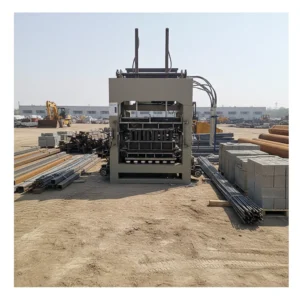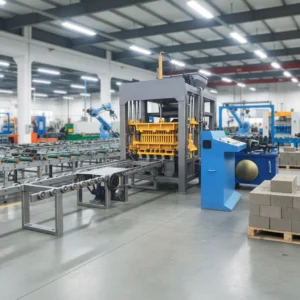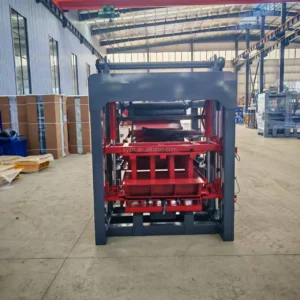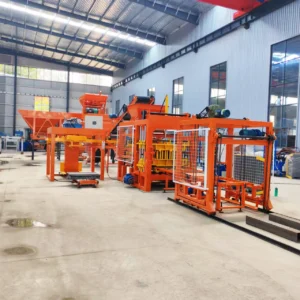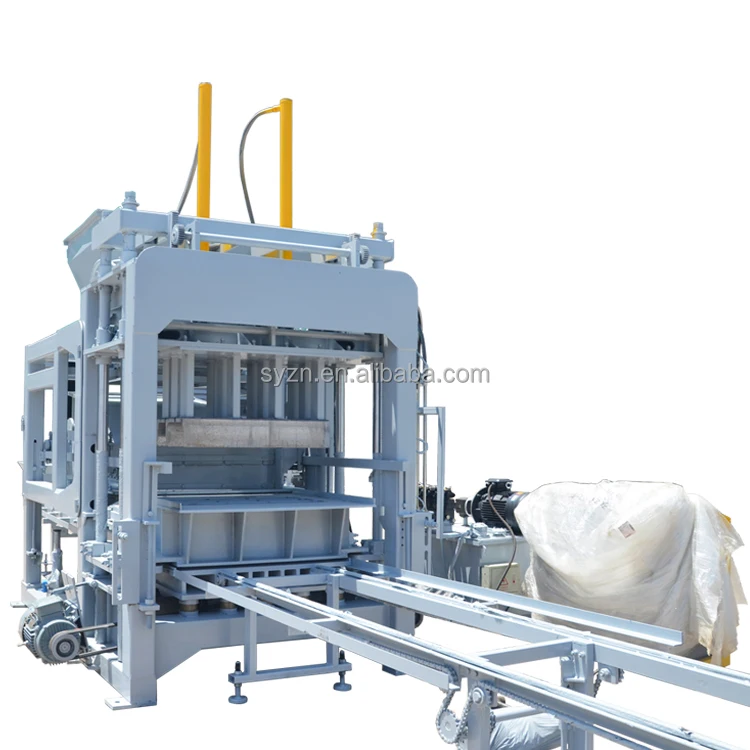
Matched Line Integration — every station from material feeding to block stacking is timed against the QT7-15 press cycle so the machine never waits for the next pallet or mix batch.
Technical Specifications
| Parameter | Value |
|---|---|
| Model | QT7-15 |
| Product Type | Hydraulic Concrete Block Making Machine |
| Pallet Size | 1150 x 700 mm |
| Molding Cycle | 15–20 seconds |
| Overall Power | 45 kW |
| Vibration Force | 100 kN |
| Vibration Frequency | 0–60 Hz (adjustable) |
| Vibration Form | Platform Vibration |
| Demolding Method | Hydraulic |
| Total Mass | 8 T |
| Control System | PLC (Programmable Logic Controller) |
| Output Capacity (400×200×200mm hollow block) | 1,260–1,680 pcs/hour |
| Output Capacity (400×150×200mm hollow block) | 1,440–1,920 pcs/hour |
| Output Capacity (200×100×60mm rectangular brick) | 3,888–4,860 pcs/hour |
| Core Components | Pallet feed machine, block making machine, storage hopper, conveyor, hydraulic unit, PLC control cabinet |
Application Suitability
| Application | Material or Output |
|---|---|
| Hollow block production | Crushed stone, cement, sand, fly ash blends for structural and non-load-bearing walls |
| Solid block production | Dense aggregate mixes for load-bearing masonry and foundation work |
| Paving brick production | Fine aggregate and cement mixes for pedestrian walkways, parking areas, and driveways |
| Construction material manufacturing | Various concrete formulations adapted to local aggregate availability |
Why the Press Is Not the Only Machine That Matters
A block machine only produces when every upstream and downstream station keeps pace.
When I first started configuring lines in Linyi, I watched a QT7-15 block machine production line sit idle for twelve seconds every cycle because the pallet feeder could not return the cured pallet fast enough. The press was rated for a 15-second cycle, but the actual line rhythm stretched past 25 seconds. Daily output dropped to roughly half of what the capacity table promised. That mismatch between the press and its supporting equipment is the most common reason buyers feel misled after commissioning [NEED_CITE: common causes of block line underperformance in field installations].
How Station Timing Shapes Real Daily Output
The QT7-15 block machine production line connects raw material feeding, mixing, pallet circulation, pressing, and stacking into a single rhythm. Each station has its own cycle that must overlap with the next. The storage hopper must release a measured batch into the mixer before the previous batch finishes curing on the rack. If the conveyor delivers mix late, the press idles. If the pallet feed machine cannot retrieve and reposition a pallet within the molding window, the entire sequence stalls. Planning these intervals on paper before the equipment ships prevents costly on-site adjustments.
Coordinating the Pallet Circuit
The 1150×700 mm pallet size on this line is not chosen in isolation. It must fit the curing racks the buyer already owns or plans to build, and it must sit within the load envelope of the site forklift. When pallets are too large for the curing area, workers stack blocks by hand on the ground, losing the speed advantage of the automatic feed. When pallets are too small, the block count per cycle drops below the line design target. Specifying pallet dimensions alongside rack spacing and forklift capacity keeps the pallet circuit moving without interruption [NEED_CITE: pallet sizing standards for concrete block curing systems].
Reading the Specs That Decide Block Quality
The 100 kN vibration force combined with hydraulic demolding determines how densely the concrete mix is compacted inside the mould. Insufficient vibration leaves voids that weaken the block; excessive vibration pushes cement paste to the surface and starves the core. The 0–60 Hz adjustable frequency lets the operator dial in the right energy level for each format — a lower frequency for large hollow blocks that need deep compaction, a higher frequency for thin paving bricks that require a smooth face. The 45 kW total power envelope must be available on a dedicated circuit; voltage sag during startup can trip the PLC and halt the sequence mid-cycle.
The Cost of Ignoring Line Balance
Buying the press alone and sourcing pallet handling, mixers, and stackers separately often leads to communication gaps between suppliers. The pallet feeder arrives with a different control protocol than the PLC cabinet. The conveyor runs faster than the mixer discharge. Workers end up shoveling mix by hand or pulling pallets off the rack manually. These workarounds erase the output advantage a QT7-15 block machine production line should deliver and raise the risk of inconsistent block density from batch to batch [NEED_CITE: risks of multi-supplier block line integration].
What Configuration Support Looks Like Here
Block machinery is our single focus, so the press, moulds, pallets, and handling equipment are specified as one matched system rather than assembled from separate catalogues. The line layout we provide states the cycle time and capacity for each block format you plan to produce, not just the fastest format on the chart. Mould design covers the formats your market actually sells, and custom drawings are available when standard moulds do not fit. Automation level is selectable — you can start with semi-automatic pallet handling and add stacking and cubing later as volume grows. Voltage, frequency, and PLC display language are confirmed before production begins so commissioning is not delayed by electrical mismatches [NEED_CITE: industrial voltage and frequency standards by export region].
Documentation & Verification
- Line layout drawing with capacity calculated per block format and stated cycle time
- Machine specification sheet covering hydraulic pressure, vibration force, and pallet dimensions
- Mould drawing and format list matching your target product range
- Pallet specification matched to your curing rack spacing and forklift capacity
- Voltage, frequency, and PLC language confirmation signed off before shipment
- Factory test record showing cycle sequence and block release for your chosen format
Installation, Commissioning & Support
- Foundation plan sized for the 8 T total mass and vibration load of the QT7-15
- Dedicated 45 kW power circuit with correct voltage and frequency for your site
- Pallet feed machine and conveyor aligned to the press during on-site assembly
- PLC parameters set to your mix design and target block format at first startup
- Operator training covering mould change, frequency adjustment, and fault diagnosis
- Wear parts and hydraulic seal list provided for first-year maintenance planning
Planning Your Line Configuration
To size the supporting equipment around the QT7-15, we need to know which block formats you intend to produce and the daily volume target for each. Share your local aggregate type and cement source so the mixer and hopper can be matched to your actual mix design. Confirm the curing area dimensions and the forklift model on site so the 1150×700 mm pallet circuit is planned around your existing infrastructure. Let us know your site voltage and frequency, and the preferred PLC display language, before the control cabinet is wired.
Frequently Asked Questions
Q: How do cycle times match across line stations to prevent the press from waiting?
A: Each station — mixer discharge, conveyor transport, pallet feed, press cycle, and block removal — is mapped on a single timing diagram. The slowest station sets the line rhythm. We adjust conveyor speed, mixer batch size, and pallet return path so no station forces the QT7-15 to idle between cycles.
Q: What automation level options exist for pallet feeding and stacking?
A: The line can start with manual pallet handling and a basic pallet feed machine, then add automatic stacking and cubing modules as output grows. The PLC control architecture supports these upgrades without replacing the main cabinet or rewiring the press.
Q: How is pallet size selected against my curing area and forklift?
A: We take the dimensions of your curing racks and the load capacity of your forklift before confirming the 1150×700 mm pallet. If your racks are narrower or your forklift has a lower rated capacity, we adjust the pallet spec and recalculate the block count per cycle accordingly.
Q: What supporting equipment is included in the complete line quotation?
A: The quotation covers the storage hopper, conveyor, mixer connection, pallet feed machine, hydraulic unit, and PLC control cabinet alongside the block making machine. Stacking, curing rack handling, and cubing modules are listed as selectable options so the investment matches your current volume.
Q: How do I plan the installation sequence for the full production line?
A: Foundation work for the press comes first, followed by pallet circuit alignment, then conveyor and hopper positioning. Electrical connections and PLC wiring are completed last. We provide a phased installation drawing so your contractor can prepare the site before the equipment container arrives.