
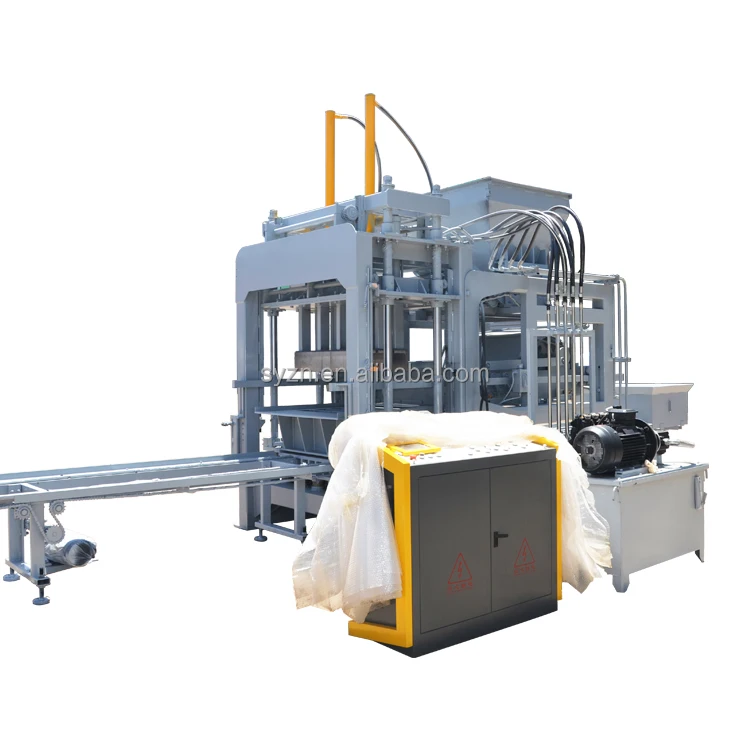
Matched Line Engineering — Every station from the PLD1200 batcher to the SY-4 stacker is timed against the QT7-15 press cycle so the host machine is never left waiting for material, pallets or offbear.
Technical Specifications
| Parameter | Value |
|---|---|
| Model | QT7-15 |
| Product Type | Automatic Hydraulic Block Making Machine |
| Dimension of Host Machine | 3200 × 2300 × 2750 mm |
| Weight of Host Machine | 6 Tons |
| Molding Area | 1150 × 700 mm |
| Host Machine Power | 45 kW |
| Vibration Force | 100 kN |
| Vibration Method | Hydraulic + Platform Vibration |
| Vibration Frequency | 2800–4500 Times/Minute |
| Pallet Size | 1150 × 700 × 25 mm |
| Molding Period | 15 Seconds (basis to be confirmed per block format) |
| Control System | Siemens PLC with independent control program |
| Motor Brand | Germany Siemens or CE standard brand |
| Travel Switch | France Schneider and Japan Omron |
| Voltage | 220 / 380 / 415 / 440 V (Customized) |
| Mould Treatment | Heat treatment and carburizing, 54–58 HRC |
| Welding | Carbon dioxide protection welding, CE standard materials |
| Batching Machine (PLD1200) | Hopper 1200 L, Storage 4 × 2.5 m³, Productivity 56 m³/h (basis to be confirmed), Ingredient precision ±2% |
| Mixer (JS500) | Charging 800 L, Discharging 500 L, Production 25 m³/h (basis to be confirmed), Mixing motor 18.5 kW |
| Stacker (SY-4) | Power 3 kW, Mobile pallet stack, 600 kg |
| Standards | CE |
Application Suitability
| Application | Material or Output |
|---|---|
| Hollow Block Production | Crushed stone, cement, sand, and aggregate mixes |
| Solid Block Manufacturing | Dense concrete mixes for load-bearing walls |
| Paving Block & Kerbstone | High-density concrete with color face option |
| Interlocking Brick | Interlock geometry for mortarless assembly |
| Stationary Block Plant Setup | Fixed production line from raw feeding to stacked curing |
Why "15-Second Cycles" Can Mean Empty Curing Racks
The press cycle is only as fast as the slowest station feeding it.
A 15-second molding period looks impressive on a quotation, but that figure assumes a specific block format, wall thickness, and mix design. When the PLD1200 batching machine or JS500 mixer cannot keep up with the host machine demand, the press sits idle waiting for material. Worse, if pallet return and stacking are handled manually because the line was quoted without the SY-4 stacker, the real daily throughput falls far below expectation. I have watched plant owners realize too late that the bottleneck was never the press itself — it was every station around it [NEED_CITE: stationary block plant throughput coordination standards]. An automatic hydraulic block making machine production line only delivers its rated output when batching, mixing, conveying, and stacking are all specified as one system.
Coordinating Every Station Around the Press
The QT7-15 host machine runs at the center of a sequence that starts with raw aggregate feeding and ends with stacked output on the curing rack. The Siemens PLC with its independent control program coordinates pallet feeding into the press, vibration and hydraulic compression during molding, brick receiving onto the conveyor, and SY-4 stacker operation — so each station hands off to the next without the operator managing timing manually. This coordination is what separates a matched automatic hydraulic block making machine production line from a collection of individual machines that happen to share a workshop floor.
Where Line Capacity Actually Breaks Down
The JS500 mixer produces at a rate that must be verified against the press demand for your specific block format. If you are running hollow blocks with thin walls, the mixer keeps pace easily. If you switch to heavy solid blocks that demand a richer mix and longer blending time, the mixer becomes the constraint. The PLD1200 batching machine stores 4 × 2.5 m³ across three aggregate species, but refill intervals depend on your local supplier delivery schedule. These are the variables that determine whether your line runs continuously or in bursts [NEED_CITE: concrete batching plant material flow analysis].
Reading the Specifications Against Your Actual Production
The 100 kN vibration force combined with hydraulic pressure determines how densely the concrete is compacted into the mould cavity, directly affecting block strength and surface finish. The vibration frequency range of 2800–4500 times per minute allows the operator to adjust for different aggregate sizes and mix moisture levels. Mould carburizing to 54–58 HRC hardness extends mould life through repeated format changes, which matters when your market demands hollow blocks in the morning and pavers in the afternoon. Pallet size at 1150 × 700 × 25 mm must match both the curing rack spacing in your yard and the fork dimensions of the lift truck you already own — a mismatch here stops the line just as surely as a mechanical failure.
The Hidden Cost of Quoting the Press Alone
When a quotation lists only the host machine, the buyer assumes pallet handling, stacking, and curing transport are either included or trivial. They are neither. Manual pallet return means two or three workers walking pallets back to the press every cycle. Hand stacking means output piles up faster than it can be moved to curing, and blocks get damaged in the shuffle. The voltage arrives wrong because nobody confirmed it before production, and the PLC display shows Chinese when the operator reads only English or French [NEED_CITE: industrial machinery export voltage and language confirmation practices]. These are not minor delays — they cancel the first week of production and erode buyer confidence before the line ever runs at capacity.
Why This Line Is Specified as One System
Block machinery is our single focus, which means the QT7-15, PLD1200, JS500, and SY-4 are not sourced from separate suppliers and forced to work together. Configuration is set against your actual mix design, local aggregate gradation, and target block format rather than a catalogue default. Mould design covers the formats your market actually sells, including custom drawings when your region demands a size we have not built before. Automation level is selectable — you can start with semi-automatic pallet handling and add the stacker and cubing system later as your volume grows. Installation and commissioning include operator training on your specific line configuration, not a generic machine walkthrough.
Documentation & Verification
- Line layout drawing with capacity calculation stated per block format
- Machine specification sheet covering press, batcher, mixer, and stacker
- Mould drawing and format list for every block type in your order
- Pallet specification matched to your curing rack and forklift
- Voltage and PLC control language confirmation record before production
- Factory test record covering every station, not the press alone
Installation, Commissioning & Support
- Workshop area of 200 m² requires level concrete foundation for the 6-ton host machine
- 45 kW host machine power demands dedicated circuit with correct voltage and frequency
- Machine dismantled for container loading and reassembled on-site with alignment verification
- PLC display language set to operator’s local language before commissioning begins
- Mould change training included so format switches do not consume a full shift
- Wear parts and mould list provided with first-order spare recommendations
Before You Send the Inquiry
Tell us the block formats your market sells, the daily volume you need to hit, and the raw materials available locally — including aggregate type and cement source. Confirm your workshop dimensions, existing curing yard layout, and the fork lift trucks you already operate. State your local voltage, frequency, and the language your operators read, so the PLC and electrical system arrive ready to run.
Frequently Asked Questions
Q: How do I know if the 15-second molding period applies to my block format?
A: The 15-second cycle is a baseline figure. Actual molding time depends on block height, wall thickness, mix design, and vibration frequency setting for your aggregate. Request a capacity calculation that states the specific block format assumed, so you can compare it against your daily production target.
Q: What happens if my mixer cannot keep up with the press?
A: The JS500 mixer output must be verified against your block format demand. If the press cycles faster than the mixer can deliver fresh concrete, the line runs in bursts rather than continuously. We calculate batch-to-press timing during line configuration to prevent this bottleneck.
Q: How should I choose pallet size for my existing curing area?
A: The 1150 × 700 × 25 mm pallet must fit your curing rack spacing and match your forklift fork width. A mismatch means either rebuilding the curing racks or replacing pallets after the machine arrives. Confirm both before production.
Q: Why does PLC language matter if the machine is automatic?
A: Operators need to read fault messages, adjust cycle parameters, and respond to alarms in their own language. If the PLC display arrives in a language the operator cannot read, commissioning stalls until the interface is reconfigured. We confirm display language before the control panel is built.
Q: Can I add automatic stacking later if I start semi-automatic?
A: Yes. The line supports upgrade from manual pallet handling to SY-4 stacker operation and full cubing. The PLC program accommodates the additional stations, and mechanical interfaces are pre-planned on the host machine frame.


