
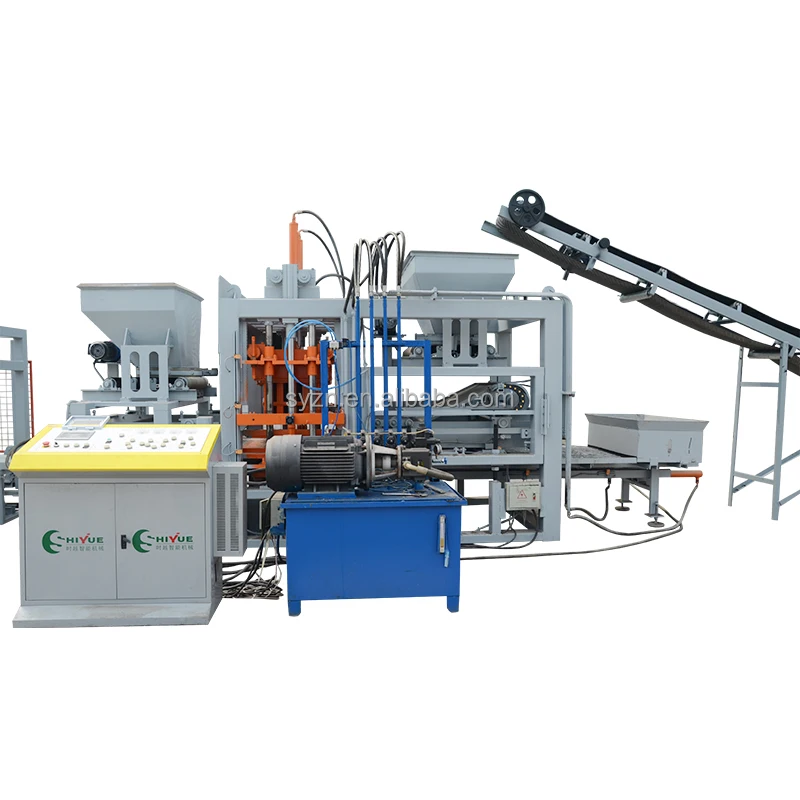
Matched Line Configuration — every station from the PLD1200 batcher through the SY-4 stacker is sized against the QT7-15 press cycle so no single point bottlenecks the automatic concrete block making machine production line.
Technical Specifications
| Parameter | Value |
|---|---|
| Model | QT7-15 |
| Product Type | Automatic Concrete Block Making Machine |
| Dimension of Host Machine | 3200 × 2300 × 2750 mm |
| Weight of Host Machine | 6 Tons |
| Molding Area | 1150 × 700 mm |
| Pallet Size | 1150 × 700 × 25 mm |
| Workshop Area | 200 m² |
| Host Machine Power | 45 kW |
| Vibration Force | 100 kN |
| Vibration Method | Hydraulic + Platform Vibration |
| Vibration Frequency | 2800–4500 Times/Minute |
| Molding Period | 15 Seconds |
| Control System | Siemens PLC with independently developed control program |
| Motor | Germany SIEMENS or CE standard brand |
| Travel Switch | France Schneider and Japan Omron |
| Mould Treatment | Heat treatment and carburizing, 54–58 HRC, lifespan over 100,000 cycles |
| Welding | Carbon dioxide protection welding |
| Automation Level | Automatic with PLC, pallet feeder, brick receiver |
| Stacking Method | SY-4 stacker, 3 kW, 600 kg capacity |
| Batching Machine | PLD1200, 1200 L hopper, 4 × 2.5 m³ storage, ±2% ingredient precision |
| Concrete Mixer | JS500, 500 L discharge, 25 m³/h capacity, 18.5 kW mixing motor |
| Grouped Equipment | Press, pallet feeder, receiver, hydraulic station, batcher, mixer, conveyor, hydraulic trolley |
| Optional | Color feeding system for color pavers |
| Voltage | 220/380/415/440 V (Customized) |
| Standards | CE |
Application Suitability
| Application | Material or Output |
|---|---|
| Hollow block production | Crushed stone, cement, sand, fly ash blends |
| Solid block production | Dense aggregate and cement mixes |
| Paving block production | Fine aggregate with cement, high-pressure compaction |
| Color paver production | Two-layer mix with pigmented face via optional color feeder |
| On-site project supply | Local aggregate sourced near development or housing sites |
| Expanded format range | Multiple mould formats run on one line with changeover |
What a 15-Second Cycle Time Actually Delivers
A 15-second molding period is measured at the press — daily throughput depends on how fast the rest of the line can feed, receive, and stack.
I have watched buyers compare quotations by cycle time alone and then wonder why real output fell short. A press that cycles every 15 seconds still waits if the mixer cannot discharge fast enough or the stacker cannot clear pallets quickly [NEED_CITE: concrete block line station-to-station cycle matching]. The automatic concrete block making machine production line here is specified so each station — batching, mixing, conveying, pressing, stacking — is matched to that press rhythm rather than bought as isolated items.
Stations That Keep Pace With the Press
The PLD1200 batching machine stores four materials in 2.5 m³ hoppers and weigh-batches at ±2% precision into the JS500 mixer. The mixer discharges 500 L per batch at a rated 25 m³/h, feeding the conveyor belt that delivers to the press hopper. When the concrete arrives on time and in the right quantity, the QT7-15 press runs its 15-second cycle without idle pauses. The automatic concrete block making machine production line approach means the mixer capacity and press consumption are calculated together before the line ships.
Handling What Comes Off the Press
Every pallet of green blocks leaving the molding area needs to go somewhere immediately. The brick receiver pulls pallets off the press, and the SY-4 stacker collects them into mobile pallet stacks at 600 kg capacity [NEED_CITE: pallet stacker load rating and curing rack logistics]. The hydraulic trolley then moves full stacks to the curing zone. When any of these stations is undersized, workers end up lifting pallets by hand — the exact situation that erodes the throughput the press was bought to deliver.
How Vibration and Pressure Shape Block Density
The 100 kN vibration force combined with hydraulic pressure and platform vibration at 2800–4500 cycles per minute compacts the concrete mix into the mould cavity. This dual-action approach drives aggregate particles together from below while hydraulic head pressure compresses from above, producing blocks with consistent density across the full 1150 × 700 mm molding area. The carburized mould surfaces at 54–58 HRC maintain dimensional accuracy over extended production runs, which matters when buyers need tight tolerances for interlocking formats. The vibration frequency range allows adjustment for different aggregate gradations — coarser crushed stone needs higher amplitude at lower frequency, while fine sand-fly ash blends respond better to higher frequency settings.
The Cost of Treating the Line as Separate Purchases
Buying a press from one supplier, a batcher from another, and a stacker from a third often produces mismatched station speeds. The mixer output may exceed what the press consumes, causing wet concrete to sit and stiffen in the conveyor [NEED_CITE: concrete workability loss in transit and holding]. Or the stacker capacity may be too small for a full shift, forcing manual pallet handling and cutting real daily output well below the press capability. These mismatches show up only after installation, when the cost of replacing a station is already sunk.
Why This Line Is Specified as One System
Block machinery is our single focus, so the press, mould, pallet, and handling equipment are designed together from the start. Configuration is set against your actual mix design, local aggregate, and target block format — not a catalogue default. The moulds are built for the formats your market sells, with custom drawings available. Automation level is selectable, letting a buyer start semi-automatic and add stations later. Installation includes commissioning with operator training so the line runs correctly from the first shift. The QT7-15 automatic concrete block making machine production line is one example of this matched-system approach applied to a mid-range capacity tier.
Documentation & Verification
- Line layout showing station spacing for your 200 m² workshop footprint
- Capacity calculation stating which block format the molding period assumes
- Hydraulic and electrical schematics covering the full grouped equipment set
- Voltage, frequency, and PLC display language confirmed before production
- Factory test record with all stations running together, not individual tests
- Mould drawing and format list with pallet specification matched to your curing area
Installation, Commissioning & Support
- Foundation plan sized to the 6-ton host machine load and vibration profile
- Dedicated power circuit for the 45 kW host plus 18.5 kW mixer and 3 kW stacker
- Machine arrives dismantled for container loading; reassembly supervised on site
- First-run commissioning with vibration frequency tuned to your local aggregate
- Operator training covering PLC control, mould changeover, and daily maintenance
- Wear parts list with mould lifespan over 100,000 cycles and hydraulic seal schedule
Before You Request a Quote
Send your target block format with dimensions, the daily output you need, and a sample of your local aggregate or raw material. Confirm the voltage and frequency at your site, the PLC language your operators prefer, and the curing area dimensions you have available. If you already run conveyors or forklifts, share the pallet size so the line is built around your existing equipment.
Frequently Asked Questions
Q: How is daily output calculated, and which block format is assumed?
A: The 15-second molding period is measured at the press for a specific mould. Daily output is calculated by multiplying cycles per hour by the number of blocks per pallet, then adjusting for shift length and changeover time. Every quotation states the exact block format and dimensions used in the calculation so you can verify the figure against your own production schedule.
Q: How must the batcher and mixer be sized so the press never waits?
A: The PLD1200 batcher and JS500 mixer are selected so their combined throughput matches or exceeds the QT7-15 press consumption rate. If your mix design requires longer mixing time or your aggregate is slow to batch, we adjust the mixer size or add a holding hopper to prevent the press from idling between cycles.
Q: What electrical and control details are confirmed before shipment?
A: Voltage, frequency, plug type, and PLC display language are all written into the order before production begins. The Siemens PLC program is loaded with your chosen language so operators can read alarms and parameters on day one, avoiding commissioning delays caused by mismatched electrical standards.
Q: What does the automation level actually include and where are manual steps left?
A: The standard configuration covers automatic pallet feeding, press cycling, brick receiving, and SY-4 stacking. Manual steps typically remain at the curing rack transfer and finished block cubing unless additional handling equipment is specified. We clarify exactly which stations are automated and which require operators so labor planning is realistic.
Q: How does mould changeover affect realistic daily production?
A: Every format change stops the press for the time needed to swap moulds and recalibrate the fill depth. We factor changeover duration into the capacity calculation so the quoted daily output reflects actual format switching, not just a single-format theoretical maximum run.


