
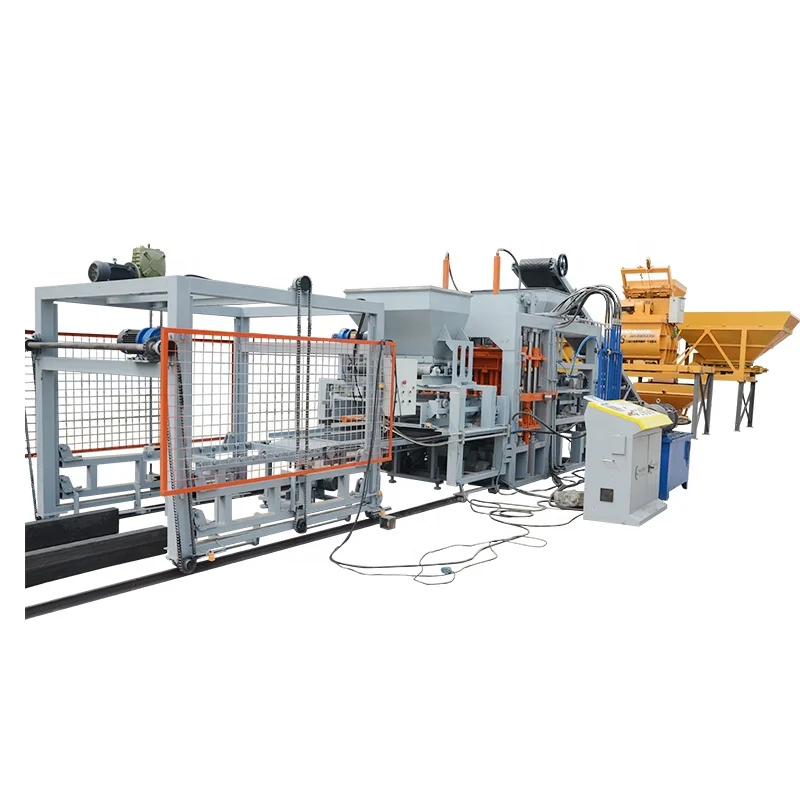
Integrated Line Balancing — Stations from PLD1200 batching to SY-4 stacking are matched against the QT7-15 press cycle so the host machine never waits for material or pallets.
Technical Specifications
| Parameter | Value |
|---|---|
| Product Type | Automatic Hydraulic Block Making Machine |
| Model | QT7-15 |
| Host Machine Power | 45 kW |
| Voltage | 220/380/415/440V (Customized) |
| Control System | Siemens PLC with independently developed control program |
| Electrical Components | France Schneider and Japan Omron travel switches |
| Host Motor | Germany SIEMENS or CE standard brand |
| Overall Dimensions (Host) | 3200×2300×2750 mm |
| Net Weight (Host) | 6 Tons |
| Molding Area | 1150×700 mm |
| Vibration Force | 100 kN |
| Vibration Method | Hydraulic + Platform Vibration |
| Vibration Frequency | 2800–4500 Times/Minute |
| Pallet Size | 1150×700×25 mm |
| Molding Period | 15 Seconds (basis to be confirmed per block format) |
| Mould Hardness | 54–58 HRC (carburizing and heat treatment) |
| Mould Lifespan | >100,000 cycles (source value — verify against manufacturer catalog) |
| Automation Level | Automatic with pallet feeder and brick receiver |
| Stacking Method | SY-4 mobile pallet stacker (3 kW) |
| Batching Machine | PLD1200 (1200L hopper, 4×2.5 m³ storage, 56 m³/h theoretical) |
| Mixer | JS500 (500L discharge, 25 m³/h production capacity) |
| Line Components | Batching, mixer, conveyor, block machine, pallet feeder, receiver, hydraulic station, trolley, stacker |
| Workshop Area | 200 m² (basis not stated in source) |
Application Suitability
| Application | Material or Output |
|---|---|
| Hollow block production | Crushed stone, cement, sand, aggregate |
| Solid block production | Fly ash, cement, gravel, stone powder |
| Paving block production | Granite chips, cement, fine aggregate |
| Color paver production | Pigmented surface layer with additional color feeding system |
Why the Automatic Block Making Machine Production Line Quoted Capacity Misses Reality
A cycle time only matters when every station in the line can match it.
I configured a QT7-15 for a Middle East project where the client ordered based on a sample output figure. His local stone powder carried high clay content, which extended the actual molding cycle well beyond the quoted 15-second baseline. The press slowed down, but the batching and mixing stations kept running at full speed, flooding the conveyor and creating material waste before anyone noticed the mismatch [NEED_CITE: impact of aggregate clay content on block molding cycle time]. When you specify an automatic block making machine production line, the capacity calculation must state which block format, which mix design, and which local aggregate it assumes — otherwise daily output becomes a guessing game.
How the Grouped Equipment Concept Removes Station Mismatch
The QT7-15 line groups the PLD1200 batching machine, JS500 mixer, belt conveyor, host press, pallet feeder, brick receiver, and SY-4 stacker into one coordinated system. Each station’s throughput is checked against the press cycle before configuration is finalized. If the mixer discharges 25 m³/h but the press demands more for a thin paving block format, the line specification is adjusted rather than the press left waiting.
Where Bottlenecks Actually Appear in Block Lines
Most block line bottlenecks do not happen at the press — they occur at pallet feeding or stacking. The SY-4 mobile pallet stacker handles loaded pallets off the brick receiver, but if the curing rack layout forces the forklift to travel long distances, empty pallets do not return fast enough. When we plan the automatic block making machine production line layout, pallet return path and curing area distance are factored in alongside the conveyor length [NEED_CITE: pallet circulation rate versus curing area distance in block plants].
Reading the Specs That Actually Determine Output
The vibration system combines hydraulic pressure with platform vibration at 2800–4500 cycles per minute, which controls block density and surface finish. The 100 kN vibration force must be matched to the buyer’s specific mix — too much force on a lightweight aggregate mix collapses the block, too little on a dense paver mix leaves voids. The 1150×700 mm molding area determines how many blocks fit per cycle, so daily output for hollow blocks and paving blocks will differ even at the same cycle speed. The 54–58 HRC mould hardness extends service life under abrasive aggregates, but the >100,000 cycle lifespan figure should be verified against the specific material being pressed. Siemens PLC control coordinates station sequencing, and the independently developed program manages the timing between mixer discharge, pallet feed, and press actuation so that no single station dictates the line rhythm.
What Happens When Voltage and Language Are Confirmed After Shipment
A block line arriving with 380V wiring in a 440V market sits idle until transformers are sourced locally. If the PLC display language was not confirmed before production, the operator reads error codes in a language they cannot follow, and commissioning stretches from days into weeks [NEED_CITE: voltage and frequency standards by export market]. We confirm voltage, frequency, and PLC display language during the quotation stage so the QT7-15 arrives ready for connection.
Why This Line Is Configured Before It Is Quoted
Block machinery is our single focus, so the QT7-15 press, moulds, pallets, and handling equipment are specified as one matched system rather than assembled from separate suppliers. Configuration is set against the buyer’s actual mix design and local aggregate, not a catalogue default. Mould design covers the formats the buyer’s market actually sells, with custom drawings available for non-standard sizes. Automation level is selectable — a buyer can start with the standard automatic configuration and add cubing later. Installation support includes operator training so the team running the line on day one understands mould change procedures and daily maintenance points.
Documentation & Verification
- Line layout drawing showing QT7-15 station positions, conveyor lengths, and total footprint against your workshop area
- Capacity calculation sheet stating output per block format based on 15-second molding period
- Hydraulic and electrical schematics with 45 kW host power and Siemens PLC wiring detail
- Mould format list with pallet size 1150×700×25 mm and HRC hardness certification
- Factory test record on buyer’s specified block format before dispatch
- Voltage, frequency, and PLC display language confirmation document
Installation, Commissioning & Support
- 200 m² workshop minimum with level concrete foundation to support 6-ton host machine and vibration loads
- Dedicated power circuit for 45 kW host plus batching, mixer, and stacker auxiliary loads
- Grouped equipment arrives in dismantled state with labeled components for on-site assembly
- First-run commissioning includes PLC program tuning to match buyer’s specific block format cycle
- Operator training covers mould change sequence, hydraulic station checks, and daily lubrication points
- Wear parts list with mould and hydraulic seal reorder intervals provided at handover
Before You Request a Quotation
To configure the QT7-15 line correctly, share your target block formats with dimensions, the daily output you need per format, and a sample or report of your local aggregate material. Include your workshop dimensions, available power supply voltage and frequency, and whether you have existing pallets or curing racks the line must integrate with.
Frequently Asked Questions
Q: How is line capacity calculated per block format, and what does the 15-second molding cycle assume?
A: The 15-second molding period is a baseline figure. Actual cycle time depends on the block format, wall thickness, and mix design. Capacity is calculated per specific format — hollow blocks, solid blocks, and pavers each yield different daily outputs from the same press. We provide a format-by-format calculation sheet with the quotation.
Q: Which stations are included in the grouped equipment list, and where could bottlenecks occur?
A: The line includes PLD1200 batching, JS500 mixer, belt conveyor, QT7-15 press, pallet feeder, brick receiver, and SY-4 stacker. Bottlenecks typically appear at pallet return speed or mixer discharge rate rather than the press itself. Each station’s capacity is cross-checked during configuration.
Q: How do batching accuracy and mixer discharge rate match the press cycle time?
A: The PLD1200 theoretical productivity is 56 m³/h and the JS500 mixer delivers 25 m³/h. These figures are checked against the QT7-15 press demand for the buyer’s target block format. If the press requires faster feed for a thin product, the mixer or batching specification is adjusted accordingly.
Q: What pallet size and material is specified, and how does it align with existing curing infrastructure?
A: The standard pallet size is 1150×700×25 mm. We confirm this against the buyer’s existing curing rack dimensions and forklift capacity before production. Mismatched pallet size forces manual re-stacking at the curing area, which defeats the purpose of automatic stacking.
Q: What is the upgrade path if automation level needs to increase after initial installation?
A: The QT7-15 automatic block making machine production line supports automation upgrades. A buyer starting with the standard pallet feeder and stacker can add automatic cubing and curing rack handling later. The Siemens PLC program accommodates additional station integration without replacing the host control system.


