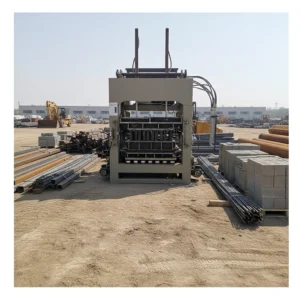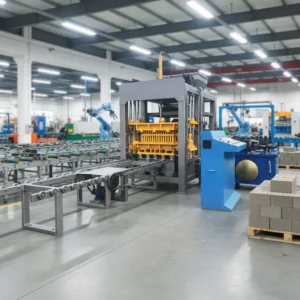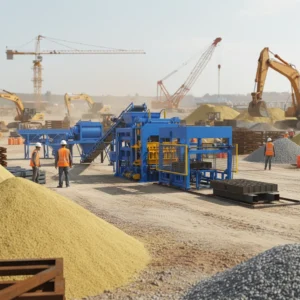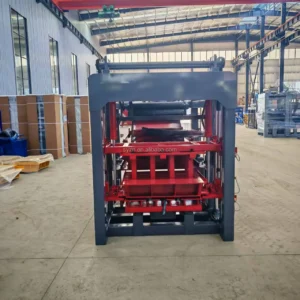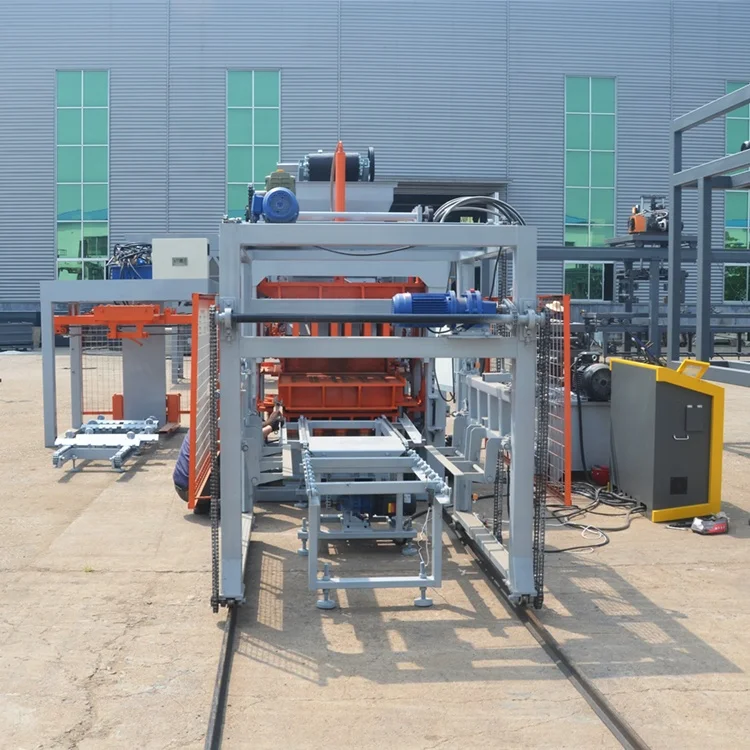
Integrated Hydraulic Station — The QT6-15 keeps its hydraulic pump isolated from press vibration and dust, maintaining consistent demolding pressure across consecutive shifts.
Technical Specifications
| Parameter | Value |
|---|---|
| Model | QT6-15 |
| Product Type | Hydraulic Concrete Block Making Machine |
| Overall Dimensions | 8200×1700×2950 mm |
| Total Mass | 7 T |
| Overall Power | 37 kW |
| Vibration Frequency | 0-60 Hz |
| Vibration Force | 45 kN |
| Vibration Form | Platform Vibration |
| Moulding Mode | Automatic loading, vibration moulding |
| Pallet Size | 880×850 mm |
| Molding Cycle | 15-20 s (basis not stated in source — confirm block format, material, thickness) |
| Demolding Method | Hydraulic |
| Control System | PLC with touch screen |
| Hydraulic System | Independent integrated hydraulic station |
| Compressive Strength of Blocks | >15 MPa |
| Output: Hollow Block 400×200×200 mm | 6 pcs/mould, 1080-1440 pcs/h, 8640-11520 pcs/8hr (cycle 15-20s) |
| Output: Hollow Block 400×150×200 mm | 8 pcs/mould, 1440-1920 pcs/h, 11520-15360 pcs/8hr (cycle 15-20s) |
| Output: Solid Brick 240×115×53 mm | 32 pcs/mould, 5760-7680 pcs/h, 46080-61440 pcs/8hr (cycle 15-20s) |
| Output: Rectangular Paver 200×100×60 mm | 21 pcs/mould, 2160-2880 pcs/h, 17280-23040 pcs/8hr (cycle 20-25s) |
| Output: Zigzag Brick 225×112.5×60 mm | 15 pcs/mould, 2160-2880 pcs/h, 17280-23040 pcs/8hr (cycle 20-25s) |
| Factory Area | 1200 m² |
| Warranty | 1 year (excluding spare parts) |
Application Suitability
| Application | Material or Output |
|---|---|
| Hollow block production | Crushed stone, sand, cement, waste ash and slag blends |
| Solid brick production | Fly ash, river sand and cement mixes for load-bearing walls |
| Rectangular paver production | Granite aggregate and cement for driveways and walkways |
| Interlocking / zigzag paver production | Fine aggregate and cement for pedestrian and light-traffic paving |
| Multicellular brick production | Lightweight aggregate blends for partition and infill walls |
Why Cycle Time Alone Misleads Line Planners
A quoted cycles-per-hour figure says nothing about the block format behind it, leaving buyers to discover shortfalls only after the hydraulic block making machine production line is running.
Capacity is meaningless without the format and cycle assumption printed beside it.
I once watched a plant owner in Southeast Asia stare at a daily tally that fell well below the brochure number. The press cycled fast enough, but his pallet feeder could not keep up and his curing racks filled before noon, forcing the press into idle loops. The bottleneck was never the press itself — it was every station around it. When the upstream mixer, pallet return loop and downstream stacker are specified as one system, those gaps close before the machine ships [NEED_CITE: line balancing principles for concrete block production].
Matching Every Station to the Press Beat
The QT6-15 completes a moulding cycle in roughly 15-25 seconds depending on format, which sets the tempo the rest of the hydraulic block making machine production line must follow. Raw material batching has to deliver a fresh mix within that window, the pallet feeder must present a clean board at each stroke, and the wet-side stacker has to clear finished pallets before the next demolding. If any station lags, the press sits idle and daily output drops regardless of its rated speed.
Pallet Circulation as the Hidden Constraint
With a pallet size of 880×850 mm, every pallet in the loop — from feeder magazine through the press, the wet-side conveyor, the stacker and the curing rack — must match that dimension. A plant that already owns curing racks spaced for a different board width faces either a rack rebuild or a fleet of adapter pallets, both of which add weeks to commissioning. Specifying the pallet interface early avoids this [NEED_CITE: pallet dimension standards in block curing systems].
Reading the Numbers That Actually Matter
Platform vibration at 0-60 Hz combined with 45 kN of vibration force and hydraulic demolding pressure determines whether the mix compacts to above 15 MPa or simply falls apart at stripping. The independent integrated hydraulic station sits away from the main frame, so dust and vibration from the moulding table do not degrade valve response over a long shift. The PLC touch-screen HMI sequences automatic loading, vibration and demolding as one routine, which keeps cycle timing consistent whether the operator is running hollow blocks at 15-second cycles or pavers at 25-second cycles.
When Supporting Equipment Gets Left Off the Quote
A press delivered without a specified pallet feeder, stacker or curing rack transfer turns into a manual bottleneck within the first week. Operators end up pulling wet pallets off the line by hand, the rhythm breaks, and the press spends more time waiting than pressing. Plants that skip line-level specification often discover that the missing stations cost more to retrofit than to include at the outset [NEED_CITE: hidden costs of unbundled block line equipment].
Why Buyers Source the Full Line Here
Block machinery is the sole focus, so the QT6-15 is never sold as a standalone press — the mixer, pallet feeder, stacker and curing rack handling are specified together as one hydraulic block making machine production line. Configuration is set against the buyer’s actual mix design and local aggregate rather than a catalogue default, which keeps compressive strength targets realistic. Mould design covers the formats the buyer’s market actually sells, including custom drawings when standard formats do not fit. Automation level is selectable, so a plant can start with semi-automatic pallet handling and add stacking and cubing later without replacing the press. Installation and commissioning support includes operator training at the buyer’s site so the line is balanced from day one.
Documentation & Verification
- Line layout showing capacity calculation per block format assumed
- Hydraulic and electrical schematics confirming integrated station I/O mapping
- Pallet specification cross-referenced against curing rack and forklift data
- Voltage, frequency and PLC display language confirmation before production
- Factory test record on buyer’s chosen block format before dispatch
- Operation and maintenance manual with wear parts and mould list
Installation, Commissioning & Support
- Foundation plan sized for 8200×1700 mm footprint and 7 T operating mass
- Dedicated 37 kW circuit with voltage and frequency confirmed to local grid
- Hydraulic station pre-filled and tested before dispatch for faster on-site start
- PLC touch screen set to buyer’s preferred language before commissioning
- Operator training covering mould change, pallet loading and fault diagnosis
- Wear parts list and mould inventory plan for first replacement cycle
Before You Request a Quote
Tell us which block or paver format you need to produce, the daily output target for each format, and the raw materials available locally — aggregate type, cement grade and any industrial waste you plan to blend. Share your existing curing rack dimensions and forklift capacity so the 880×850 mm pallet interface can be verified. Confirm local voltage, frequency and preferred PLC language so the hydraulic block making machine production line arrives ready to commission.
Frequently Asked Questions
Q: How is line capacity verified per block format rather than a single cycles-per-hour figure?
A: Each output figure is stated with the exact block dimension, pieces per mould and cycle time assumed. For example, hollow blocks at 400×200×200 mm are rated at 8640-11520 pieces per eight-hour shift based on a 15-20 second cycle with six pieces per mould. The layout document lists every format separately so you can match the figure to your product mix.
Q: Which supporting stations must match the QT6-15 cycle time to avoid idle press time?
A: The raw material mixer, pallet feeder, wet-side conveyor and stacker all need to complete their motions within the press cycle window. If the mixer batch is not ready or the pallet magazine cannot index a fresh board in time, the press waits. Line layout documents confirm each station’s timing relative to the press cycle.
Q: How is the 880×850 mm pallet coordinated with existing curing racks and forklifts?
A: The pallet specification is shared before production so the buyer can measure curing rack spacing and forklift tine width. If the existing racks do not match, alternative pallet sizes or rack modifications are discussed at the quotation stage, preventing surprises at commissioning.
Q: Can automation be staged — starting semi-automatic and upgrading later?
A: Yes. The QT6-15 press and PLC remain the same whether pallets are loaded manually or fed automatically. The pallet feeder, stacker and cubing stations can be added later as separate modules, with the PLC program updated to include the new I/O without replacing the main controller.