
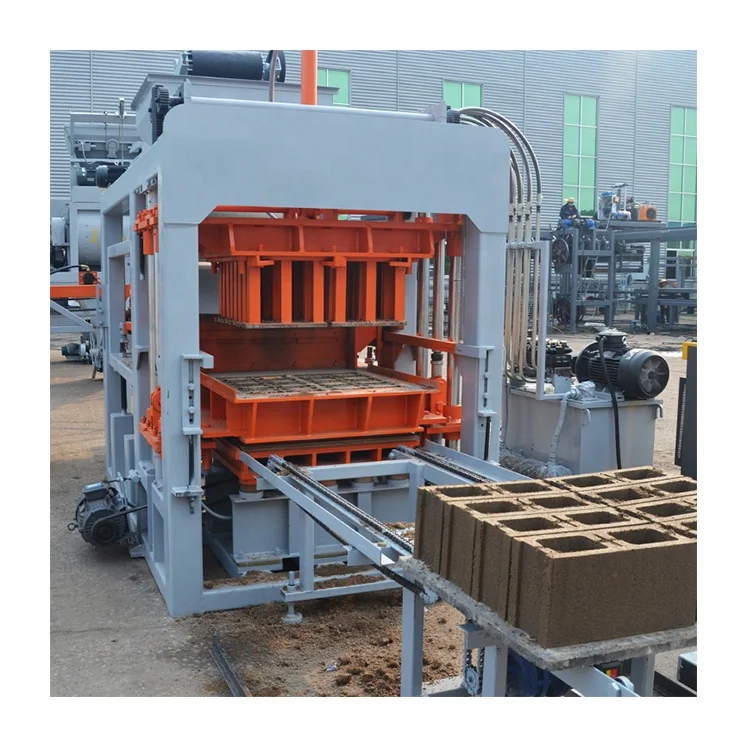
Matched Line Integration — the QT6-15 block making machine is specified alongside its mixer, pallet feeder, brick conveyor and block sweeper so cycle times align across every station from the start.
Technical Specifications
| Parameter | Value |
|---|---|
| Model | QT6-15 |
| Product Type | Hydraulic Concrete Block Making Machine |
| Overall Dimensions (L×W×H) | 7400×1900×2660 mm |
| Molding Cycle | 15–25 s |
| Vibration Frequency | 4600 r/min |
| Exciting Power | 40–50 kN |
| Total Power | 31.25 kW |
| Mixer Model | JQ350 |
| Pallet Size | 850×550×25 mm |
| Total Weight | 7 T |
| Applied Products | Paver, solid brick, hollow block, curbstone |
| Raw Materials | Crushed stones, sand, cement, dust, fly ash |
| Control System | PLC control system |
| Output Capacity (Hollow Block 400×200×200 mm) | 1200–1680 pcs/hr (basis: 15–20 s cycle, 6 pcs/mould assumed) |
| Output Capacity (Solid Brick 240×115×53 mm) | 3240 pcs/hr (basis: 15–20 s cycle, mould cavity count to be confirmed) |
| Included Equipment | Block making machine, hydraulic station, PLC control system, pallet feeder, brick conveyor, block sweeper, manual hydraulic trolley |
Application Suitability
| Application | Material or Output |
|---|---|
| Hollow Block Production | Crushed stone, sand, cement, fly ash (400×200×200 mm, 400×150×200 mm) |
| Solid Brick Manufacturing | Sand, cement, dust, stone powder (240×115×53 mm) |
| Paver and Curbstone Casting | High-density aggregate and cement mixes |
| On-site Construction Supply | Self-contained line for project contractors |
| Building Material Distribution | Multi-format production for regional suppliers |
Why the "Pieces Per Hour" Figure Fails to Reflect Plant Reality
A concrete block making machine production line only achieves its rated cycle if the upstream mixer and downstream pallet handling keep exact pace with the press.
Most quotations state the peak output of the hydraulic press alone. When a buyer installs the machine without matching the mixer discharge rate or the pallet feeder speed, the press spends a large portion of every shift waiting for material or for an empty pallet. This gap between the quoted figure and the real daily output is the most common source of disappointment in block plant projects. [NEED_CITE: common causes of capacity shortfall in block plants] A line is only as fast as its slowest station, and the bottleneck often sits outside the press itself.
Matching the JQ350 Mixer to the Press Cycle
The JQ350 mixer must discharge a full batch in less time than the QT6-15 takes to complete a moulding cycle and return the press head. If the mixer batch size is too small or the mixing time too long, the press sits idle. This concrete block making machine production line configuration pairs the JQ350 with the press so the discharge interval stays within the 15–25 second cycle window.
Closing the Gap Between Press and Curing Area
Once a block leaves the press, it must travel on its pallet to the curing area without manual lifting. The included brick conveyor and block sweeper move the loaded pallets forward while the manual hydraulic trolley handles transfer to curing racks. If these stations are added as an afterthought, the operator ends up stacking output by hand — exactly the hidden cost that cancels out the labour saving the buyer paid for. [NEED_CITE: manual handling costs in block production]
Reading the Core Parameters of the QT6-15
The vibration frequency of 4600 r/min and exciting power of 40–50 kN work together with the hydraulic station to compact the mix into the mould. High vibration alone does not guarantee block strength; the hydraulic pressure must hold the mix under compaction for the full cycle. The pallet size of 850×550×25 mm defines the footprint of every block produced, so it must match the buyer’s existing curing racks and forklift tine spacing. The total power draw of 31.25 kW must be verified against the site transformer and dedicated circuit before shipment. These four parameters — vibration, pressure, pallet dimension, and power — form the basis of every capacity and layout decision.
What Happens When the Line Stations Are Mismatched
If the pallet feeder delivers slower than the press cycle, the press waits and throughput drops. If the brick conveyor runs too fast, wet blocks collide and break before curing. These timing mismatches do not show up in a single-machine quotation; they only appear once the line is running under load. The cost is paid in wasted cement, broken product, and overtime shifts. [NEED_CITE: line synchronization issues in block manufacturing]
Why This Configuration Approach Works
Every station is selected to keep pace with the QT6-15 press, so the mixer, pallet feeder, conveyor and sweeper are documented as one system rather than assembled from separate suppliers. Configuration is set against the buyer’s actual mix design and local aggregate, not a catalogue default. Mould options cover the formats the buyer’s market sells, with custom drawings available for non-standard shapes. The automation level is selectable, allowing a buyer to start with the included manual hydraulic trolley and upgrade to automatic stacking later. Voltage, frequency and PLC display language are confirmed in writing before production begins, preventing commissioning delays.
Documentation & Verification
- Line layout drawing showing mixer, press, feeder and conveyor positions with overall dimensions
- Capacity calculation sheet stating the block format assumed for each output figure
- Pallet specification matched to buyer’s curing rack system and forklift capacity
- Voltage, frequency and PLC display language confirmation sheet before production
- Factory test record covering press, mixer, pallet feeder and conveyor as one integrated line
Installation, Commissioning & Support
- Foundation plan based on the 7400×1900 mm footprint and 7 T operating weight
- Power supply confirmation for 31.25 kW total draw with dedicated circuit sizing
- Assembly sequence for dismantled shipment and on-site reconnection of hydraulic lines
- First-run parameter setting on the PLC for vibration timing and pallet feeder speed
- Operator training covering mould change, mix adjustment and daily greasing points
- Wear parts list for hydraulic seals, vibration springs and pallet guide rollers
What to Prepare Before Requesting a Quotation
Provide the target block formats, the daily output required for each format, and a sample of the local aggregate and sand. Share the available workshop length, width and height, along with the local voltage and frequency. Specify whether an existing mixer or curing system will be integrated, or if the full line from raw material feeding to pallet handling is required.
Frequently Asked Questions
Q: How are cycle times matched across the mixer, press and pallet feeder?
A: The JQ350 mixer batch volume and discharge time are calculated against the QT6-15 moulding cycle of 15–25 seconds. The pallet feeder speed is then set so an empty pallet arrives the moment the press head lifts. This prevents the press from waiting on either station.
Q: What block format is assumed in each capacity figure?
A: The 1200–1680 pcs/hr figure assumes a 400×200×200 mm hollow block with a 15–20 second cycle. The solid brick figure of 3240 pcs/hr assumes a 240×115×53 mm format. Real daily output depends on mix design, operator pace and curing logistics.
Q: Is automatic stacking available, or is output handled manually?
A: The standard line includes a manual hydraulic trolley for transferring loaded pallets to curing racks. Automatic stacking and cubing modules are available as an upgrade for buyers who want to reduce manual handling at the end of the line.
Q: How is pallet size selected for my curing area?
A: The 850×550×25 mm pallet must clear the buyer’s existing curing rack uprights and match the forklift tine spacing. We confirm these dimensions during the proposal stage so the pallets integrate with the curing infrastructure already on site.



