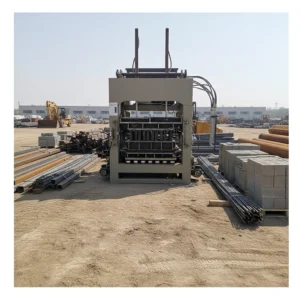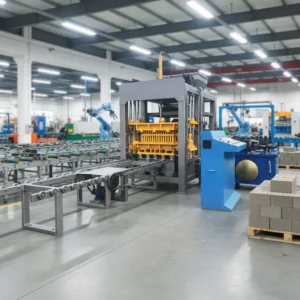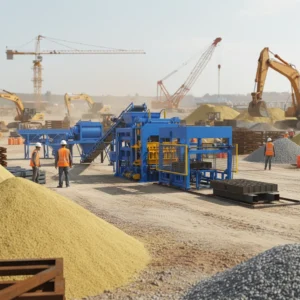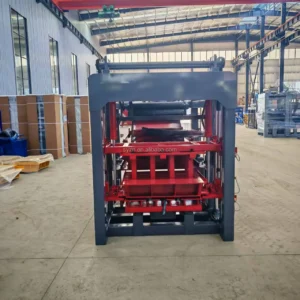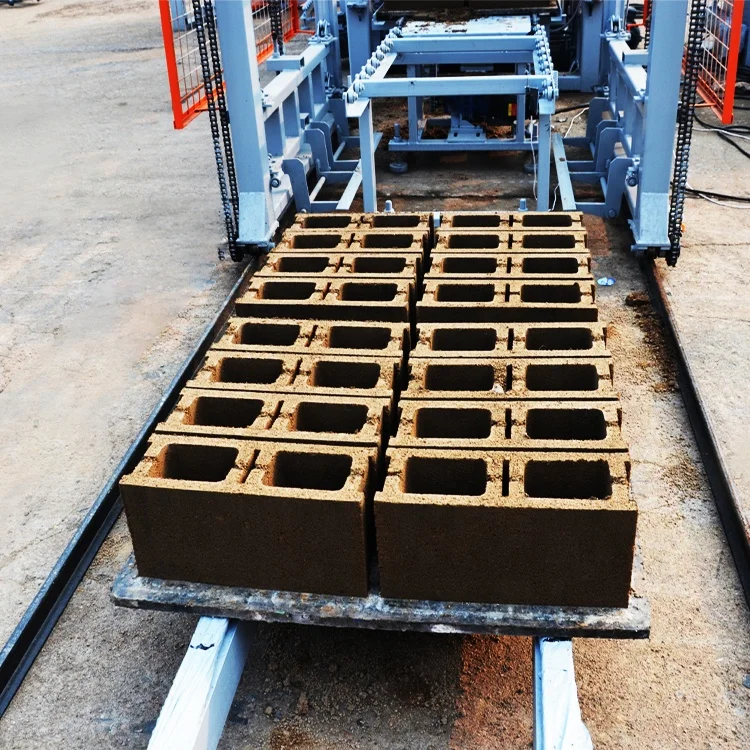
Line-Synchronized Layout — the QT6-15 sits at the centre of a matched block production line where feeding, mixing, pallet handling and stacking are configured to its cycle time so the press never waits for upstream or downstream stations.
Technical Specifications
| Parameter | Value |
|---|---|
| Model | QT6-15 |
| Product Type | Concrete Block Making Machine |
| Overall Dimensions (L×W×H) | 8200×1700×2950 mm |
| Vibration Frequency | 0-60 Hz |
| Vibration Form | Platform Vibration |
| Moulding Mode | Load automatically, vibration moulding |
| Pallet Size | 880×850 mm |
| Molding Cycle | 15-20 s (basis to be confirmed per block format and material) |
| Overall Power | 37 kW |
| Vibration Force | 45 kN |
| Total Mass | 7 T |
| Demolding Method | Hydraulic |
| Factory Area Required | 1200 m² |
| Control System | PLC with touch screen, fault diagnosis system, safe logic interlock circuit |
| Hydraulic System | Independent integrated hydraulic station isolated from dust and main machine vibration |
| Automation Level | High (automatic loading, PLC-controlled process, intelligent electronic control) |
| Raw Material Adaptability | Waste ash, slag, and various aggregates |
| Output — Hollow Block 400×200×200 mm | 6 pcs/mould, 1080-1440 pcs/h, 8640-11520 pcs/8hr |
| Output — Hollow Block 400×150×200 mm | 8 pcs/mould, 1440-1920 pcs/h, 11520-15360 pcs/8hr |
| Output — Solid Brick 240×115×53 mm | 32 pcs/mould, 5760-7680 pcs/h, 46080-61440 pcs/8hr |
| Output — Rectangular Paver 200×100×60 mm | 21 pcs/mould, 2160-2880 pcs/h, 17280-23040 pcs/8hr (20-25 s cycle) |
| Output — Zigzag Paver 225×112.5×60 mm | 15 pcs/mould, 2160-2880 pcs/h, 17280-23040 pcs/8hr (20-25 s cycle) |
Application Suitability
| Application | Material or Output |
|---|---|
| Hollow block production | Crushed stone, sand, cement and waste ash mixes for 400×200×200 mm and 400×150×200 mm formats |
| Solid brick production | Fine aggregate and cement blends for 240×115×53 mm standard bricks |
| Paving brick production | High-density aggregate mixes for 200×100×60 mm rectangular and 225×112.5×60 mm zigzag pavers |
| On-site construction block making | Local aggregate and cement adapted to project-specific compressive strength targets |
| Format expansion for existing plants | Mould changeovers to add hollow, solid and paver formats on a single line |
What a Concrete Block Making Machine Production Line Actually Needs Beyond the Press
Quoted press cycles mean little when the mixer or pallet feeder cannot keep pace with the host machine.
Buyers often receive capacity figures that reflect only the press cycle. I once saw a block plant where the mixer discharge interval was forty seconds longer than the press cycle, which left the host machine idle for a significant part of every shift. The real daily output fell far below the number on the quotation. When configuring a concrete block making machine production line, every supporting station — raw material feeding, mixing, pallet feeding, stacking and curing rack handling — must be timed against the QT6-15 cycle so material and pallets arrive before the press finishes its current mould. [NEED_CITE: synchronization of upstream and downstream stations in block production lines]
Raw Material Feeding and Mixer Placement
Raw material feeding sets the rhythm for the entire line. The QT6-15 requires a consistent supply of mixed material at intervals matching its 15-20 second moulding cycle for standard blocks and 20-25 second cycle for pavers. If the mixer batch size and discharge timing are calculated against the press output rather than the actual cycle per format, the concrete block making machine production line will either flood the hopper or starve the press. Feeder belt length, incline angle and discharge gate timing all need to match the physical distance between the mixer station and the press hopper.
Pallet Circulation and Curing Rack Handling
Pallet handling is the station most often underestimated in a block production line. The QT6-15 uses 880×850 mm pallets, and at peak cycle rates the line consumes and returns a continuous stream of them. The pallet feeder must release a fresh pallet in time for every demould, and the wet-side conveyor must carry loaded pallets to the curing racks without bottlenecking. If the curing area is too far from the press or the forklift cannot turn pallets fast enough, loaded pallets pile up on the conveyor and the press stops. [NEED_CITE: pallet circulation rates versus curing area capacity in block plants]
Reading the Numbers That Matter on the Line
The QT6-15 vibration platform operates at 0-60 Hz with 45 kN force across the 880×850 mm pallet area, which distributes compaction energy over the full mould footprint. This matters when switching between a tall hollow block and a thin paver — the frequency and amplitude must be adjusted per format to avoid over-compacting the face mix or leaving the core under-dense. The independent hydraulic station sits away from the main vibration and dust path, which protects seal life and valve response across long production shifts. The PLC touch screen controls batching, vibration duration and demould sequence, and the fault diagnosis circuit flags station mismatches before they cause a full line stop. Block compressive strength above 15 MPa is achievable when the vibration parameters and hydraulic pressure are matched to the buyer’s specific aggregate grading and cement content.
What Happens When Supporting Stations Are Missed
A quotation that lists only the press and omits pallet handling, stacking and curing equipment leaves the buyer to source those stations separately, often after the machine has already shipped. I have visited plants where blocks were stacked by hand because the automatic stacker was never specified, which slowed the line to a fraction of its rated pace. When pallet size is chosen without checking the buyer’s existing curing racks or forklift tine spacing, pallets either do not fit the racks or require a new forklift purchase. Voltage and PLC language left unconfirmed before production can delay commissioning by weeks once the container arrives on site. [NEED_CITE: common causes of delayed commissioning in exported block machinery]
Why Buyers Source the Full Line from One Configuration Point
Block machinery is our single focus, so the QT6-15 press, moulds, pallets and handling equipment are specified together as a matched system rather than assembled from separate vendors. Line configuration is set against the buyer’s actual mix design, local aggregate and target block format — not a catalogue default — which means capacity calculations reflect the product the plant will actually sell. Automation level is selectable from semi-automatic pallet handling through to fully automatic stacking and cubing, allowing a buyer to start at a lower investment and add stations later. Mould design covers the formats the buyer’s market demands, including custom drawings, so format flexibility is real rather than theoretical. Installation, commissioning and operator training are included so the line runs at designed pace from the first shift.
Documentation & Verification
- Line layout drawing with capacity calculation stated per block format and cycle time
- Machine specification sheet covering QT6-15 dimensions, power and vibration ratings
- Mould drawing and format list for hollow block, solid brick and paver configurations
- Pallet specification confirming 880×850 mm size, material and load rating
- Hydraulic and electrical schematic for on-site maintenance reference
- Voltage, frequency and PLC display language confirmation signed before production
Installation, Commissioning & Support
- Factory area of 1200 m² confirmed against QT6-15 overall dimensions and curing space
- 37 kW total power requirement mapped to dedicated circuit and local voltage
- Machine shipped in dismantled sections for container loading and reassembled on site
- First-run commissioning includes PLC parameter setting for each target block format
- Operator training covers mould change procedure and fault diagnosis system use
- Wear parts and mould list provided with recommended replacement intervals
What We Need to Configure Your Line
To build an accurate line layout around the QT6-15, share your target block formats with daily output targets, the local aggregate types and cement availability in your area, and your existing factory footprint with curing space dimensions. Let us know your site voltage and frequency, preferred PLC display language, and whether you already have pallets, forklifts or curing racks that the line must integrate with.
Frequently Asked Questions
Q: How is daily output calculated across the full concrete block making machine production line?
A: Daily output is calculated by matching the QT6-15 press cycle time for each specific block format to the upstream mixer discharge rate and downstream pallet circulation speed. The capacity figures quoted here assume continuous operation over an eight-hour shift with pallets returning from the curing area without delay. If any supporting station runs slower, the real output follows that station’s pace.
Q: Which supporting stations are included and which are optional?
A: The line can be configured from a basic press-only setup through to a fully automatic line with raw material feeding, mixing, pallet feeding, automatic stacking, curing rack handling and cubing. Each station is listed separately in the quotation so you see exactly what is included. Pallet handling and stacking are the most common additions buyers request after their first production season.
Q: How do I match pallet size and material to my existing curing area and forklift?
A: The QT6-15 uses 880×850 mm pallets. We confirm the pallet material — typically bamboo, PVC or steel — against your curing method and climate, and check that the pallet dimensions align with your curing rack spacing and forklift tine width before production begins.
Q: What factory area and utility connections does the complete QT6-15 line require?
A: The press and immediate supporting stations need a factory area of approximately 1200 m² including curing space. The 37 kW total power draw requires a dedicated circuit at your site voltage and frequency, which we confirm before manufacturing. Water supply for mixing and dust control must also be planned into the layout.
Q: How is the line configured to my local raw material and target block format?
A: We review your local aggregate grading, cement type and available admixtures, then set vibration frequency, hydraulic pressure and moulding cycle against the specific block format you plan to sell. This ensures block compressive strength and surface finish meet your market standard without requiring material substitutions.