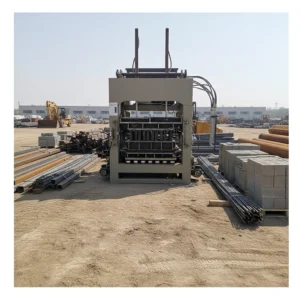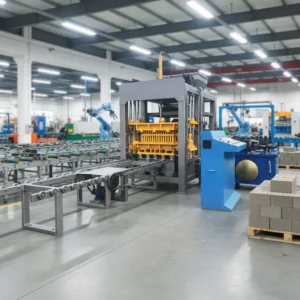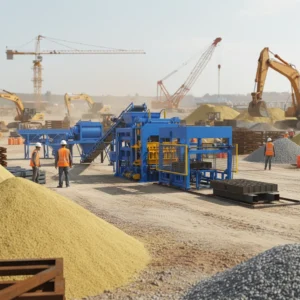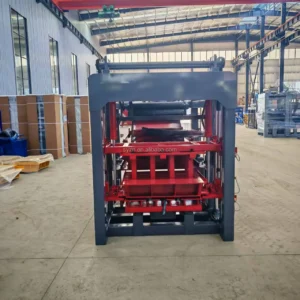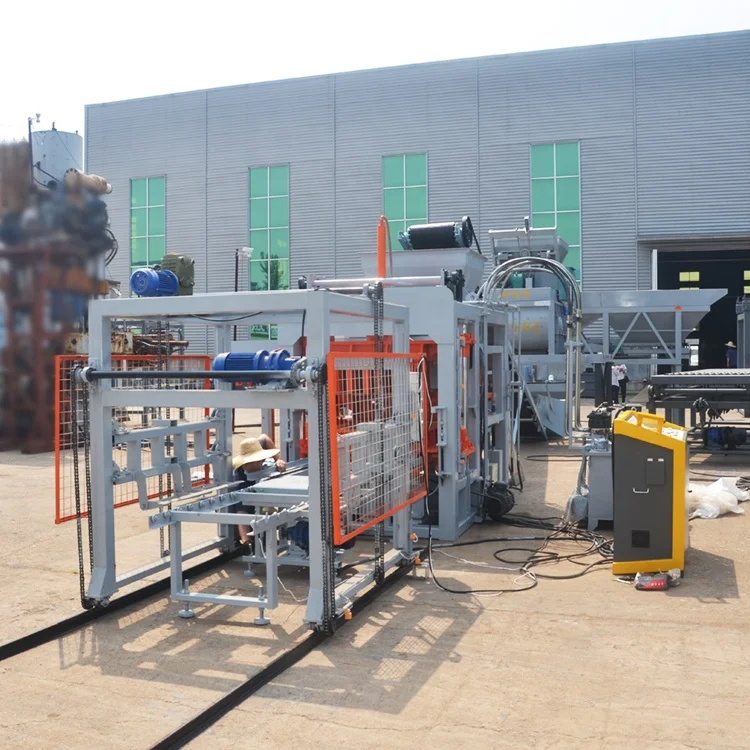
Matched Line Engineering — the QT6-15 block making machine production line is configured so feeding, mixing, pressing, pallet handling, stacking and curing stations share one cycle plan rather than arriving from separate vendors hoping to align on site.
Technical Specifications
| Parameter | Value |
|---|---|
| Model | QT6-15 |
| Product Type | Hydraulic Hollow Block Making Machine |
| Overall Dimensions (L×W×H) | 8200×1700×2950 mm |
| Total Mass | 7 T |
| Pallet Size | 880×850 mm |
| Vibration Form | Platform Vibration |
| Vibration Frequency Range | 0–60 Hz |
| Vibration Force | 45 kN |
| Demolding Method | Hydraulic |
| Hydraulic System | Independent integrated hydraulic station |
| Moulding Mode | Automatic load, vibration moulding |
| Molding Cycle | 15–20 s (hollow/solid); 20–25 s (paving formats) |
| Overall Power | 37 kW |
| Control System | PLC with touch screen interface |
| Automation Level | High degree of automation with intelligent electronic control |
| Output – 400×200×200 mm hollow block | 1080–1440 pcs/hour; 8640–11520 pcs/8 hr |
| Output – 400×150×200 mm hollow block | 1440–1920 pcs/hour; 11520–15360 pcs/8 hr |
| Output – 240×115×53 mm solid brick | 5760–7680 pcs/hour; 46080–61440 pcs/8 hr |
| Output – 200×100×60 mm rectangular brick | 2160–2880 pcs/hour; 17280–23040 pcs/8 hr (20–25 s cycle) |
| Output – 225×112.5×60 mm zigzag brick | 2160–2880 pcs/hour; 17280–23040 pcs/8 hr (20–25 s cycle) |
| Compressive Strength of Blocks | More than 15 MPa |
| Raw Material Adaptability | Waste ash, slag, cement reduction capability |
| Recommended Factory Area | 1200 m² |
| Warranty | 1 year (excluding spare parts) |
| Standards | CE (where applicable) |
Application Suitability
| Application | Material or Output |
|---|---|
| Hollow block production for building walls | Crushed stone, sand, cement, with ash or slag substitution |
| Solid brick manufacturing for load-bearing and infill | Local aggregate blended with cement and mineral fines |
| Rectangular and zigzag paving for yards and walkways | Fine aggregate, cement, pigment where colour layers are used |
| Interlocking brick runs for retaining walls and landscaping | Graded aggregate with cement binder |
| Waste-material block production | Fly ash, slag and other industrial by-products in the mix |
| Turnkey plant setup for contractors and distributors | Full format range from one press with matched handling stations |
What "Per-Hour Output" Hides About the Rest of the Line
A press rating means little when upstream feeding or downstream stacking cannot keep up.
In my Linyi workshop I have seen buyers quote a QT6-15 block making machine production line on press capacity alone, then arrive on site to find the mixer batches too slowly, the pallet return jams, or cured cubes are still being stacked by hand. The press sits idle for seconds each cycle, and the "per-hour" number quietly collapses by a third before lunch [NEED_CITE: line balancing practices in concrete block plants]. Daily output then disappoints, and the buyer blames the press instead of the missing stations.
Matching Every Station to the Same Cycle Plan
The QT6-15 press completes a hollow block cycle in 15–20 seconds, which sets the heartbeat for the whole QT6-15 block making machine production line. Raw material feeding, mixing discharge, pallet indexing, wet-product stacking and green-block transfer to the curing area must each finish inside that window. If any station runs long, the press waits; if any station runs short, it accumulates idle capacity that you paid for but never use. Line configuration therefore starts from the target block format and works outward to each station, not the other way around.
Why Pallet Choice Ripples Through Every Other Station
The 880×850 mm pallet size on this press determines the footprint of the pallet feeder, the width of the return conveyor, the spacing of the curing rack and the fork-pocket layout of the cubing station. Specify a pallet that does not match the curing area you already built, and you re-rack the entire yard; specify a pallet material that warps under local humidity, and the stacking station mis-indexes every few cycles [NEED_CITE: pallet material behaviour under curing humidity]. Pallet selection is therefore a line-level decision, not a press accessory.
Reading the Specs That Actually Govern Output
The 45 kN vibration force, delivered through platform vibration at 0–60 Hz, must be read together with the hydraulic demolding pressure and the buyer’s actual mix design. Strong vibration on a lean cement mix risks edge spalling; weak vibration on a stiff mix leaves honeycomb cores in hollow blocks. The independent integrated hydraulic station sits away from dust and main-frame vibration, which keeps pressure stable across long shifts and avoids the drift that quietly changes block density hour by hour. PLC control with a touch screen then ties press, feeder and stacker into one monitored loop, so a fault at any station appears on the same screen rather than on a separate panel across the workshop. The 37 kW overall power draw must be matched by a dedicated circuit at the local voltage and frequency, confirmed before the line leaves the factory.
The Hidden Cost of Quoting the Press Alone
When a line is scoped as press-only, the first surprise on site is usually pallet handling: wet blocks are moved by hand, shift output drops, and labour cost absorbs the margin the machine was meant to protect. The second surprise is curing: without a rack-handling and cubing plan, green blocks sit on the floor, crack under their own weight, and compressive strength never reaches the 15 MPa the press can deliver [NEED_CITE: green block handling damage in small plants]. By the time the buyer adds the missing stations, the original layout is already compromised and rework begins.
Why the Line Comes from One Source
Block machinery is our single focus, so the QT6-15 block making machine production line is specified as one matched system rather than assembled from separate suppliers hoping their cycles align. Configuration is set against your actual mix design, local aggregate and the block format your market sells, not a catalogue default. Mould design covers the formats you need, including custom drawings, and pallet size is chosen with your curing area and existing forklift in mind. Automation level is selectable, so you can start with semi-automatic pallet handling and upgrade the stacking and cubing stations later without changing the press. Installation and commissioning cover the whole line, with operator training on every station before handover.
Documentation & Verification
- Line layout and capacity calculation stating the block format assumed at each station
- Pallet specification matched to your curing rack spacing and forklift capacity
- Voltage, frequency and PLC language confirmation for every station before shipment
- Factory test record demonstrating coordinated cycle timing across feeding, pressing and stacking
- Hydraulic and electrical schematics for the independent integrated station and PLC loop
- Operation and maintenance manual covering the full line, not the press alone
Installation, Commissioning & Support
- Foundation plan sized to the 8200×1700 mm press footprint and 7 T mass with vibration isolation
- Dedicated 37 kW circuit at confirmed local voltage and frequency feeding press and stacker
- Dismantling plan for container loading with reassembly sequence for the full line on site
- First-run parameter setting on PLC touch screen across press, feeder and stacking stations
- Operator training on mould change, pallet indexing and fault diagnosis at every station
- Wear parts and mould list covering hydraulic seals, vibration springs and format-specific tooling
Planning the Inquiry Around Your Actual Plant
To size the QT6-15 block making machine production line to your site, please share the block formats you sell today, the daily output you need per format, and the local aggregate and cement you can actually source. Include the curing area dimensions, the forklift you already use, and the local voltage, frequency and preferred PLC display language. If you are adding this line to an existing plant, list the upstream mixers and downstream dispatch equipment already in place so the new stations can be timed against them.
Frequently Asked Questions
Q: How do I verify that feeding, mixing, press, stacking and curing stations are timed without bottlenecks?
A: Ask for a line layout that states the assumed block format and shows the cycle time at each station against the 15–25 s press window. A factory test record should demonstrate coordinated timing across feeding, pressing and stacking before dispatch, not just a standalone press run.
Q: What supporting equipment is included in the quotation versus what I must source separately?
A: The scope should explicitly list raw material feeding, mixing, pallet feeding, stacking, curing rack handling and cubing. Anything omitted will force manual handling on site, reducing real daily output far below the press-rated figure.
Q: How does pallet size selection affect the rest of the line from press to curing and dispatch?
A: The 880×850 mm pallet sets the feeder width, return conveyor size, rack spacing and cubing pattern. Choosing a pallet that does not match your existing curing area or forklift forces changes across multiple stations, not just the press.
Q: What automation level fits my labour availability and output target?
A: Automation is selectable from manual pallet handling through to fully automatic stacking and cubing. Start with the stations where labour is hardest to keep, then upgrade remaining stations later without replacing the QT6-15 press itself.
Q: How is the line laid out for my factory area and what utilities does each station need?
A: A 1200 m² factory area is recommended for a complete setup. Each station has its own power, water and compressed-air requirement, confirmed on the line layout together with local voltage and frequency before production begins.