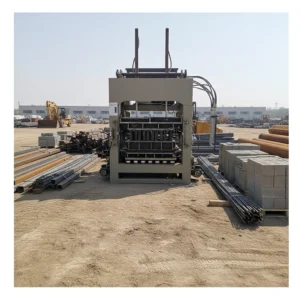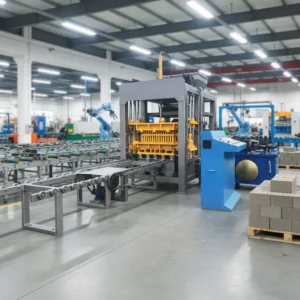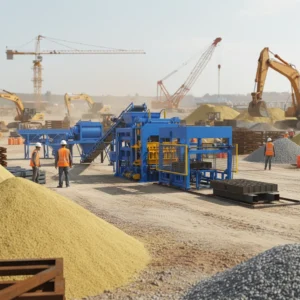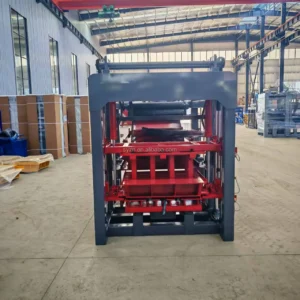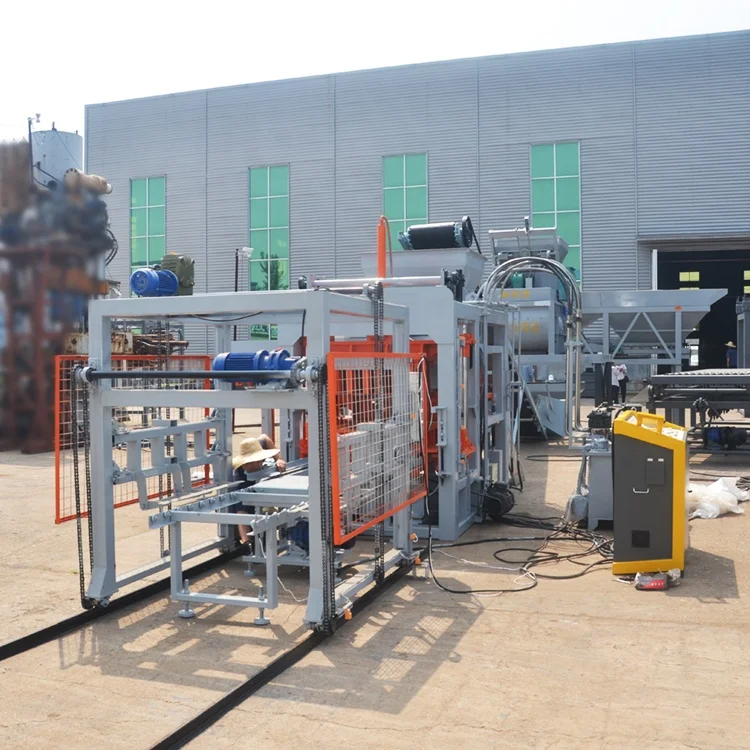
Matched Line Integration — the QT6-15 is specified alongside raw material feeding, mixing, pallet handling, stacking, and curing rack equipment so that each station keeps pace with the press cycle, eliminating bottlenecks that cut real daily throughput.
Technical Specifications
| Parameter | Value |
|---|---|
| Product Type | Automatic Hydraulic Concrete Block Making Machine |
| Model | QT6-15 |
| Overall Dimensions (L×W×H) | 8200×1700×2950 mm |
| Total Mass | 7 T |
| Overall Power | 37 kW |
| Vibration Form | Platform Vibration |
| Vibration Frequency | 0-60 Hz (adjustable) |
| Vibration Force | 45 kN |
| Moulding Mode | Automatic loading, vibration moulding |
| Demolding Method | Hydraulic |
| Pallet Size | 880×850 mm |
| Molding Cycle | 15-20 s (basis not stated in source — confirm block format / material / thickness) |
| Hydraulic System | Independent integrated hydraulic station |
| Control System | PLC with touch screen interface |
| Fault Diagnosis | Built-in fault diagnosis system |
| Block Compressive Strength | >15 MPa |
| Recommended Factory Area | 1200 m² |
| Raw Material Adaptability | Waste ash, slag, and various aggregates |
| Output Capacity (Hollow block 400×200×200 mm) | 1080-1440 pcs/hour, 8640-11520 pcs/8hr |
| Output Capacity (Hollow block 400×150×200 mm) | 1440-1920 pcs/hour, 11520-15360 pcs/8hr |
| Output Capacity (Solid brick 240×115×53 mm) | 5760-7680 pcs/hour, 46080-61440 pcs/8hr |
| Output Capacity (Rectangular paver 200×100×60 mm) | 2160-2880 pcs/hour, 17280-23040 pcs/8hr (cycle 20-25 s) |
| Output Capacity (Zigzag paver 225×112.5×60 mm) | 2160-2880 pcs/hour, 17280-23040 pcs/8hr (cycle 20-25 s) |
Application Suitability
| Application | Material or Output |
|---|---|
| Hollow block production for building walls | Crushed stone, cement, waste ash, slag aggregates |
| Solid brick manufacturing for load-bearing structures | Cement, sand, local fine aggregates |
| Rectangular and zigzag paver production | Cement, granite dust, coarse sand blends |
| On-site block production for housing projects | Locally sourced aggregates with cement binder |
| Format expansion for existing concrete product plants | Multiple mould formats on shared pallet size |
What a Quoted Cycle Time Hides About Your Daily Output
A block press rated at 15-20 seconds per cycle will never reach that tempo if the mixer, pallet feeder, or stacker cannot keep up.
The block production line equipment surrounding the press determines whether you actually achieve the cycles-per-hour figure on the spec sheet. I have stood on plant floors where a machine completed a mould every 18 seconds, but the operator waited another 12 seconds for the next pallet to arrive because the pallet feeder was undersized. The supporting equipment was treated as an afterthought in the quotation, and real daily throughput fell to roughly half of what was promised. When planning block making machine supporting equipment, every station must be matched to the press cycle [NEED_CITE: line balancing principles in concrete block production].
How the Stations Connect Around the Press
Raw material feeding, mixing, pallet feeding, the press itself, stacking, and curing rack handling form a single chain. If any station runs slower than the QT6-15 molding cycle, the press sits idle and throughput drops. The block production line equipment must be specified so that mixer discharge, pallet travel speed, and stacker indexing all align with the 15-20 second cycle range for hollow and solid formats. This is where line-level planning diverges from simply buying a standalone press.
Why Pallet Quantity and Flow Dictate Curing Capacity
The 880×850 mm pallet size on the QT6-15 determines how many blocks cure per rack tier and how many tiers fit in the recommended 1200 m² factory area. If pallets are not returned to the feeder fast enough after curing, the press stops. Pallet quantity must cover the press output for the entire curing duration, not just one shift. This calculation is often missing from quotations that focus only on the press, leaving the buyer to discover the shortfall after commissioning [NEED_CITE: pallet circulation requirements in block curing systems].
Reading the Specs That Matter for Line Balance
The independent integrated hydraulic station is isolated from the main vibration, which protects valve seals and hose fittings during continuous shifts — a critical factor when the press runs 8,640 to 11,520 hollow blocks (400×200×200 mm) per 8-hour day. Vibration force of 45 kN combined with adjustable platform vibration (0-60 Hz) allows the operator to tune compaction for different aggregates, but the mixer upstream must deliver a consistent mix to take advantage of that adjustability. The PLC with built-in fault diagnosis monitors the press cycle, yet it cannot compensate for a mixer that discharges unevenly or a pallet feeder that jams. Total connected power of 37 kW must be verified against the site supply alongside the mixer, conveyor, and stacker loads so that no single circuit is overloaded during simultaneous start-up.
The Hidden Cost of Treating Supporting Equipment as Optional
When block making machine supporting equipment is left out of the initial purchase, the buyer ends up sourcing a mixer, pallet return conveyor, and stacker separately — often from suppliers who do not know the press cycle time. The result is a line where stations run at different speeds, pallets pile up at transfer points, and the operator spends more time clearing jams than monitoring quality. Retrofitting matched equipment later costs more than specifying it together from the start [NEED_CITE: cost of line reconfiguration versus initial integrated specification].
Why Buyers Specify the Full Line Here
Block machinery is the single focus of this supply scope, so the QT6-15 press, moulds, pallets, and handling equipment are configured as one system rather than assembled from unrelated vendors. Line layout and capacity calculations state the block format assumed for each output figure, so you can verify real daily throughput against your product mix. Pallet size and material are confirmed against your existing curing area and forklift capacity before production begins. Voltage, frequency, and PLC display language are locked in during the order stage to prevent commissioning delays. Mould design covers the formats your market actually sells, including custom drawings where standard formats do not match local demand.
Documentation & Verification
- Line layout showing station positions and pallet flow path for the QT6-15
- Capacity calculation table listing output per block format with cycle time assumptions
- Hydraulic and electrical schematics matching the as-built independent station
- Factory test record run on your specified block format and mix design
- Pallet specification sheet confirming size, material, and quantity against curing area
Installation, Commissioning & Support
- Foundation plan sized to the 8200×1700 mm footprint and 7 T mass with vibration isolation
- Dedicated power circuit rated for 37 kW total connected load plus upstream mixer draw
- Pallet feeder and return conveyor aligned to the 880×850 mm pallet during on-site assembly
- PLC touch screen configured to buyer language before first production run
- Operator training covering mould change, vibration frequency adjustment, and fault diagnosis response
- Wear parts list covering hydraulic seals, vibration springs, and mould liners with reorder intervals
What We Need to Size Your Line Correctly
Share the block formats you plan to produce, your target daily output per format, and the raw materials available locally. Let us know your existing curing area dimensions, forklift capacity, and the voltage and frequency at your site so the block production line equipment is configured to match before production begins.
Frequently Asked Questions
Q: How is line-level capacity calculated when the QT6-15 produces multiple block formats with different cycle times?
A: Each format has its own cycle time — hollow and solid blocks run at 15-20 seconds while pavers require 20-25 seconds. Line capacity is calculated per format, and the supporting equipment is sized to the fastest cycle in your product mix so no station becomes a bottleneck when you switch moulds.
Q: Which supporting stations must match the press cycle to prevent bottlenecks?
A: The mixer discharge rate, pallet feeder speed, stacker indexing, and curing rack handler all need to complete their task within the press cycle. If any station takes longer than 15-20 seconds, the press waits and real throughput drops below the quoted figure.
Q: How should pallet size and material be chosen in relation to the curing area and forklift?
A: The QT6-15 uses 880×850 mm pallets. The curing rack spacing, forklift tine width, and stacking height must all accommodate this dimension. Pallet material is selected based on the curing method and expected service life under your production volume.
Q: What voltage, frequency, and PLC language confirmation is required before the line enters production?
A: The site voltage, frequency, and preferred PLC display language must be confirmed during the order stage. Changing these after the electrical panel is built causes commissioning delays and may require component replacement on site.
Q: What is included in the line layout documentation, and how does it differ from a standalone press quotation?
A: The line layout shows every station from raw material intake through curing rack handling, with pallet flow paths and cycle time matching at each point. A standalone press quotation covers only the press itself, leaving the buyer to source and integrate supporting equipment separately.