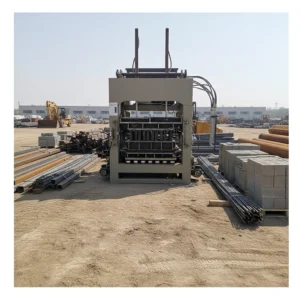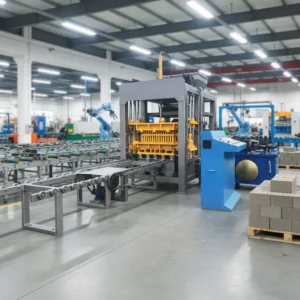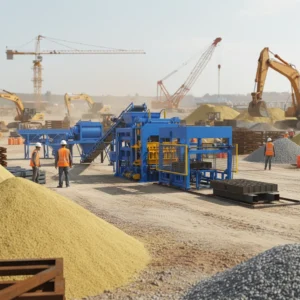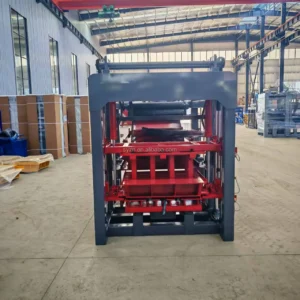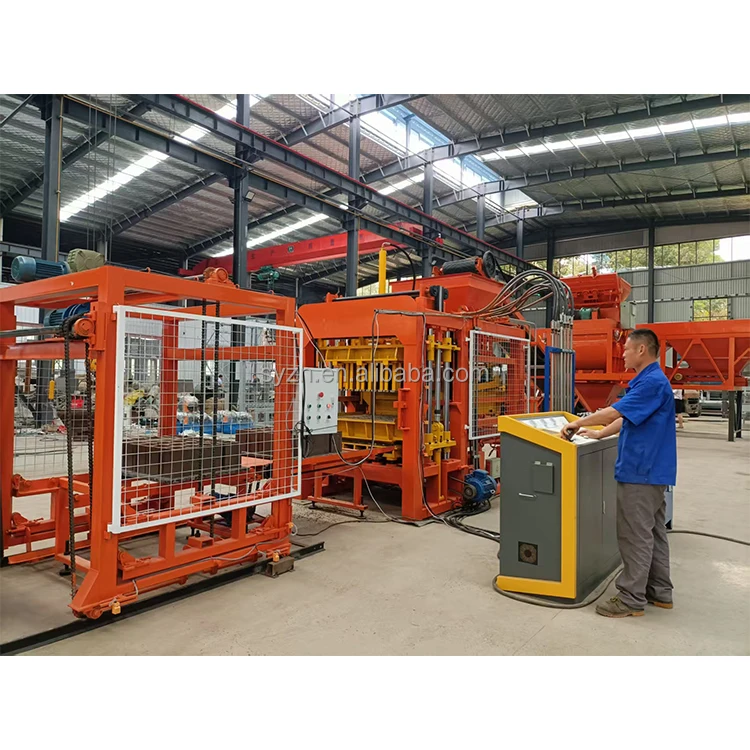
Complete Line Integration — Every station from raw material feeding through stacking is specified as one matched system so the QT6-15 press is never starved or bottlenecked.
Technical Specifications
| Parameter | Value |
|---|---|
| Model | QT6-15 |
| Product Type | Hydraulic Concrete Block Making Machine |
| Overall Dimensions (L×W×H) | 8200×1700×2950 mm |
| Vibration Form | Platform Vibration |
| Vibration Frequency | 0-60 Hz |
| Vibration Force | 45 kN |
| Moulding Mode | Automatic load, vibration moulding |
| Demolding Method | Hydraulic |
| Pallet Size | 880×850 mm |
| Molding Cycle | 15-20 s (basis not stated in source — confirm block format / material / thickness) |
| Output Capacity (Hollow block 400×200×200 mm) | 1080-1440 pcs/h, 8640-11520 pcs/8hr |
| Output Capacity (Hollow block 400×150×200 mm) | 1440-1920 pcs/h, 11520-15360 pcs/8hr |
| Output Capacity (Solid brick 240×115×53 mm) | 5760-7680 pcs/h, 46080-61440 pcs/8hr |
| Output Capacity (Rectangular brick 200×100×60 mm) | 2160-2880 pcs/h, 17280-23040 pcs/8hr (Molding cycle 20-25s) |
| Output Capacity (Zigzag brick 225×112.5×60 mm) | 2160-2880 pcs/h, 17280-23040 pcs/8hr (Molding cycle 20-25s) |
| Block Compressive Strength | >15 MPa |
| Overall Power | 37 kW |
| Total Mass | 7 T |
| Control System | PLC controlled with touch screen HMI |
| Hydraulic System | Independent integrated hydraulic station |
| Recommended Factory Area | 1200 m² |
| Raw Material Adaptability | Waste ash, slag, aggregate, cement |
Application Suitability
| Application | Material or Output |
|---|---|
| Hollow block production | Crushed stone, cement, and waste ash blends for medium-to-high capacity plants |
| Solid brick manufacturing | Fine aggregate and cement mixes for structural and partition walls |
| Rectangular paving brick production | Coarse aggregate with cement for driveways, walkways, and commercial yards |
| Zigzag interlocking paver production | High-strength aggregate and cement for roadways and public spaces |
| Multicellular brick production | Lightweight ash, slag, and cement formulations for insulated wall systems |
What "8640 Blocks per Shift" Actually Means on Your Floor
Capacity numbers only hold when every station around the press keeps pace.
The QT6-15 block machine production line can deliver 8640 to 11520 hollow blocks (400×200×200 mm) across an eight-hour shift, but that figure assumes your mixer feeds on time, your pallet feeder cycles without jamming, and your stacking station clears wet blocks before the next tray exits. I have stood on shop floors in West Africa where a fast press sat idle for twenty minutes every hour because the curing rack crew could not keep up. The bottleneck is rarely the press itself; it is the station you did not budget for. [NEED_CITE: production line synchronization principles for block plants]
Upstream Feeding and Mix Delivery
A hydraulic block making machine turnkey setup starts well before the press. Raw material batching, weighing, and mixing must deliver a consistent charge to the hopper within the QT6-15 molding cycle window. If the mixer batch time exceeds the press cycle, the vibration table waits and your shift output drops proportionally. The feeding conveyor, mixer discharge gate, and press hopper sensor must be wired into the same PLC logic so that a missed signal at any point pauses the entire line safely rather than dumping a half-mixed charge onto the platform.
Downstream Pallet Circulation and Stacking
Once the QT6-15 press demolds a tray, that pallet must travel to the curing area and an empty pallet must return before the next cycle fires. The 880×850 mm pallet size is specified alongside curing rack spacing and forklift tine width so that pallets move smoothly from the wet block conveyor through the rack system and back. When a plant owner chooses pallets without checking their existing forklift capacity or rack dimensions, pallets pile up on the floor and workers handle heavy wet trays by hand — exactly the scenario that erases any capacity advantage the press offered. [NEED_CITE: pallet handling standards in concrete product plants]
Reading the Specs That Matter for Line Balance
The 45 kN vibration force and adjustable 0-60 Hz frequency determine how quickly the concrete settles into the mould cavity, which directly sets the minimum molding cycle. Pair that with the independent integrated hydraulic station: because it sits apart from the main frame, dust and vibration do not degrade valve response, so demolding stays consistent across a long shift. The 37 kW overall power draw tells your electrician what dedicated circuit to run, and the PLC with touch screen HMI means the operator sees every station status in one place rather than walking the line to check limit switches. The recommended 1200 m² factory area covers the press footprint, pallet return path, curing racks, and raw material storage as a single layout.
The Cost of Leaving Stations Off the Quotation
When a buyer prices only the press and assumes local fabrication will handle the rest, the gaps show up at commissioning. A pallet feeder that cycles two seconds slower than the press forces every mold cycle to wait. A curing rack built without matching the 880×850 mm pallet means blocks must be double-handled. A mixer sized for half the press throughput turns a mid-capacity line into a small-workshop operation. These mismatches do not appear in any spec sheet — they appear on your floor as idle time and overtime labor. [NEED_CITE: common block line commissioning delays]
Why Source the Full Line from One Specification Point
Block machinery as a single focus means the QT6-15, its moulds, pallets, and every handling station are engineered as one system rather than assembled from mismatched suppliers. Configuration is set against your actual mix design and local aggregate, not a catalogue default, so vibration force and hydraulic pressure match what you can source on site. Mould design covers the formats your market actually buys, with custom drawings available. Automation level is selectable — start with semi-automatic pallet handling and add automatic stacking later without replacing the press. Installation support includes line layout, commissioning, and operator training so every station runs at the intended rhythm from day one. [NEED_CITE: block machinery supplier evaluation criteria]
Documentation & Verification
- Line layout and capacity calculation stating the block format assumed for each output tier
- Machine specification sheet covering all 37 kW power circuits and PLC I/O points
- Mould drawing and format list for every block type included in your order
- Pallet specification matched to your curing rack dimensions and forklift capacity
- Hydraulic and electrical schematic for integration with existing plant infrastructure
- Factory test record on your target block format before dispatch
Installation, Commissioning & Support
- Foundation drawing provided for the 8200×1700 mm footprint and 7 T operating mass
- Dedicated 37 kW power circuit with voltage and frequency confirmed before production
- Machine ships dismantled for container loading with reassembly sequence documented
- PLC display language set to your operator preference before commissioning begins
- On-site operator training covers mould change, pallet circulation, and fault diagnosis
- Wear parts and mould list provided with recommended replacement intervals
What to Include in Your Inquiry
Tell us which block formats your market demands, your target daily output per format, and the raw materials you can source locally. Share your available factory floor dimensions, existing forklift capacity, and local voltage and frequency so the QT6-15 block machine production line is configured for your exact conditions from the first drawing.
Frequently Asked Questions
Q: How is line capacity calculated and which block format does each output figure assume?
A: Every output figure states the exact block format. For example, 8640-11520 pieces per eight-hour shift applies to 400×200×200 mm hollow blocks at the stated molding cycle. Switching to a smaller solid brick format changes the per-mould count and cycle time, so a separate capacity line is provided for each product you plan to run.
Q: How do upstream stations synchronize cycle times with the QT6-15 press?
A: The PLC logic links the mixer discharge, feeding conveyor, and pallet feeder to the press cycle. If any upstream station is not ready, the press pauses safely rather than running a short charge. This prevents wasted material and inconsistent block density across the shift.
Q: What pallet size and material are recommended for my curing area and forklift?
A: The 880×850 mm pallet is selected alongside your curing rack spacing and forklift tine width. Material choice — wood, bamboo, or composite — depends on your local climate and expected pallet lifespan. All three are factored into the line quotation so there are no surprises at delivery.
Q: What is included beyond the press itself in the line quotation?
A: The quotation covers raw material feeding, mixing, pallet feeding, the QT6-15 press, wet block conveyor, and stacking configuration. Curing rack handling and cubing equipment are included based on your chosen automation level. Each station is listed with its own cycle time to confirm line balance.