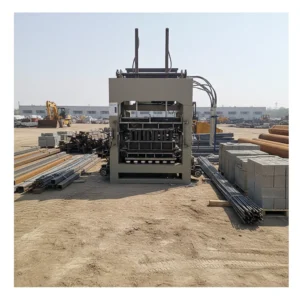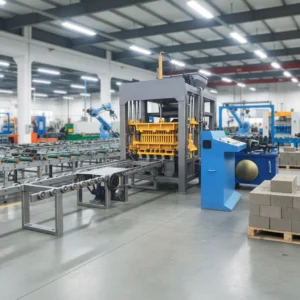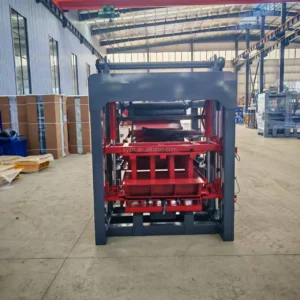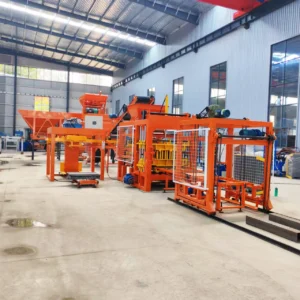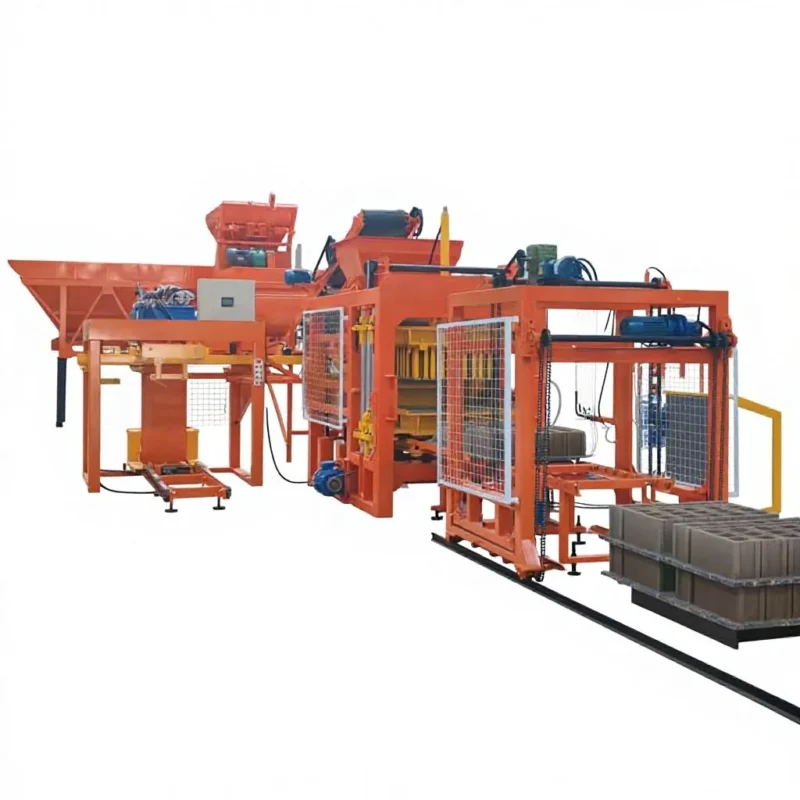
Matched System Integration — the QT6-15 block machine production line is specified as a complete loop where press cycle, mixer output, pallet return, and stacking pace are verified against each other before the quotation is issued.
Technical Specifications
| Parameter | Value |
|---|---|
| Product Type | Automatic Hydraulic Concrete Block Making Machine |
| Model | QT6-15 |
| Overall Dimensions (L×W×H) | 8200×1700×2950 mm |
| Total Mass | 7 T |
| Overall Power | 37 kW |
| Vibration Force | 45 kN |
| Vibration Frequency | 0–60 Hz |
| Vibration Form | Platform Vibration |
| Moulding Mode | Automatic loading, vibration moulding |
| Demolding Method | Hydraulic |
| Pallet Size | 880×850 mm |
| Molding Cycle | 15–20 s for hollow/solid formats; 20–25 s for pavers (basis not stated in source — confirm block format / material / thickness) |
| Control System | PLC with touch screen HMI and fault diagnosis |
| Hydraulic System | Independent integrated hydraulic station |
| Factory Area Required | 1200 m² |
| Output Capacity (Hollow Block 400×200×200 mm) | 8640–11520 pcs/8 hr (6 pcs/mould, 15–20 s cycle) |
| Output Capacity (Hollow Block 400×150×200 mm) | 11520–15360 pcs/8 hr (8 pcs/mould, 15–20 s cycle) |
| Output Capacity (Solid Brick 240×115×53 mm) | 46080–61440 pcs/8 hr (32 pcs/mould, 15–20 s cycle) |
| Output Capacity (Rectangular Paver 200×100×60 mm) | 17280–23040 pcs/8 hr (21 pcs/mould, 20–25 s cycle) |
| Output Capacity (Zigzag Paver 225×112.5×60 mm) | 17280–23040 pcs/8 hr (15 pcs/mould, 20–25 s cycle) |
| Block Compressive Strength | >15 MPa (source value — verify against manufacturer catalog) |
| Automation Level | High (PLC controlled, automatic process, fault diagnosis) |
| Raw Material Adaptability | Waste ash, slag, and various aggregates; reduced cement dosage capability |
| Voltage & Frequency | Configurable to buyer’s local supply (to be confirmed) |
| Warranty | 1 year for whole machine (excluding spare parts) |
| Key Features | Independent hydraulic station, PLC touch screen control, automatic fault diagnosis, platform vibration system |
Application Suitability
| Application | Material or Output |
|---|---|
| Hollow block production for building walls | Crushed stone, sand, cement, and fly ash mixes; 400×200×200 mm and 400×150×200 mm formats |
| Solid brick production for masonry | Fine aggregate and cement blends; 240×115×53 mm standard brick format |
| Paving block production | Dense aggregate mixes with higher cement content; rectangular 200×100×60 mm and zigzag 225×112.5×60 mm formats |
| Industrial waste utilization | Waste ash, slag, and recycled aggregates blended with reduced cement dosage |
| Medium-to-high capacity block plants | Complete line setups requiring approximately 1200 m² factory area with supporting equipment stations |
When the Press Outruns the Rest of the Line
A block press can only produce as fast as the slowest station feeding or clearing it.
I once watched a QT6-15 block machine production line stall every third cycle because the pallet feeder could not return a clean pallet in time. The press sat idle, the mixer kept running, and wet concrete hardened inside the hopper. The buyer had selected each station from a different supplier, and nobody had checked whether the pallet return speed matched the 15–20 second molding cycle. The rated output figures assume every upstream and downstream station keeps pace — when one station lags, real daily throughput drops well below the quoted number [NEED_CITE: line balance principles in concrete block manufacturing].
Matching Every Station to the Press Cycle
The QT6-15 block machine production line operates on a platform vibration system with a molding cycle between 15 and 20 seconds for hollow and solid formats, extending to 20–25 seconds for denser paver mixes. Every supporting station — raw material feeding, mixing, pallet circulation, stacking, and curing rack handling — must deliver its output within that window. If the mixer takes 30 seconds to discharge a batch that the press consumes in two cycles, the press will idle and the line throughput collapses. The PLC control with touch screen HMI coordinates timing signals across stations so the sequence is governed from a single point rather than relying on individual operators to keep rhythm.
Pallet Circulation as the Hidden Bottleneck
Pallet handling is where most line imbalances surface. The QT6-15 uses 880×850 mm pallets, and at a 15-second cycle, a new pallet must be positioned, loaded, vibrated, stripped, and returned before the next press stroke begins. If the curing rack handler takes longer to unload a cured pallet than the press needs to fill a fresh one, wet blocks accumulate on the discharge conveyor. The independent integrated hydraulic station, isolated from main machine vibration and dust, ensures consistent hydraulic response across demolding and pallet transfer so that mechanical delays do not compound at the pallet return point [NEED_CITE: hydraulic system isolation in vibration press design].
Reading the Specs Beyond the Headline Numbers
The vibration force of 45 kN and variable vibration frequency from 0–60 Hz work together with the hydraulic demolding system to determine block density and surface finish. Higher vibration frequency compacts finer aggregates more effectively, which matters when producing pavers that require a smooth face and high compressive strength. The 37 kW overall power rating covers the press motor, hydraulic pump, and vibration system simultaneously — undersizing the electrical supply to save on transformer costs will cause voltage sag during peak vibration, producing inconsistent compaction across the pallet. The pallet size of 880×850 mm must also align with the buyer’s existing curing area rack spacing and forklift fork width; a mismatch here means blocks cannot be moved from the line to the curing zone without manual re-handling.
The Cost of Ignoring Station Synchronization
Buyers who purchase the press alone and source supporting equipment separately often discover the hidden costs after installation. A stacker that cycles slower than the press forces an operator to manually pull blocks off the line, negating the automation the buyer paid for. A mixer undersized for the press throughput means the line runs at partial capacity every shift. Voltage and frequency left unconfirmed before production can delay commissioning by weeks if the local supply does not match the motor winding. These problems do not show up in any single station’s specification sheet — they only appear when the stations are connected [NEED_CITE: integration failures in multi-supplier block plant setups].
Why Sourcing the Complete Line Matters Here
Block machinery is the single focus of this manufacturing operation, so the QT6-15 and its supporting stations are specified as one matched system rather than assembled from separate catalogs. Configuration is set against the buyer’s actual mix design, local aggregate, and target block format, not a default list. Mould design covers the formats the buyer’s market actually sells, including custom drawings when standard formats do not match local demand. The automation level is selectable — a buyer can start with semi-automatic pallet handling and upgrade the stacking and cubing stations later without replacing the press. Installation support includes operator training on the PLC fault diagnosis system so the crew can identify which station is causing a line stoppage before calling for service.
Documentation & Verification
- Line layout drawing showing every station positioned around the QT6-15 with cycle times matched at each point
- Capacity calculation document stating the exact block format assumed for each output figure
- Pallet specification sheet confirming 880×850 mm size, material, and quantity cross-referenced against curing area
- Voltage, frequency, and PLC display language confirmation record before production begins
- Factory test record on the buyer’s target block format before dispatch
- Hydraulic and electrical schematic for the independent integrated station
Installation, Commissioning & Support
- Foundation plan for 8200×1700 mm machine footprint and 7 T operating mass with vibration isolation
- Electrical supply verification for 37 kW total load at buyer’s confirmed voltage and frequency
- Independent hydraulic station commissioning with pressure calibration to buyer’s mix density target
- PLC touch screen language set to operator preference during on-site programming
- Pallet return and stacking station timing adjusted to match 15–20 second press cycle
- Mould change procedure training covering hydraulic clamp release and alignment for new block formats
Before You Request a Quote
To size the QT6-15 block machine production line correctly, share your target block formats with dimensions, the daily output you need per format, and your local aggregate and cement supply details. Confirm your available factory area, existing curing rack dimensions, and forklift specifications so the pallet and handling stations can be matched. Provide your local voltage, frequency, and preferred PLC display language so the control system is configured before shipment.
Frequently Asked Questions
Q: How is the daily output calculated, and which block format is each figure based on?
A: Each output figure in the specification table is tied to a specific block format, mould cavity count, and molding cycle range. For example, the hollow block capacity assumes a 400×200×200 mm format with 6 cavities per mould at a 15–20 second cycle. If your target format differs, the cycle time and cavity count change, and the daily output must be recalculated for your actual product mix.
Q: Which supporting equipment stations are included in the line quotation, and which are optional?
A: The line quotation specifies raw material feeding, mixing, pallet feeding, stacking, and curing rack handling as stations that must match the press cycle. Each station can be included or excluded based on your existing equipment. The quotation clearly lists which stations are part of the package and which remain your responsibility, so there are no surprises at installation.
Q: How do I match pallet size and material to my existing curing area and forklift?
A: The QT6-15 uses 880×850 mm pallets. Before the line is finalized, share your curing rack shelf dimensions and forklift fork width so we can confirm the pallet will fit both. Pallet material — typically bamboo, PVC, or steel — is selected based on your curing environment humidity and expected pallet lifespan under daily cycling.
Q: What happens if one station cycles slower than the press?
A: The PLC control system monitors timing across connected stations and can flag which station is causing a delay through the fault diagnosis display. During line design, each station’s cycle is calculated against the press cycle to prevent bottlenecks. If your budget requires staging the investment, we can configure the line so slower manual stations are replaced with automatic ones later.
Q: Can the automation level be configured so I start semi-automatic and upgrade later?
A: Yes. The QT6-15 press and its PLC control system are designed to accept additional automation modules over time. You can begin with manual pallet handling and add automatic stacking and cubing stations later without replacing the press or rewriting the control program, keeping your initial investment lower while preserving the upgrade path.