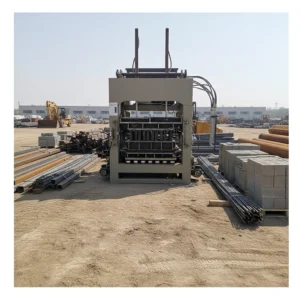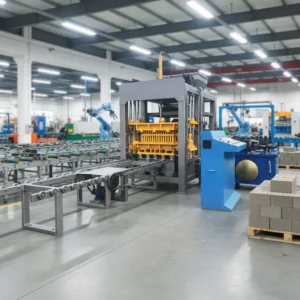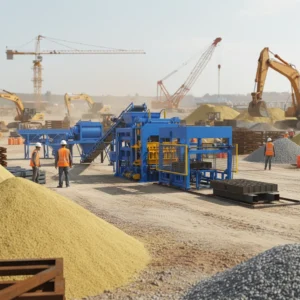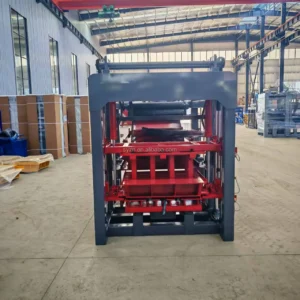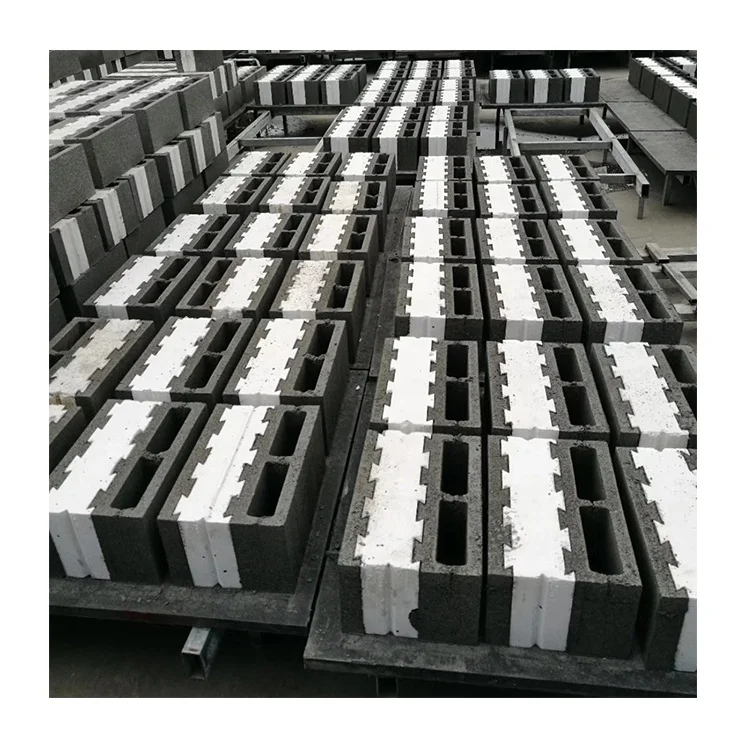
Matched Line Configuration — the QT6-15 is quoted as a complete production cell with mixer, pallet feeder, and conveyor stations timed to the press cycle, not as a standalone machine surrounded by assumptions.
Technical Specifications
| Parameter | Value |
|---|---|
| Model | QT6-15 |
| Product Type | Automatic Concrete Hollow Block Making Machine |
| Overall Dimensions (L×W×H) | 7400×1900×2660 mm |
| Total Weight | 7 T |
| Molding Cycle | 15–25 s |
| Vibration Frequency | 4600 r/min |
| Exciting Force | 40–50 kN |
| Rated Power | 31.25 kW |
| Mixer Model | JQ350 |
| Pallet Size | 850×550×25 mm |
| Control System | PLC control system |
| Hydraulic Station | High-pressure hydraulic system, included |
| Output (400×200×200 mm hollow block) | 9,600–13,440 pcs / 8 hr shift (basis to be confirmed) |
| Output (400×150×200 mm hollow block) | 14,400–19,200 pcs / 8 hr shift (basis to be confirmed) |
| Output (240×115×53 mm solid brick) | 16,200–19,440 pcs / 8 hr shift (basis to be confirmed) |
| Applied Products | Hollow block, solid brick, paver, curbstone |
| Standards | CE |
Application Suitability
| Application | Material or Output |
|---|---|
| Hollow block production for wall construction | Crushed stone, sand, cement, fly ash blends |
| Solid brick manufacturing | Dense aggregate mixes with cement binder |
| Paver and curbstone forming | High-strength concrete with fine aggregate grading |
| On-site block production for housing projects | Locally sourced aggregate with portable mixing |
| Small-to-medium concrete product plants | Multi-format output on a single pallet size |
What the "Automatic Line" Label Often Leaves Out
A press quoted without its upstream and downstream stations is not an automatic concrete block machine production line — it is a machine waiting for someone to feed it and clear its output.
Over the years planning block lines in Shandong, I have watched plant owners sign for a host machine and then discover that pallet feeding, wet block conveying, and sweeping are listed as optional extras. The result is a semi-manual operation carrying a fully automatic price tag. The JQ350 mixer output, the 15–25 s molding cycle, and the pallet feeder travel speed must be calculated against each other before a quotation is issued, not reconciled on the factory floor [NEED_CITE: block plant line balance and cycle synchronization]. When one station runs faster than the next, the press sits idle and the shift output falls well below the catalogue figure.
Stations That Must Keep Time with the Press
Every station in an automatic concrete block machine production line has a cycle that either matches the press or bottlenecks it. The QT6-15 press completes a molding cycle in 15–25 seconds. The JQ350 mixer must deliver a fresh batch to the hopper within that window; if mixing takes longer, the press waits. The pallet feeder must index a new pallet into position before the press head descends. The brick conveyor must clear the loaded pallet before the next one arrives. PLC coordination across these stations is what keeps the line moving without operator intervention.
Where the Line Ends and Manual Labour Begins
A quotation that stops at the brick conveyor leaves the buyer to handle stacking, curing rack loading, and pallet return by hand. These are the most labour-intensive steps on the floor. The QT6-15 line scope includes the pallet feeder and block sweeper so that wet blocks leave the press cleanly and move downstream without manual lifting. Whether stacking and curing rack handling are added as further stations or left to the buyer’s existing equipment is a decision that should be made before the order is placed, not after the container arrives [NEED_CITE: manual handling costs in block plant operations].
Reading the Specs That Actually Matter
The vibration frequency of 4600 r/min and the exciting force of 40–50 kN work together with the high-pressure hydraulic station to compact the mix into a dense block. If vibration is high but hydraulic pressure is low, the block surface may finish well but lack internal strength. The 850×550×25 mm pallet size determines how many blocks fit on each board and how many boards fit in the curing area — a mismatch here means buying new curing racks or re-slicing pallets. The 31.25 kW rated power covers the press, hydraulic pump, and vibration motor; the mixer draws separately and must be on a circuit that can handle simultaneous start-up without voltage sag [NEED_CITE: electrical load planning for concrete block plants].
The Cost of Ignoring Line Balance
When a buyer orders a press on cycle-time claims alone, the first sign of trouble is the mixer falling behind during a run of larger hollow blocks. Operators start rushing pallets by hand to compensate, introducing inconsistent feeding that produces uneven block weight. Over a shift, the output gap between expectation and reality widens, and the buyer attributes it to machine quality rather than line design. Pallets pile up at the conveyor end because no stacking station was quoted, and the curing area becomes a bottleneck that no amount of press speed can overcome [NEED_CITE: production loss from unbalanced block line stations].
Why Source the Line from One Supplier
Specifying the press, mixer, pallet feeder, and conveyor from one source means every station is tested together before dispatch. The QT6-15 configuration is set against the buyer’s actual mix design and local aggregate, not pulled from a catalogue default. Mould design covers the formats the buyer’s market sells, with custom drawings available. The automation level can start semi-automatic and be upgraded station by station. Installation and commissioning cover the entire line, so operator training addresses the sequence of stations rather than a single machine.
Documentation & Verification
- Line layout drawing showing station sequence and footprint for the QT6-15
- Capacity calculation stating the block format assumed for each output figure
- Voltage, frequency, and PLC display language confirmation sheet before production
- Pallet specification matched to curing rack dimensions and forklift capacity
- Factory test record covering the full press-to-conveyor cycle
- Hydraulic and electrical schematic for the complete line
Installation, Commissioning & Support
- Foundation plan sized to the 7400×1900 mm footprint and 7 T operating weight
- Dedicated circuit planned for the 31.25 kW press load plus separate mixer draw
- Machine dismantling and container loading sequence documented before shipment
- Commissioning covers PLC tuning across press, pallet feeder, and conveyor timing
- Operator training includes mould change procedure and daily maintenance checkpoints
- Wear parts and hydraulic seal list provided with recommended replacement intervals
What to Share with Your Inquiry
To size the line correctly, provide the block formats you sell and the daily output you need for each. Confirm your local voltage and frequency, the aggregate types available near your site, and the dimensions of your existing curing area and forklift capacity. If you already operate upstream or downstream equipment, list those stations so the line scope can be drawn around them.
Frequently Asked Questions
Q: Which stations are included in the QT6-15 line quotation and which are optional?
A: The standard scope covers the press, hydraulic station, PLC control, JQ350 mixer, pallet feeder, brick conveyor, and block sweeper. Stacking and curing rack handling are configurable additions. Every station is listed in the quotation so you can see exactly what is included before comparing offers.
Q: How does the JQ350 mixer output match the press cycle to prevent idle time?
A: The JQ350 batch volume and mixing time are calculated against the 15–25 second molding cycle. The target is for a fresh batch to reach the press hopper before the current cycle completes, keeping the press running without pauses during continuous production.
Q: What pallet size does the line use, and can it fit my existing curing racks?
A: The QT6-15 uses 850×550×25 mm pallets. If your curing racks or forklift are built for a different pallet dimension, the specification can be reviewed before production to align pallet size with your handling equipment and curing area layout.
Q: How are voltage, frequency, and PLC language confirmed before the machine ships?
A: A written confirmation sheet listing your site voltage, frequency, and preferred PLC display language is signed off before production begins. This prevents commissioning delays caused by electrical mismatch or unreadable control screens after arrival.
Q: How does mould change affect line uptime when switching block formats?
A: The mould change procedure is covered during operator training. The PLC stores cycle parameters for each mould, so once the physical change is complete the press resumes the correct vibration and pressure settings without manual recalibration.