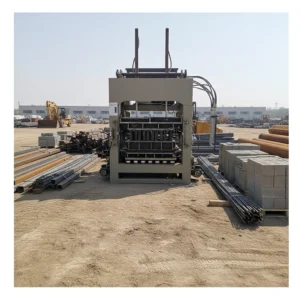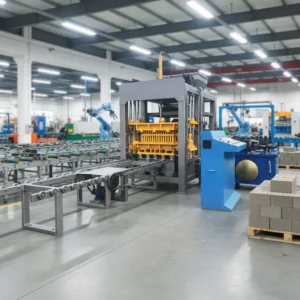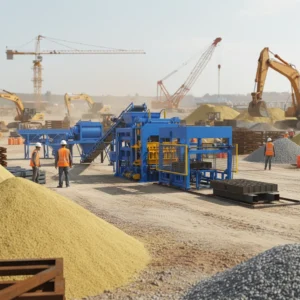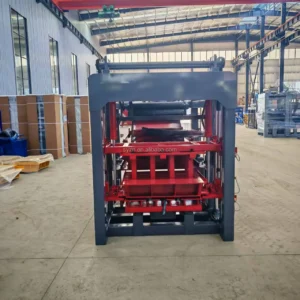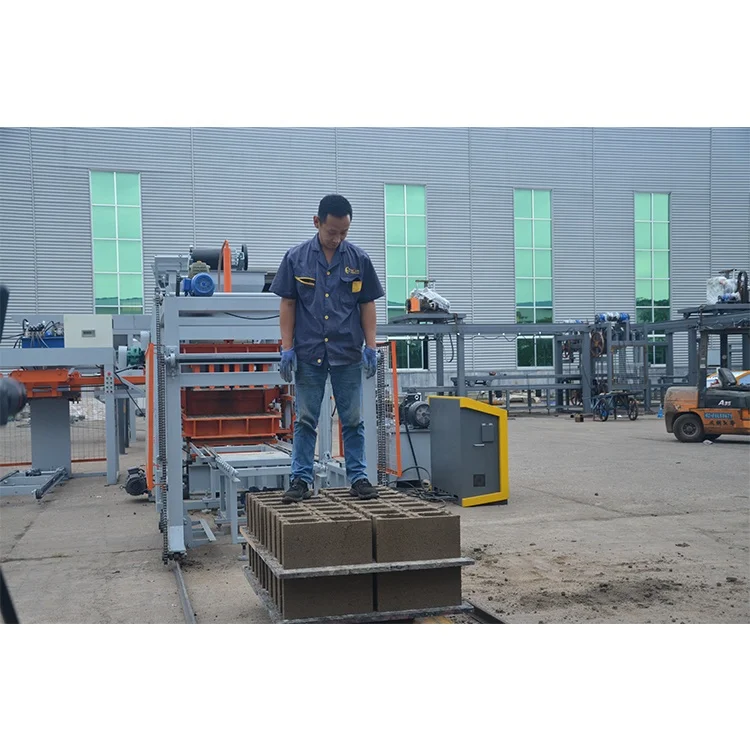
Complete Block Line Engineering — every station from raw material feeding to cured block output is specified against the QT6-15 cycle time so the press is never left waiting upstream or downstream.
Technical Specifications
| Parameter | Value |
|---|---|
| Product Type | Automatic Hydraulic Concrete Block Making Machine |
| Model | QT6-15 |
| Overall Dimensions (L×W×H) | 8200×1700×2950 mm |
| Vibration Form | Platform Vibration |
| Vibration Force | 45 kN |
| Vibration Frequency | 0-60 Hz |
| Hydraulic System | Independent integrated hydraulic station |
| Demolding Method | Hydraulic |
| Pallet Size | 880×850 mm |
| Molding Cycle | 15-20 s (basis to be confirmed against block format and mix) |
| Overall Power | 37 kW |
| Total Mass | 7 T |
| Control System | PLC with touch screen interface |
| Factory Area Required | 1200 m² |
| Moulding Mode | Automatic loading, vibration moulding |
| Key Features | PLC fault diagnosis, action interlock logic, automatic loading |
Application Suitability
| Application | Material or Output |
|---|---|
| Hollow block production plants | 400×200×200 mm hollow blocks from crushed stone and cement, 1,080-1,440 pcs/h (based on 6 pcs/mould, 15-20 s cycle) |
| Solid brick manufacturing | 240×115×53 mm solid bricks from cement-based mixes, 5,760-7,680 pcs/h (based on 32 pcs/mould, 15-20 s cycle) |
| Paving block facilities | 200×100×60 mm rectangular pavers, 2,160-2,880 pcs/h (based on 21 pcs/mould, 20-25 s cycle) |
| On-site construction production | Waste ash and slag-based blocks for contractors producing at project locations |
| Interlocking and porous brick lines | Custom format pavers from locally sourced aggregate blends |
What Quoted Cycle Times Never Tell You
A block production line runs only as fast as its slowest station, and that is rarely the press.
I spent years watching buyers celebrate a 15-second molding cycle on paper, then arrive at the factory to find raw material feeders that cannot keep up, pallet return conveyors moving at half the required speed, and stacking stations backed up by hand. The QT6-15 press itself may complete its cycle on time, but if the upstream mixer delivers material in irregular batches or the downstream stacker cannot receive boards fast enough, the actual output drops significantly [NEED_CITE: block production line throughput matching principles]. This is why a turnkey block making machine quotation must name every station, not just the host press.
Where Every Station Connects
A complete block production line built around the QT6-15 begins with raw material feeding and moves through mixing, pallet feeding, pressing, wet block stacking, and curing rack handling. Each station must be matched to the 15-20 second molding window. The independent hydraulic station sits apart from the main vibration zone, which matters for the longevity of seals and hoses when the platform delivers 45 kN of vibration force continuously throughout a shift.
Matching Throughput Across the Full Layout
The PLC touch screen controls the press sequence, but it cannot compensate for a mixer that batches too slowly or a pallet feeder that jams on warped boards. When sizing a block production line, I start from the target block format and work backward: if you need a certain number of pallets per hour through the press, the mixer must deliver that same volume, the pallet return loop must clear and recycle boards at matching speed, and the stacker must accept loaded pallets without queuing [NEED_CITE: concrete block plant layout and station synchronization]. Any bottleneck in this chain becomes the real capacity of the entire line.
Reading the Specs That Actually Matter
The 45 kN vibration force combined with independent hydraulic pressure determines how densely the concrete is compacted in the mould, directly affecting block compressive strength. Platform vibration distributes energy across the full pallet area rather than concentrating it at one point, which matters for larger formats like the 880×850 mm pallet. The 0-60 Hz adjustable frequency allows tuning for different mix consistences — a dry, zero-slump mix for hollow blocks requires different vibration characteristics than a slightly wetter paver mix. The PLC interlock logic prevents the press from cycling if a pallet is not seated correctly or if the mould head is not fully lowered, reducing both scrap and mechanical stress on the frame. The 37 kW total power draw must be verified against the buyer’s site transformer capacity and the local voltage standard before production begins.
When Supporting Equipment Gets Cut from the Quote
The most expensive mistake I see is a buyer accepting a quotation for the press alone, assuming the rest of the line already exists or can be sourced locally later. When the pallet handling, stacking and curing equipment are not included in the block production line configuration, the buyer faces unplanned costs and commissioning delays that push the project back by weeks [NEED_CITE: common block plant commissioning delays from incomplete line scope]. The QT6-15 may be installed and running, but without matched supporting stations, operators end up moving pallets by hand — and no automatic press can maintain its cycle time when humans are the bottleneck.
Why This Line Configuration Works
Block machinery is the single focus here, meaning the QT6-15 press, mould, pallet and every handling station are specified as one matched system rather than assembled from separate suppliers who point blame when cycle times do not align. The configuration is set against the buyer’s actual mix design and local aggregate, not a catalogue default that works in Shandong but fails in Lagos or Lima. Mould design covers the formats the buyer’s market actually sells, with custom drawings when standard options do not fit. The automation level is selectable, so a buyer can begin with semi-automatic pallet handling and add automatic stacking later as production volume justifies the investment. Installation and commissioning include operator training on the full line, not just the press controls.
Documentation & Verification
- Line layout with capacity calculation stating the block format assumed at each station
- Machine specification sheet with pallet size 880×850 mm and power requirements
- Mould drawing and format list for every block type in the quotation
- Hydraulic and electrical schematic for the independent station and PLC wiring
- Voltage, frequency and PLC display language confirmed in writing before production
- Factory test record demonstrating cycle time on the buyer’s specified block format
Installation, Commissioning & Support
- The 1200 m² factory area must be surveyed for curing rack placement relative to the 880×850 mm pallet size before the line is anchored
- The 37 kW power requirement needs a dedicated circuit with correct voltage and frequency confirmed before the PLC is energized
- The independent hydraulic station arrives pre-filled and must be bled and pressure-tested on site before the first cycle
- PLC touch screen language and fault diagnosis parameters are set to the buyer’s operator language during commissioning
- The 7 T machine mass requires a level concrete foundation with embedded anchor points before delivery
- Mould change training covers the full format list so operators can switch block types without external technicians
What We Need to Size Your Line
To build a block production line that runs without bottlenecks, tell us which block formats you sell today and which you plan to add. Share your local raw materials and whether you have existing curing racks or forklifts the pallet size must accommodate. Confirm your site voltage, frequency and the language your operators read so the PLC interface is correct from day one.
Frequently Asked Questions
Q: How do I verify the mixer and pallet feeder match the QT6-15 cycle time?
A: Request a line capacity calculation that states the throughput of every station based on your target block format. The mixer batch size and cycle, pallet return conveyor speed, and stacker acceptance rate must all equal or exceed the press output at the 15-20 second molding cycle for your specific block.
Q: Which supporting equipment stations come with the quotation?
A: The complete block production line scope includes raw material feeding, mixing, pallet circulation, stacking and curing rack handling. Each station is named in the quotation with its individual throughput rating. Optional upgrades to higher automation levels are listed separately so you can compare configurations.
Q: How should pallet size relate to my existing curing area?
A: The 880×850 mm pallet must fit your curing rack spacing and match the forks on the forklift you already operate. If your racks were built for a different pallet dimension, new racks may be needed — this should be identified during the line layout stage, not after the machine arrives.
Q: What factory area do I need for the complete QT6-15 line?
A: The 1200 m² requirement covers the press, raw material storage, mixing, pallet circulation, stacking, and curing area. The actual layout depends on your building shape and curing method. Share your building dimensions so the line can be arranged with correct flow between stations.
Q: How does the PLC coordinate the press with other stations?
A: The PLC touch screen runs action interlock logic that prevents the press from cycling if the pallet feeder has not delivered a board or the stacker is not ready to receive one. This prevents jams and protects the mould. The same system provides fault diagnosis messages to help operators identify which station caused a stoppage.