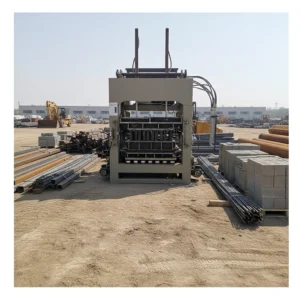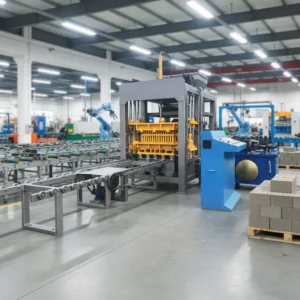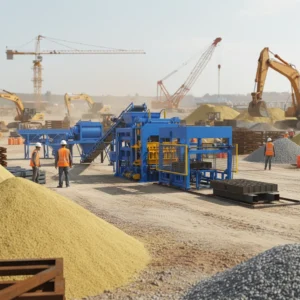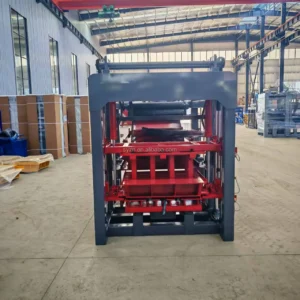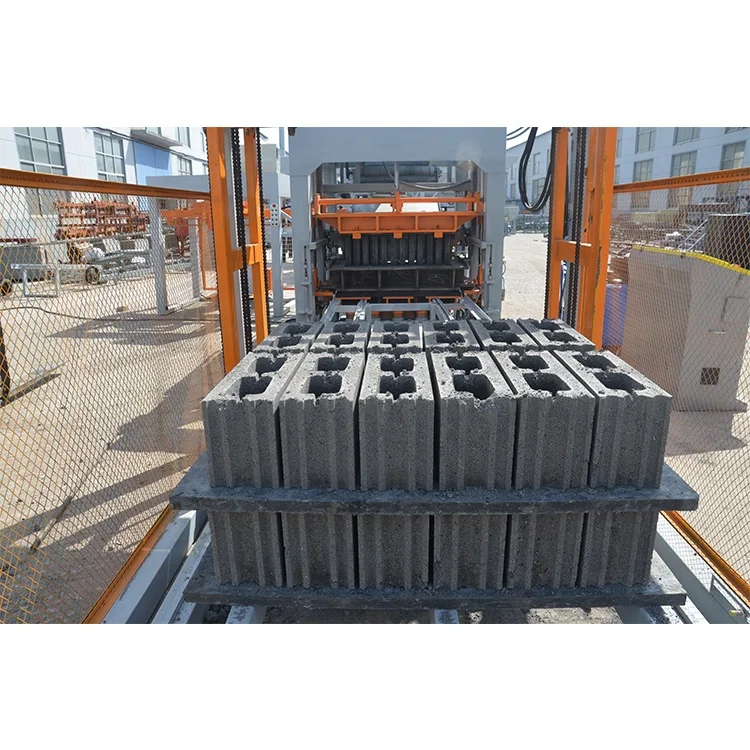
Integrated Line Rhythm — the JS500 mixer, pallet feeder, and brick conveyor are timed to the 15-second press cycle so material flow never stalls at the forming station.
Technical Specifications
| Parameter | Value |
|---|---|
| Product Type | Fully Automatic Concrete Block Making Machine |
| Model | QT5-15 |
| Overall Dimensions (L×W×H) | 7100 × 1600 × 2610 mm |
| Total Weight | 5 T |
| Molding Cycle | 15 s (basis not stated in source — confirm block format / material / thickness) |
| Vibration Frequency | 0–60 Hz |
| Vibration Force (Exciting Power) | 40 kN |
| Total Power | 33.5 kW |
| Mixer Model | JS500 |
| Pallet Size | 1100 × 550 mm |
| Control System | PLC control system |
| Hydraulic Station | Included |
| Automation Level | Fully automatic with pallet feeder, brick conveyor, block sweeper |
| Output — Hollow Block 400×200×200 mm | 5 pcs/mould, 450 pcs/hr, 3600 pcs/8hr |
| Output — Hollow Block 400×150×200 mm | 6 pcs/mould, 540 pcs/hr, 4320 pcs/8hr |
| Output — Solid Brick 400×100×200 mm | 8 pcs/mould, 720 pcs/hr, 5760 pcs/8hr |
| Applicable Products | Paver, solid block, hollow block, curbstone (mould change required) |
| Raw Materials | Crushed stones, sand, cement, dust, fly ash |
| Included Auxiliary Equipment | Pallet feeder, brick conveyor, block sweeper, manual hydraulic trolley |
| Assembly State | Shipped as complete set, nude packing in 20GP container |
Application Suitability
| Application | Material or Output |
|---|---|
| Hollow block production for masonry walls | Crushed stone, sand, cement — 400×200×200 mm and 400×150×200 mm formats |
| Solid brick manufacturing for load-bearing structures | Cement, sand, fly ash blends — 400×100×200 mm format |
| Paving block production for walkways and yards | Crushed stone and cement mixes with pigments |
| Curbstone forming for road and infrastructure projects | High-density concrete mixes with coarse aggregate |
| On-site block production for housing developments | Locally sourced sand, dust, and cement |
| Building material distributor format expansion | Multiple mould sets on a single press platform |
What "3600 Blocks per Shift" Actually Depends On
Capacity figures only hold when the mixer, pallet feeder, and conveyor all keep pace with the press.
Every quotation I have reviewed from competing suppliers lists an impressive hourly block count, but the number almost always assumes the forming station is the only station that matters. On a real shop floor, a QT5-15 block making machine production line stalls when the JS500 mixer discharges slower than the press cycles, or when the pallet feeder jams because its sensor timing was never matched to the hydraulic press rhythm. The operator ends up standing idle while the entire line waits for one mismatched component upstream [NEED_CITE: line synchronization standards in concrete block manufacturing].
How Each Station Feeds the Next
The QT5-15 block making machine production line connects raw material batching through to cured block handling as a continuous sequence. The JS500 mixer delivers a batch volume sized to fill the mould hopper across multiple press cycles, preventing the forming station from running dry mid-shift. The pallet feeder indexes a fresh pallet into position before the press completes its current stroke, so there is no dead time between cycles.
Where Bottlenecks Actually Form
Most production interruptions on a line like this trace back to material flow between the mixer discharge and the press hopper. If the belt conveyor angle is too shallow or the gate opening too narrow, wet concrete bridges in the chute and the operator has to intervene manually. Pallet return speed matters equally — if finished blocks are not cleared from the delivery conveyor fast enough, the sweeper cannot prepare the next pallet and the press waits [NEED_CITE: material handling bottleneck analysis in block plants].
Reading the Specification Sheet Correctly
Vibration force at 40 kN combined with hydraulic pressure determines the density and compressive strength of every block that leaves the mould. A higher vibration frequency range up to 60 Hz allows the operator to tune compaction for different aggregate gradations — coarser crushed stone needs more energy to settle into the mould corners than fine sand mixes. The 1100 × 550 mm pallet size is fixed, which means the buyer must confirm that their existing curing racks, forklift tines, and stacking area are dimensioned to accept that pallet footprint before the machine ships. Mould change covers hollow block in two sizes, solid brick, paver, and curbstone, but the changeover time depends on whether the clamping system is manual or hydraulic-assisted. Total power draw at 33.5 kW includes the mixer, hydraulic pump, vibration motor, and conveyor drives running simultaneously, so the site electrical supply must support that continuous load plus starting surge current.
The Cost of Skipping Line Integration
Buyers who source the press from one supplier and the mixer, pallet feeder, and conveyor from three others frequently discover that the PLC on the press cannot communicate with the auxiliary drives. The result is a line where every station runs on its own timer, and synchronization depends entirely on the operator watching and adjusting manually. Voltage mismatch between the press and the conveyor motor can delay commissioning by days if the correct transformer or variable frequency drive was not specified before production [NEED_CITE: voltage and frequency standards by export market].
Why Procurement Through a Single Line Supplier Matters
The JS500 mixer is selected specifically because its batch discharge rate matches the QT5-15 mould fill requirement across the stated formats. Pallet feeder indexing speed is preset at the factory to align with the 15-second molding cycle, reducing the commissioning variables the buyer must solve on site. The block sweeper and brick conveyor ship as part of the base set, so the buyer does not discover after delivery that output must be stacked by hand. Mould drawings for hollow block, solid brick, paver, and curbstone are prepared together with the machine order, ensuring the hydraulic pressure and vibration profile are matched to the buyer’s target block density. Factory testing runs the complete line — mixer through conveyor — before disassembly and container loading, so cycle time alignment is verified under load rather than assumed from individual component specs [NEED_CITE: factory acceptance testing protocols for block production lines].
Documentation & Verification
- Line layout drawing showing station spacing and material flow direction for your site footprint
- Capacity calculation sheet stating the block format and mix assumed for each output figure
- Hydraulic and electrical schematics matching the as-built configuration
- Pallet specification confirming 1100 × 550 mm size and load rating
- Factory test record documenting press cycle time and mixer discharge rate under load
- Voltage, frequency, and PLC display language confirmation signed before production
Installation, Commissioning & Support
- Foundation pad leveled to within tolerance for the 7100 × 1600 mm machine footprint and 5 T operating weight
- Dedicated 33.5 kW supply circuit with breaker sized for motor starting surge
- Mixer, press, and conveyor reassembled and belt-tracked on site before first production run
- PLC parameters set for buyer’s confirmed voltage, frequency, and display language
- Operator training covers mould change procedure, pallet feeder adjustment, and daily greasing points
- Wear parts list and hydraulic seal kit supplied with first shipment
What to Include in Your Inquiry
Share the block format your market sells most — dimensions, target compressive strength, and whether you need face-mix paver capability. Confirm the local aggregate type and gradation so the mix design can be matched to the vibration and pressure settings. State your site voltage, frequency, and preferred PLC language to avoid delays once the QT5-15 block making machine production line arrives.
Frequently Asked Questions
Q: How is the output capacity of 3600–5760 pcs/8hr calculated, and which block format does each figure assume?
A: Each capacity figure is tied to a specific block format and mould cavity count. The 3600 pcs/8hr figure assumes 400×200×200 mm hollow blocks at 5 pieces per mould. The 5760 pcs/8hr figure assumes 400×100×200 mm solid bricks at 8 pieces per mould. Actual output depends on mix consistency, operator pace, and pallet circulation speed across the full shift.
Q: How do the mixer, pallet feeder, and conveyor cycle times align with the 15-second press cycle?
A: The JS500 mixer batch volume is sized to keep the press hopper filled across multiple consecutive cycles. The pallet feeder indexes a new pallet before the press completes its current stroke. The brick conveyor clears finished blocks at a rate that prevents backlog at the sweeper station, maintaining continuous flow through the line.
Q: What supporting equipment is included versus optional on this line?
A: The base configuration includes the JS500 mixer, pallet feeder, brick conveyor, block sweeper, and manual hydraulic trolley. Curing rack handling systems and automatic cubing or stacking stations are configured separately based on the buyer’s plant layout and target automation level.
Q: Can the line be configured for semi-automatic operation now and upgraded to full automation later?
A: The press platform supports a progression from manual pallet handling through to automatic pallet feeding and block conveying. The PLC architecture allows additional automation modules such as automatic stackers or cubing systems to be integrated without replacing the core control hardware.
Q: What voltage, frequency, and PLC language options are confirmed before shipment?
A: Voltage and frequency are set to match the buyer’s site supply and confirmed in writing before production begins. The PLC display language is configured to the operator’s preference. These confirmations are documented to prevent commissioning delays after the machine arrives at the destination port.