
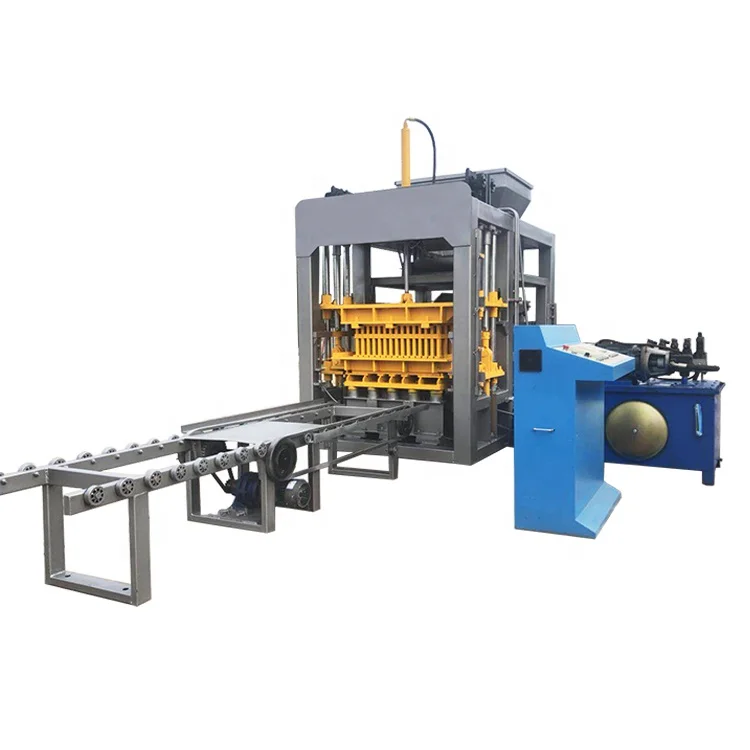
Single-Focus Line Design — the QT5-15 press, pallet feeder, and stacker are specified as one synchronized block production line equipment system rather than sourced from separate suppliers and forced to work together on your floor.
Technical Specifications
| Parameter | Value |
|---|---|
| Model | QT5-15 |
| Product Type | Automatic Concrete Block Making Machine |
| Overall Dimensions (L×W×H) | 7400×1950×2800 mm |
| Rated Pressure | 21 MPa |
| Main Vibration Form | Platform Vibration |
| Vibration Frequency | 2800–4500 r/min |
| Pallet Size | 1100×550 mm |
| Molding Cycle | 15–25 s |
| Overall Power | 26.5 kW |
| Demolding Method | Hydraulic |
| Output (Hollow Brick 400×200×200 mm) | 1800 pcs/h (5 pcs/mold, 16–20 s cycle) |
| Output (Hollow Block 400×150×200 mm) | 1300 pcs/h (6 pcs/mold, 15–20 s cycle) |
| Output (S Paver 225×112.5×60 mm) | 3700 pcs/h (16 pcs/mold, 15–17 s cycle) |
| Applied Products | Concrete blocks, hollow/solid blocks, pavers, interlocking blocks, curbstone, colored pavers |
| Raw Materials | Crushed stone, sand, cement, fly ash, gravel, slag |
| Key Features | Hydraulic demolding, platform vibration, automatic pallet feed compatibility |
Application Suitability
| Application | Material or Output |
|---|---|
| Hollow block production for structural walls | Crushed stone, sand, cement at 400×200×200 mm or 400×150×200 mm |
| Solid block manufacturing for load-bearing construction | Gravel, sand, cement with hydraulic compaction |
| Interlocking paver and colored paver runs | Fine aggregates, cement, pigment at 225×112.5×60 mm |
| Curbstone production for road and infrastructure projects | Coarse aggregate blends with high-pressure molding |
| Fly ash block production for lightweight masonry | Fly ash, sand, cement with adjusted vibration frequency |
Why the Press Alone Never Tells the Real Output Story
A block production line equipment package that leaves out pallet handling and stacking guarantees your actual daily output will fall far below what the press specification sheet promises.
I spent years on the factory floor running vibration tables and hydraulic circuits through their paces before machines left the plant, and then I watched what happened when a QT5-15 unit arrived at a buyer’s site without a matched pallet feeder or automatic stacker. The press cycled perfectly at its rated 15–25 second molding window. Workers could not keep up moving loaded pallets by hand, so real throughput dropped to roughly half the calculated figure. That pattern repeats across dozens of installations I have overseen [NEED_CITE: common output gaps from unmatched block line components]. The machine is never the bottleneck—it is everything around the press that either lets it run or forces it to wait.
Matching Station Speed to Press Cycle
Every station in a block production line equipment layout must clear its task before the next press cycle completes. The QT5-15 runs a 15–25 second molding cycle depending on block format, which means raw material feeding, pallet advance, block stripping, and pallet return must each finish inside that window. When a raw material hopper feeds too slowly, the mixer delivers an incomplete batch and the press idles. When a pallet return conveyor lags, the next mold has nothing to press onto. Specifying every station against the same cycle target keeps the press cycling continuously instead of waiting between strokes.
Where Supporting Stations Connect
The raw material feeding station delivers aggregate and cement to the mixer at a rate that matches the QT5-15’s consumption at full cycle speed. The mixer discharges into a distribution hopper positioned above the press mold cavity. Pallet feeding stations advance clean pallets from the magazine to the vibration table in sync with each demolding stroke. After compaction, the loaded pallet travels to a wet-side stacking area or directly to curing racks, depending on the automation level selected [NEED_CITE: synchronization standards for block line material flow]. Each connection point is a place where timing must be calculated and confirmed before the first block is pressed.
Reading the Numbers That Matter
The 21 MPa rated pressure and platform vibration system operating at 2800–4500 r/min work together to compact the mix inside the mold cavity. Higher vibration frequency fluidizes fine particles while hydraulic pressure drives coarse aggregate into a dense matrix. The 1100×550 mm pallet size determines how many blocks each mold produces per cycle and must match the curing rack dimensions and forklift capacity already on your site. The 26.5 kW overall power draw tells your electrical team the dedicated circuit requirement, and the hydraulic demolding method ensures blocks release cleanly without edge damage at the end of each stroke. The molding cycle of 15–25 seconds varies with block format and mix moisture, so capacity calculations must state the exact format assumed.
The Hidden Cost of Unspecified Line Components
Buyers who receive a quotation for the press alone often discover later that pallet handling, stacking, and curing rack transport were never included. That means workers move heavy loaded pallets by hand, injuries accumulate, and the shift output never reaches the capacity the buyer planned around [NEED_CITE: workplace injury patterns in manual block handling operations]. Pallet size and material may have been chosen without regard to the curing area layout or the forklift already in the yard, forcing a second purchase of compatible pallets and racks. Voltage, frequency, and PLC display language left unconfirmed before shipment can delay commissioning by weeks once the equipment arrives.
Why Buyers Spec the Whole Line Here
Block machinery is our single focus, so the QT5-15 press, mold, pallet, and every handling station are configured as one matched system rather than assembled from separate suppliers who each optimize for their own unit. Configuration starts from your actual mix design, local aggregate availability, and target block format instead of a catalogue default. Molds are designed for the formats your market actually sells, and custom drawings are accepted when standard formats do not fit. Automation level is selectable, so a buyer can start with semi-automatic pallet handling and upgrade to full stacking and cubing as volume grows. Installation support includes on-site commissioning and operator training so the line runs at its rated cycle from the first shift.
Documentation & Verification
- Line layout drawing with capacity calculation stated per block format
- Pallet specification matched to curing rack and forklift dimensions
- Voltage, frequency, and PLC display language confirmation sheet
- Factory test record on buyer’s target block format before dispatch
- Hydraulic and electrical schematic for on-site troubleshooting
- Operation and maintenance manual with wear parts list
Installation, Commissioning & Support
- Foundation plan sized to the 7400×1950 mm machine footprint and vibration load
- Dedicated 26.5 kW circuit with voltage and frequency confirmed before build
- Press arrives partially assembled; hydraulic and electrical connections completed on site
- First-run parameter setting covers vibration frequency, pressure, and cycle timing
- Operator training on mold change, pallet loading, and daily maintenance routines
- Wear parts list with reorder intervals for hydraulic seals and vibration components
What to Include in Your Inquiry
Provide the block formats your market sells and the daily volume each format requires. Tell us about your local raw materials—aggregate type, available cement grades, and any fly ash or slag sources—so the mix design can be built around what you can actually source. Include your workshop dimensions, ceiling height, and existing forklift or curing rack specifications so pallet and handling stations are sized correctly.
Frequently Asked Questions
Q: How do supporting equipment stations synchronize with the QT5-15 press cycle time?
A: Each station—raw material feeder, mixer discharge, pallet advance, and stacker—is specified to complete its task within the 15–25 second molding window. If any station runs slower, the press idles between cycles. We calculate and confirm every station timing against your target block format before the line is built.
Q: What pallet size and material works with my existing curing infrastructure?
A: The QT5-15 uses 1100×550 mm pallets. We confirm material—bamboo, PVC, or steel—against your curing environment humidity and forklift tine spacing. Mismatched pallets cause warping or handling delays that cut actual output below the calculated rate.
Q: Which automation level matches my current labor availability?
A: Automation is selectable from manual pallet handling through to fully automatic stacking and cubing. A semi-automatic start keeps capital outlay lower, and the system accepts upgrades to full pallet feeding and stacking when volume or labor constraints change.
Q: How is the raw material feed configured for my locally available aggregates?
A: Feed configuration is built around your specific crushed stone, sand, fly ash, or slag sources. Mixer ratios and hopper gate timing are set so the press receives a consistent batch every cycle, avoiding density variation that leads to inconsistent block strength.
Q: What documentation confirms line capacity for my specific block formats?
A: You receive a line layout and capacity calculation document that states the exact block format assumed for each output figure. This prevents the common gap between quoted cycle rates and actual daily production when formats change.


