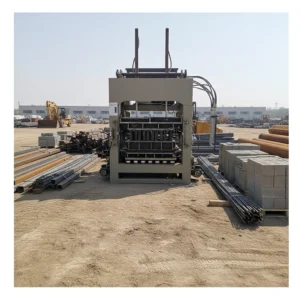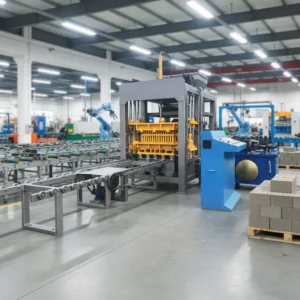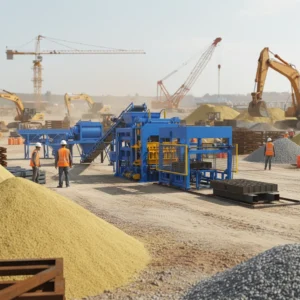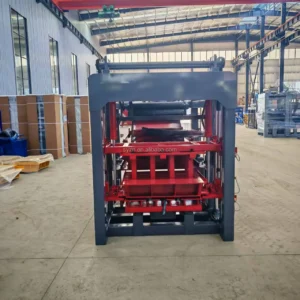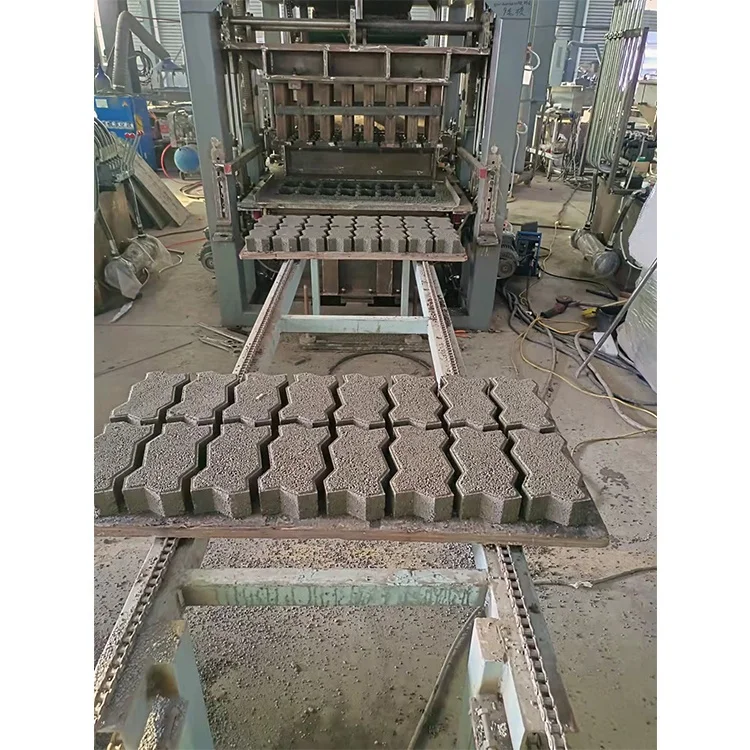
Line-matched output — the QT5-15 is configured as a complete system where the JS500 mixer, pallet feeder and conveyor are timed to the press cycle, not sourced as standalone units.
Technical Specifications
| Parameter | Value |
|---|---|
| Product Type | Automatic Concrete Block Making Machine |
| Model | QT5-15 |
| Overall Dimensions | 7100 × 1600 × 2610 mm |
| Molding Cycle | 15 s |
| Vibration Frequency | 0–60 Hz |
| Vibration Force | 40 kN |
| Rated Power | 33.5 kW |
| Mixer | JS500 |
| Pallet Size | 1100 × 550 mm |
| Total Weight | 5 T |
| Control System | PLC |
| Applied Products | Paver, solid block, hollow block, curbstone |
| Raw Materials | Crushed stones, sand, cement, dust, fly ash |
| Output Capacity | 450 pcs/hr (based on 400×200×200 mm hollow block, 5 pcs/mould) |
| Output Capacity | 540 pcs/hr (based on 400×150×200 mm hollow block, 6 pcs/mould) |
| Output Capacity | 720 pcs/hr (based on 400×100×200 mm solid brick, 8 pcs/mould) |
| Automation Level | Fully automatic |
| Hydraulic Pressure | (basis to be confirmed) |
| Voltage & Frequency | (basis to be confirmed) |
| Mould Change Time | (basis to be confirmed) |
| Stacking Method | (basis to be confirmed) |
Application Suitability
| Application | Material or Output |
|---|---|
| Hollow block production for masonry walls | Crushed stone, sand, cement and fly ash blends |
| Solid brick manufacturing for load-bearing structures | Fine aggregate with cement binder |
| Paving block production for walkways and yards | Coarse aggregate with high cement content |
| Curbstone forming for road and pavement edging | Dense mix with larger stone fractions |
| On-site block production for housing projects | Locally sourced aggregate matched to regional standards |
What the Quoted Cycle Time Leaves Out of Your Daily Output
A 15-second press cycle only translates to real output when the mixer, pallet feeder and conveyor keep pace.
Plant owners frequently receive a cycle time figure for the QT5-15 automatic block making machine production line press alone, then discover on site that the pallet feeder hesitates between cycles or the JS500 mixer cannot replenish the hopper fast enough. The result is a press standing idle for several seconds every cycle, shaving hundreds of blocks off a shift. I have watched lines where the press was rated for a certain hourly figure but the actual daily tally fell noticeably short because the supporting stations were never timed as a single system. [NEED_CITE: cycle time matching across block line stations]
How Each Station Connects Around the Press
The QT5-15 automatic block making machine production line places the press at the centre of a timed sequence. The JS500 mixer feeds the hopper at a rate matched to the 15-second molding cycle, so the press never starves for material mid-stroke. Upstream, raw material feeding delivers aggregate and cement in batches sized to keep the mixer continuously loaded without overflow.
Downstream, the pallet feeder pushes a fresh 1100 × 550 mm pallet into position the moment the press completes a cycle. The block sweeper clears the top surface before the brick conveyor carries the loaded pallet toward the curing area. Every station must finish its task within the press cycle; otherwise the bottleneck simply moves rather than disappears.
Where Line-Level Timing Breaks Down
Mismatched timing usually surfaces in the first week of production. A pallet feeder that arrives half a second late forces the press PLC to hold the next cycle, accumulating idle gaps that cost a noticeable portion of shift output. A mixer positioned too far from the press hopper introduces a transport delay that starves the feed belt. [NEED_CITE: common block line integration bottlenecks] These are not press faults — they are line design oversights that turn a fully automatic machine into one that behaves semi-automatic in practice.
Reading the Specs That Actually Govern Output
Vibration force and frequency work together to compact the mix. The 40 kN force at up to 60 Hz must be matched to the buyer’s specific aggregate gradation and cement ratio; too much vibration on a lean mix cracks the block, too little leaves voids. The 33.5 kW rated power covers the press motor, vibration system and hydraulic pump — confirming your site supply can sustain this draw continuously prevents tripped breakers mid-shift. Pallet size of 1100 × 550 mm dictates the curing rack spacing and the forklift tine width you already have on site; ordering pallets that do not fit existing racks doubles handling labour. The PLC control system manages the full cycle sequence, but its display language must be confirmed before production so your operators can read fault codes without guesswork.
The Hidden Cost of Treating the Line as Separate Purchases
When the mixer, press and pallet feeder arrive from different suppliers with no single party responsible for timing, commissioning stretches into weeks of adjustment. Each supplier points to their own equipment running correctly in isolation, while the line as a whole stutters. I have seen plants lose an entire production season chasing interface faults that a matched line would have resolved at the factory test stage. [NEED_CITE: multi-supplier integration delays in block plants]
Why Sourcing the Full Line from One Supplier Matters Here
The QT5-15 is specified alongside the JS500 mixer and supporting stations as one matched system, not assembled from separate catalogue items. Line layout and capacity calculations state the exact block format assumed for every output figure, so you know what a shift actually produces. Electrical confirmation — voltage, frequency and PLC language — is handled before production begins, avoiding the three-week standstill I once caused on a Jamaican site by overlooking this step. Pallet specification is checked against your existing curing racks and forklift dimensions before dispatch.
Documentation & Verification
- Line layout drawing showing station spacing and pallet flow for your block format
- Capacity calculation sheet stating the mould and block size behind each output figure
- Electrical schematic confirming your voltage and frequency before production starts
- Factory test record run on your target mix design and block format
- Operation and maintenance manual with PLC fault code reference in your language
- Wear parts and mould list with part numbers for reorder
Installation, Commissioning & Support
- Foundation plan sized to the 7100 × 1600 mm press footprint and 5 T operating weight
- Dedicated power circuit rated for the 33.5 kW continuous draw at your confirmed voltage
- Press shipped dismantled with marked connection points for on-site reassembly
- First-run commissioning includes cycle timing verification across mixer, press and feeder
- Operator training covers PLC fault diagnosis and mould change procedure
- Wear parts list with hydraulic seal and vibration pad reorder intervals
What to Include in Your Inquiry
Tell us the block formats you sell locally and the daily output you need, along with your raw material sources and aggregate type. Share your site voltage, frequency and preferred PLC display language so the QT5-15 automatic block making machine production line arrives ready to connect. If you already have curing racks or forklifts on site, provide their dimensions so the 1100 × 550 mm pallet specification aligns with your existing equipment.
Frequently Asked Questions
Q: How is daily output calculated and which block format is the figure based on?
A: Every output figure we quote names the exact block size and mould cavity count behind it. For the QT5-15, that means 450 pieces per hour based on 400×200×200 mm hollow blocks at five per mould, or 720 pieces per hour based on 400×100×200 mm solid bricks at eight per mould. Daily shift output is then calculated from the format you will actually produce.
Q: Which supporting equipment is included in the line quotation?
A: The JS500 mixer, pallet feeder, block sweeper and brick conveyor are quoted as part of the line. Raw material silos, curing racks and forklifts are typically buyer-supplied. We confirm the boundary between supplied and buyer-provided items in the line layout before production begins.
Q: How do cycle times match across the mixer, press and pallet feeder?
A: Each station is timed so its task completes within the 15-second press cycle. The JS500 mixer batch size and discharge rate are set to replenish the hopper before the next cycle begins, and the pallet feeder stroke speed is adjusted so the press PLC never registers a missing-pallet hold.
Q: What raw material mix does the QT5-15 require and how is the JS500 mixer configured for it?
A: The machine runs crushed stone, sand, cement, dust and fly ash in ratios matched to your local aggregate and target block strength. The JS500 mixer blade geometry and batch timing are set during commissioning to produce a consistent mix that feeds the press hopper without segregation or dry patches.
Q: What electrical standards and PLC language options are confirmed before shipment?
A: We confirm your site voltage, frequency and phase before the electrical panel is wired, and the PLC display language is set to your operator’s preference. This confirmation step is documented in the electrical schematic and verified during the factory test, so no rewiring or reprogramming is needed on arrival.