
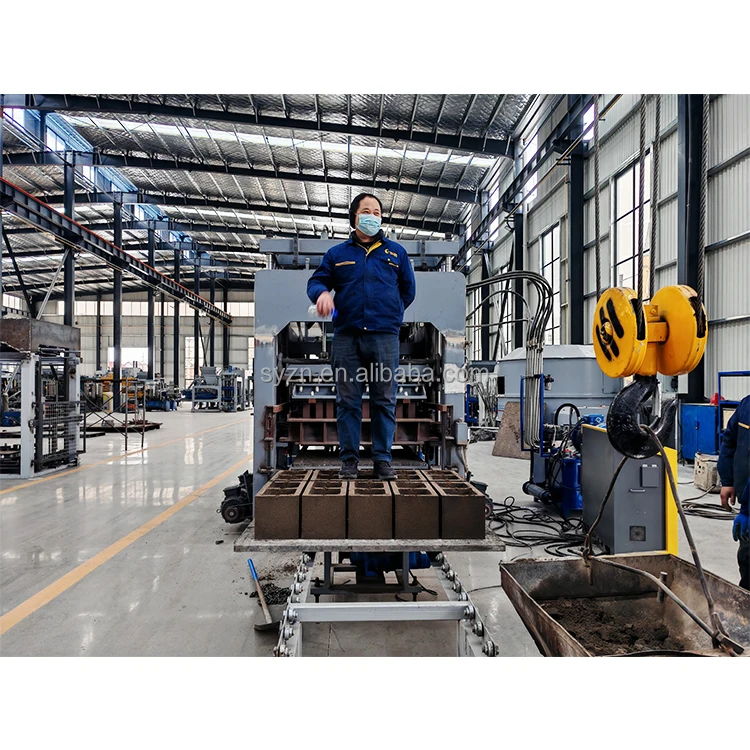
System-Matched Press Configuration — the QT5-15 is specified as part of a balanced block line where feeding, mixing, pallet flow, and stacking are sized to the same cycle so the press never idles upstream or downstream.
Technical Specifications
| Parameter | Value |
|---|---|
| Model | QT5-15 |
| Product Type | Automatic Hydraulic Concrete Block Making Machine |
| Overall Dimensions (L×W×H) | 7400×1950×2800mm |
| Rated Pressure | 21 MPa |
| Main Vibration Form | Platform Vibration |
| Vibration Frequency | 2800–4500 r/min |
| Pallet Size | 1100×550mm |
| Molding Cycle | 15–25s (basis to be confirmed by block format and material) |
| Overall Power | 26.5 kW |
| Demolding Method | Hydraulic |
| Applied Products | Hollow blocks, solid blocks, pavers, interlocking blocks, curbstone, colored pavers |
| Raw Materials | Crushed stone, sand, cement, fly ash, gravel, slag, dust |
| Output (Hollow brick 400×200×200mm) | 5 pcs/mold, 16–20s cycle, 1800 pcs/h |
| Output (Hollow block 400×150×200mm) | 6 pcs/mold, 15–20s cycle, 1300 pcs/h |
| Output (S paver 225×112.5×60mm) | 16 pcs/mold, 15–17s cycle, 3700 pcs/h |
| Automation Level | Automatic (subject to line configuration) |
Application Suitability
| Application | Material or Output |
|---|---|
| Hollow block production for masonry walls | Crushed stone, sand, cement, fly ash in 400×200×200mm or 400×150×200mm formats |
| Paving block production for walkways and yards | Sand, gravel, cement, pigment for colored S-type pavers at 225×112.5×60mm |
| Solid block production for load-bearing structures | Dense aggregate and cement mix with higher hydraulic pressure setting |
| Interlocking block and curbstone production | Custom mould formats with adjusted vibration frequency and cycle time |
Why "Cycles per Hour" Is Not a Line Capacity Figure
A press cycle only sets the ceiling — the real throughput is whatever the slowest upstream or downstream station allows.
Quoting an automatic block making machine production line at a single cycles-per-hour number without naming the block format is common in this industry. Buyers receive a headline figure and assume it applies across every product they intend to make. On site, the actual daily count for a hollow block is often much lower than for a thin paver, yet the quotation treats them as interchangeable. I have watched entire shifts stall because the pallet return conveyor could not keep pace with the press on a fast-curing paver format, or because the mixer discharge interval left the hopper starving between batches [NEED_CITE: line cycle balancing for block production plants]. The QT5-15 capacity figures above are each tied to a specific block dimension and cycle range so you can match the number to the format your market actually buys.
Matching the Press Station to the Rest of the Line
The QT5-15 sits at the center of a turnkey concrete block plant where every station must finish its task within the same cycle window. Raw material batching and mixing must discharge a fresh charge before the press hopper runs empty. The pallet feeder must place a new pallet on the vibration table before the hydraulic head completes its current stroke. If any station is slower than the 15–25 second molding cycle, the press pauses and the quoted output becomes unreachable.
Where Bottlenecks Typically Hide
On a recent project in South Asia, a buyer’s existing belt conveyor could not move mixed material fast enough to keep a 26.5 kW press hopper full during a paver run. The mixer batch size was correct, but the conveyor speed was set for a lighter block format. We lengthened the conveyor drive ratio and added a surge bin between the mixer and press. Without that adjustment, the automatic block making machine production line would have lost roughly one press cycle in every four [NEED_CITE: material feed rate versus press hopper demand]. Line balance is a calculation, not an assumption.
Reading the Specs Against Your Local Conditions
The 21 MPa rated pressure and platform vibration at 2800–4500 r/min together determine the density and green strength of the block leaving the mould. If your local aggregate has high clay or silt content — something I have encountered repeatedly on sites across East Africa — the standard vibration frequency may not compact the mix adequately, and the block edges will chip during pallet transfer. Adjusting the frequency upward or extending the vibration dwell requires coordination with the PLC timing, not a manual override. The 1100×550mm pallet size must also match the curing rack spacing and forklift tine width you already have on site; choosing a different pallet dimension after the racks are built means rebuilding the curing area.
What Happens When the Line Is Not Balanced
A press that idles between cycles produces inconsistent compaction because the hydraulic oil temperature drops and the first block after a pause receives a different pressure profile than the blocks in continuous flow. This inconsistency shows up as variable compressive strength across a single pallet — some blocks pass testing, others fail. Downstream, manual stacking replaces the automatic stacker when the pallet return loop falls behind, and the buyer ends up paying for labor the quotation said was eliminated [NEED_CITE: block strength variability from intermittent press cycling]. These are not warranty issues; they are configuration oversights that surface weeks after commissioning.
Why Buyers Source the Full Line from One Supplier
Block machinery is our single focus, so the QT5-15 press, its moulds, pallets, and handling equipment are specified as one matched set rather than assembled from separate vendors. Configuration is set against your actual mix design and local aggregate, not a catalogue default. Moulds are designed for the formats your market sells, including custom drawings when standard options do not cover your requirement. The automation level is selectable — a buyer can start with semi-automatic pallet handling and add automatic stacking later without replacing the press. Installation support includes operator training so your crew understands the cycle logic before the first production run.
Documentation & Verification
- Line layout showing QT5-15 station placement and cycle time matched to each upstream and downstream unit
- Capacity calculation sheet listing output per block format, not a single headline number
- Hydraulic and electrical schematic for integration with your existing plant control panel
- Pallet specification confirming 1100×550mm dimensions against your curing rack and forklift data
- Factory test record run on your specified block format before dispatch
Installation, Commissioning & Support
- Foundation plan sized to the 7400×1950mm footprint with vibration isolation pads under the platform
- Dedicated 26.5 kW power circuit with voltage and frequency confirmed to match your local grid before production
- Machine shipped in dismantled modules for container loading; reassembly and alignment on your prepared slab
- First-run parameter tuning: vibration frequency, hydraulic pressure, and cycle timing adjusted to your aggregate sample
- Operator training covering mould change procedure, daily pallet inspection, and hydraulic oil level checks
- Wear parts list identifying high-wear items with reorder codes for your first replacement cycle
Before You Request a Quote
To size the line correctly around the QT5-15, please share the block formats you plan to produce and the daily output target for each. Confirm the raw materials available locally — especially the type and grading of sand or crushed stone — so we can match the mixer and batching configuration. Let us know your existing pallet dimensions, curing area layout, and forklift capacity so the handling system fits without modification.
Frequently Asked Questions
Q: How do I verify that the stated output per format accounts for the full line cycle?
A: The capacity figures shown for the QT5-15 list block dimensions and cycle range for each format. A complete line quotation should include a station-by-station timing chart showing that pallet feeding, material discharge, and stacking all complete within that same cycle window. If any station runs longer, the press idles and the stated output is not achievable.
Q: What upstream and downstream equipment must match the QT5-15 cycle time?
A: The mixer discharge interval, belt conveyor speed, pallet feeder stroke time, and automatic stacker lift cycle must each finish within the 15–25 second molding window. If the mixer batches every 40 seconds but the press cycles every 17 seconds on pavers, the hopper will starve and the press will pause.
Q: How is pallet size and material chosen to fit my curing racks and forklift?
A: The 1100×550mm pallet is the standard size for the QT5-15, but the material — bamboo, PVC, or steel — depends on your curing method and forklift tine spacing. We confirm your rack dimensions and forklift model before finalizing the pallet specification to avoid mismatches on arrival.
Q: Can the automation level be scaled after initial installation?
A: Yes. The QT5-15 press station itself supports automatic operation, but the line can start with manual pallet handling and semi-automatic stacking. Upgrading to fully automatic stacking and cubing later requires adding the pallet return conveyor and stacker modules without replacing the press.
Q: What raw material feed configuration keeps pace with the press molding cycle?
A: The mixer capacity and conveyor belt speed must deliver a fresh batch to the press hopper before it empties. For high-output formats like the S paver at 15–17 seconds per cycle, a larger mixer or a surge bin between mixer and press prevents feed starvation during continuous runs.


