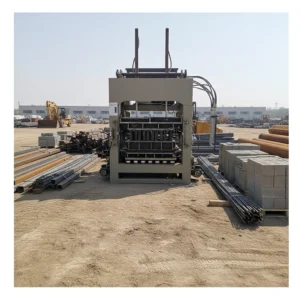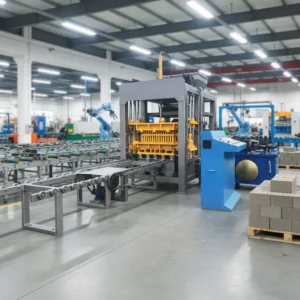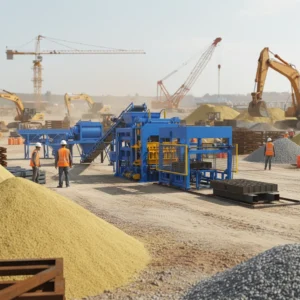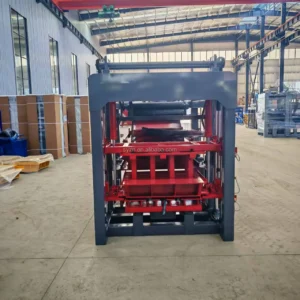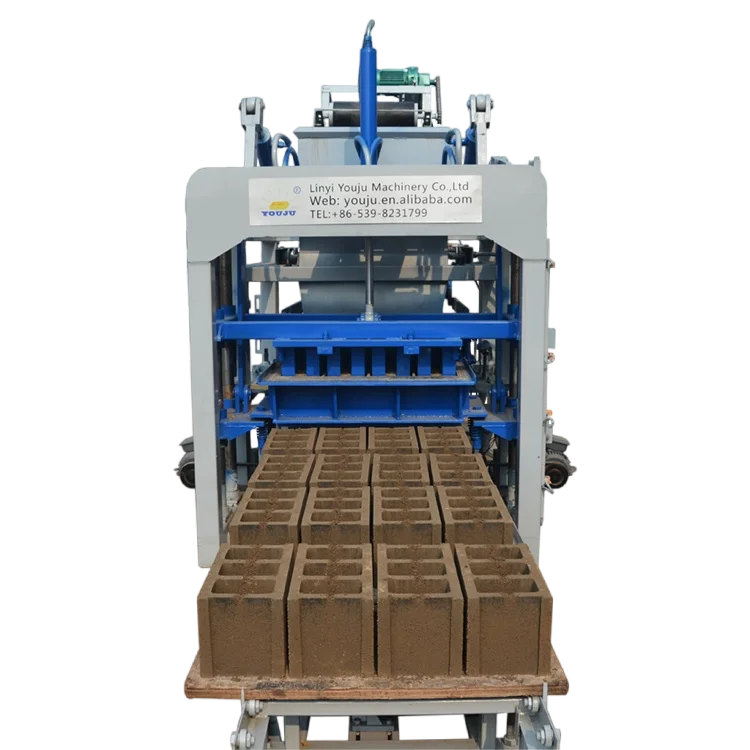
Integrated Line Rhythm — every station from raw material infeed to stacking is timed so the QT415 press never waits for a pallet or mix batch.
Technical Specifications
| Parameter | Value |
|---|---|
| Product Type | Full Automatic Vibration Press Concrete Block Making Machine |
| Model | QT415 |
| Overall Dimensions (L×W×H) | 4100×1600×2600 mm |
| Rated Pressure | 16–21 MPa |
| Main Vibration Form | Platform Vibration |
| Vibration Frequency | 4200 r/min |
| Vibration Force | 55 kN |
| Pallet Size | 880×550 mm |
| Molding Cycle | 25–30 s (basis not stated in source — confirm block format / material / thickness) |
| Overall Power | 18.45 kW |
| Total Mass | 4 T |
| Demolding Method | Hydraulic |
| Applied Products | Concrete blocks, hollow/solid blocks, pavers, interlocking blocks, curbstone, colored pavers |
| Raw Materials | Crushed stone, sand, cement, dust, fly ash, gravel, slag |
| Automation Level | Full Automatic |
| Container Loading | 1×40HQ (basic equipment) |
Application Suitability
| Application | Material or Output |
|---|---|
| Hollow block production for residential wall systems | Crushed stone, sand, cement, fly ash blends |
| Solid block manufacturing for load-bearing structures | Gravel, cement, slag mixes |
| Interlocking paver production for driveways and walkways | Colored pigments with fine aggregate and cement |
| Kerbstone and curb units for road infrastructure | Dense aggregate with high cement content |
| On-site block production for housing projects | Locally sourced sand, dust and cement |
Why "Cycles Per Hour" Can Mislead Your Line Plan
A cycle time only matters when every upstream and downstream station can match it.
The QT415 block machine production line quotes a molding cycle of 25–30 seconds, but that figure assumes a specific block format and mix consistency. In practice I have watched plants in East Africa lose most of a shift because the mixer could not feed fast enough or the pallet return loop bottlenecked at a bend. When the raw material feeding, mixing and pallet circulation stations are not specified together, the press sits idle more often than it runs [NEED_CITE: block plant line balancing principles].
Matching Every Station to the Press Rhythm
A 25-second cycle means the mixer must deliver a fresh batch to the hopper, the pallet feeder must slide a clean pallet into position, and the wet block stacker must clear the previous pallet — all within that window. The QT415 block machine production line is configured so raw material feeding, mixing, pallet circulation and stacking share a single timing logic rather than operating as independent islands. When one station drifts, the whole line slows, and daily output falls well below the quoted figure.
Pallet Handling as the Hidden Bottleneck
The 880×550 mm pallet size on the QT415 was chosen to align with standard curing rack spacing and common forklift fork widths. Pallets that do not match the curing area force double-handling: blocks are stacked on the wrong rack, moved again by hand, and cracked in the process [NEED_CITE: pallet and curing rack coordination in block plants]. Specifying pallet material, load rating and return speed at the quotation stage prevents orphan pallets that sit in the yard because no rack accepts them.
How Vibration and Pressure Shape Block Density
Platform vibration at 4200 r/min delivers a 55 kN force through the mould table, while hydraulic pressure between 16 and 21 MPa compacts the mix from above. The two forces must be balanced against the buyer’s actual aggregate gradation and cement ratio; too much vibration on a lean mix shakes the fines to the bottom, leaving a weak face. The QT415 block machine production line lets the operator adjust vibration duration and hydraulic dwell independently so density stays consistent whether the format is a thin paver or a tall hollow block.
When the Line Is Quoted Without Stacking
Plants that receive a press-only quotation often discover that stacking, curing rack handling and cubing were never included. Operators end up carrying wet blocks by hand, which limits daily throughput and increases breakage. The QT415 block machine production line scope should explicitly state whether automatic stacking and cubing are part of the package, because adding them later requires structural changes to the line layout and additional PLC I/O channels that may not be available on the base control panel.
Why a Single-Source Line Reduces Commissioning Risk
Buying the press, mixer, pallet return conveyor and stacker from different suppliers means no single party owns the timing logic. Voltage, PLC language and sensor compatibility become the buyer’s problem to solve on site. Sourcing the QT415 block machine production line as one matched system means the factory test runs every station together before container loading, so the timing offsets are already set when the line arrives. Operator training then covers the whole sequence, not just the press [NEED_CITE: single-source versus multi-vendor block line commissioning].
Documentation & Verification
- Line layout drawing with capacity stated per block format and assumed cycle time
- Voltage, frequency and PLC display language confirmation sheet signed before production
- Pallet specification cross-referenced to your curing rack dimensions and forklift fleet
- Factory test record covering full automatic sequence from feeding through stacking
- Hydraulic and electrical schematic with component list for local spare sourcing
- Operation and maintenance manual in the agreed control language
Installation, Commissioning & Support
- Foundation plan matched to the 4100×1600 mm footprint and 4 T operating mass
- Dedicated power circuit sized for the 18.45 kW total load at your confirmed voltage
- Pallet return conveyor assembled on site with tension set to your pallet weight
- PLC parameters tuned during commissioning to match your local aggregate and mix design
- Operator training covering mould change, pallet handling and automatic stacking sequence
- Wear parts list with hydraulic seals and vibration motor bearings for first-year stock
Preparing Your Line Inquiry
To size the QT415 block machine production line accurately, share your target block formats with dimensions, the daily output you need per format, and the local aggregate you plan to use. Include your site voltage and frequency, the PLC display language your operators read, and the curing rack and forklift specifications already on site so pallet and stacking stations are matched from day one.
Frequently Asked Questions
Q: How is daily output calculated per block format for the QT415 line?
A: Daily output is calculated by dividing available production hours by the molding cycle for each specific format. The 25–30 second cycle must be confirmed against the block dimensions and mix you plan to run, because larger hollow blocks and dense pavers each require different vibration and pressure settings that shift the cycle time.
Q: How must upstream stations be timed so the press is never idle?
A: The mixer must complete a batch, the pallet feeder must deliver a pallet, and the stacker must clear the previous pallet — all within one molding cycle. Each station’s motor speed and sensor delay are set during the factory test so the QT415 press receives material and pallets in continuous rhythm.
Q: What pallet size is specified and why does it matter?
A: The line uses 880×550 mm pallets chosen to fit standard curing rack slots and common forklift fork widths. Confirming pallet material and load rating against your existing curing area prevents double-handling and block damage during the move from press to rack.
Q: Is automatic stacking included in the line quotation?
A: Stacking and cubing scope must be confirmed at quotation stage. If they are excluded, blocks leave the press onto a pallet that must be moved by hand, which noticeably reduces daily throughput and increases breakage compared to a fully automatic stacker integrated into the line.