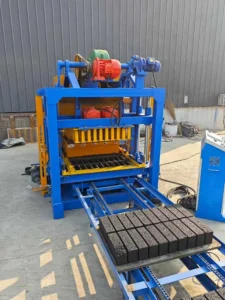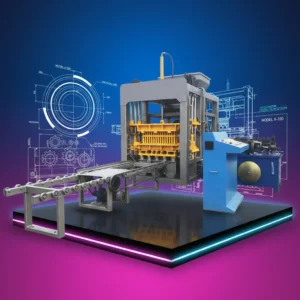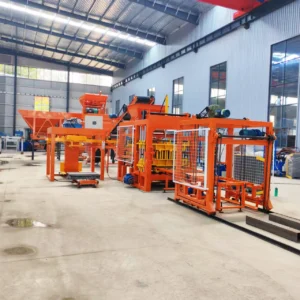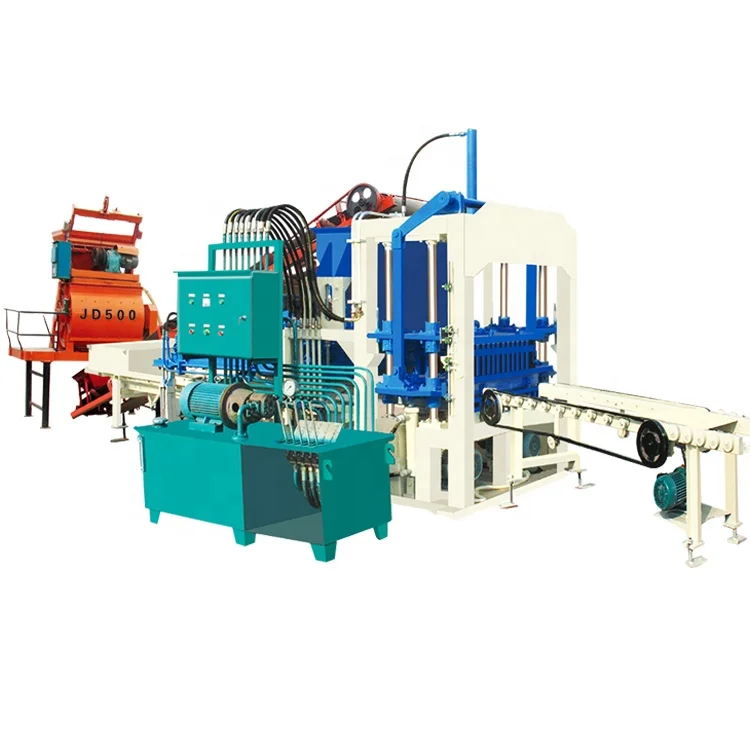
Matched Line Coordination — the QT4-20 press cycle is balanced against mixer discharge, pallet feeder indexing, and stacker lift speed so no station sits idle while another catches up.
Technical Specifications
| Parameter | Value |
|---|---|
| Model | QT4-20 |
| Product Type | Automatic Hydraulic Block Making Machine |
| Overall Dimensions (L×W×H) | 7100 × 1600 × 2610 mm |
| Rated Pressure | 21 MPa |
| Vibration Force | 60 kN |
| Vibration Frequency | 2800–4500 r/min |
| Main Vibration Form | Platform vibration |
| Pallet Size | 1020 × 570 mm |
| Molding Cycle | 15–25 s (basis not stated in source — confirm block format / material / thickness) |
| Overall Power | 27.5 kW |
| Total Mass | 5.8 T |
| Demolding Method | Hydraulic |
| General Water Consumption | 8 T/day |
| Factory Area Required | 500 m² |
| Control System | PLC with person-machine conversation interface |
| Applied Products | Concrete blocks, hollow/solid blocks, pavers, interlocking blocks, curbstone, colored pavers |
| Raw Materials | Crushed stone, sand, cement, dust, fly ash, gravel, slag |
| Automation Level | Automatic production line |
| Warranty | 1 year (free spare parts excluding quick-wear; free repair for design and production defects) |
Application Suitability
| Application | Material or Output |
|---|---|
| Hollow block production for residential wall systems | Crushed stone, sand, cement, fly ash blends |
| Solid block manufacturing for load-bearing structures | Gravel, sand, cement mixes with higher cement ratios |
| Paving block and colored paver runs for municipal projects | Fine aggregate, cement, pigment additives |
| Interlocking and curbstone production for roadworks | Coarse aggregate, slag, cement combinations |
| Grassed and revetment bricks for landscaping and erosion control | Permeable aggregate blends with controlled moisture |
What a Cycle Time Figure Leaves Out About Line Output
A 15–25 second press cycle means nothing if the pallet feeder cannot index fast enough or the mixer batch is not ready when the hopper calls for it.
I have watched plant owners in the Pearl River Delta sign off on an automatic block machine production line based purely on the press cycle printed in a brochure, only to find the pallet station hesitating every third round while the press waits empty. The daily throughput drops to a fraction of what was expected, and the bottleneck is never the press itself [NEED_CITE: common bottlenecks in concrete block production lines]. The QT4-20 must be evaluated as the centre of a full sequence — from raw material feeding through mixing, pallet indexing, pressing, and downstream stacking — because every station upstream and downstream must match its tempo or the entire line stalls.
How Upstream Feeding and Mixing Must Keep Pace
The mixer must discharge a fresh batch before the QT4-20 hopper runs dry mid-cycle. With a 27.5 kW overall power draw and a molding cycle in the 15–25 second window, the upstream batching station needs a discharge rate timed to the press demand. If the mixer is undersized or the belt conveyor runs too slowly, the press pauses and the automatic block machine production line loses rhythm. Matching mixer capacity to press consumption is the first coordination point that determines whether the line runs continuously or in stop-start bursts.
Pallet Handling as the Hidden Bottleneck
Every cycle, a 1020 × 570 mm pallet must be fed into position, receive the compacted block, and exit to the curing rack before the next pallet arrives. The pallet feeder indexing speed, the green-product conveyor travel time, and the stacker lift cycle all have to fall within the press window. When any one of these stations lags, the QT4-20 sits idle and output falls. This is where most line layouts fail — not at the press, but at the transfer points between stations [NEED_CITE: pallet handling coordination in block plants].
Reading the Pressure and Vibration Numbers Together
The 21 MPa rated pressure and 60 kN vibration force on the QT4-20 work as a pair. Hydraulic pressure compacts the mix from above while platform vibration at 2800–4500 r/min settles aggregate particles from below. Block density and strength depend on both forces reaching the mould simultaneously. A high pressure with weak vibration leaves voids in the core; strong vibration with insufficient pressure produces blocks that crumble at the edges. The correct balance changes with every mix design and local aggregate gradation, which is why the same machine can produce excellent blocks with one material blend and weak blocks with another.
The Cost of Treating the Press as a Standalone Purchase
When a buyer orders the QT4-20 without confirming pallet size against the curing racks and forklift already on site, pallets arrive that do not stack on existing racks. When voltage and PLC display language are not locked before production, the control panel arrives in a language the operators cannot read, delaying commissioning by weeks. These are not machine defects — they are specification gaps that surface only after the equipment is bolted to the floor [NEED_CITE: specification gaps in machinery export orders]. The result is a line that technically works but cannot produce at the pace the business plan assumed.
Why Line-Level Specification Matters Here
Block machinery is the single focus of this supply chain, so the QT4-20 is specified alongside its pallet feeder, mixer, stacker, and curing rack handler as one matched system rather than a collection of separate purchases. Configuration is set against the buyer’s actual mix design and local aggregate, not a catalogue default. The 500 m² factory area requirement guides line layout from raw material storage through the curing zone. Automation level is selectable, letting a buyer start with semi-automatic pallet handling and add automatic stacking later. Pallet size and curing rack spacing are confirmed together with the buyer’s existing forklift capacity.
Documentation & Verification
- Line layout drawing with capacity calculation per block format for the QT4-20
- Electrical schematic confirming voltage, frequency, and PLC language before production
- Factory test record showing press and supporting stations running in sequence
- Pallet specification matched to curing rack spacing and forklift capacity
- Hydraulic and control system diagrams for the QT4-20 automatic block machine production line
- Operation and maintenance manual covering all line stations
Installation, Commissioning & Support
- Foundation plan sized to the QT4-20 overall footprint of 7100 × 1600 × 2610 mm
- Dedicated power circuit confirmed for the 27.5 kW total load before energisation
- PLC interface language and voltage verified on-site during first-day commissioning
- Operator training covering mould change, pallet feeder reset, and emergency stop sequence
- Wear parts list including hydraulic seals and vibration motor bearings with reorder codes
- Daily maintenance checklist aligned to the 8 T/day water consumption and hydraulic system
What to Include in Your Enquiry
To size the automatic block machine production line correctly, share the block formats your market sells, the daily output you need per format, and the local aggregate and cement available in your region. Include your workshop dimensions, existing forklift capacity, and the voltage and frequency at your site so the line layout and electrical system are confirmed before production begins.
Frequently Asked Questions
Q: How is daily output calculated for the QT4-20 line?
A: Daily output depends on the block format, mix design, and how every supporting station keeps pace with the press cycle. A capacity calculation must state which block format each cycle-time figure assumes, because a hollow block and a paving brick consume different mould fill times and curing rack space. We provide a format-by-format output sheet with the line quotation.
Q: Which supporting stations are included in the line quotation?
A: The quotation specifies raw material feeding, mixing, pallet feeding, stacking, and curing rack handling alongside the QT4-20 press. Each station is listed individually so you can see which are included and which remain optional. This prevents the common situation where the press arrives but pallet handling and stacking are left to manual labour.
Q: How must the pallet size match the curing area and forklift?
A: The 1020 × 570 mm pallet size determines curing rack slot width, rack spacing, and the forklift tine capacity needed to move loaded racks. If your existing racks or forklift were sized for a different pallet dimension, the mismatch stalls the line after pressing. We confirm pallet size against your current yard equipment before finalising the line layout.
Q: What electrical details are confirmed before the line ships?
A: Voltage, frequency, and PLC display language are locked in writing before the QT4-20 enters production. This ensures the control panel matches your site power supply and your operators can read the interface on day one. The electrical schematic is shared for approval alongside the line layout drawing.
Q: How are station speeds balanced across the line?
A: The mixer discharge rate, pallet feeder index speed, and stacker lift cycle are each set to fall within the QT4-20 press window. If any station runs slower than the press, it becomes a bottleneck; if it runs faster, it wastes energy and causes pile-ups. The line layout drawing shows the timed sequence so every station is coordinated before installation.