
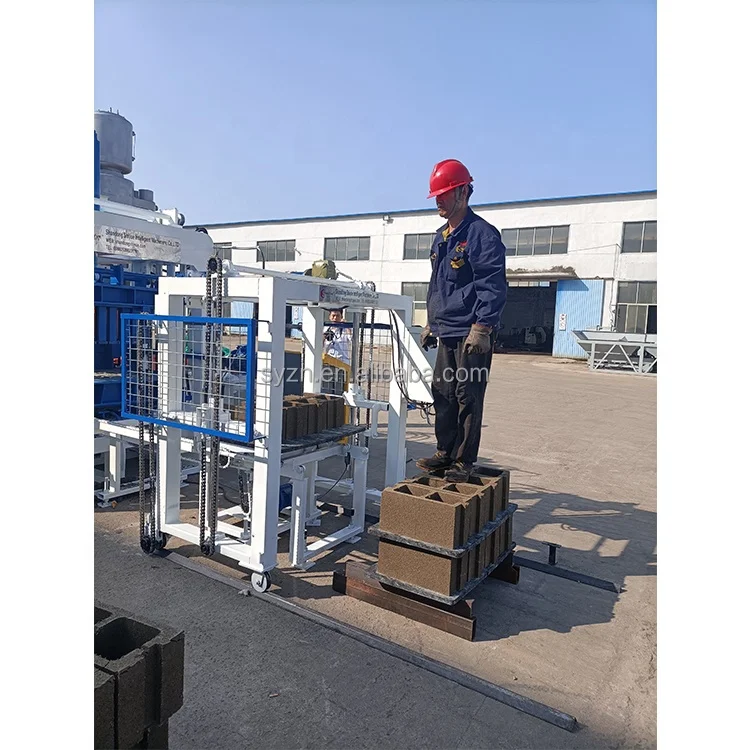
Line Balance Over Raw Speed — A 799-piece-per-hour press is only as productive as the mixer and pallet return feeding it, so every station is sized to the QT4-18 cycle before the line ships.
Technical Specifications
| Parameter | Value |
|---|---|
| Model | QT4-18 |
| Product Type | Hydraulic Automatic Hollow Block Making Machine |
| Vibration Form | Platform Vibration |
| Vibration Frequency | 0–60 Hz (adjustable) |
| Vibration Force | 45 kN |
| Pallet Size | 900 × 500 mm |
| Molding Cycle | 18–25 s |
| Demolding Method | Hydraulic |
| Control System | PLC with interlocking electric-hydraulic procedures |
| Automation Level | Automatic |
| Output Capacity | 799 pcs/h based on 400×200×200 mm hollow block, 4 pcs/mould, 18 s cycle |
| Output Capacity | 999 pcs/h based on 400×150×200 mm hollow block, 5 pcs/mould, 18 s cycle |
| Output Capacity | 5199 pcs/h based on 240×115×52 mm solid brick, 26 pcs/mould, 18 s cycle |
| Daily Output (8 hr) | 6399 pcs based on 400×200×200 mm hollow block |
| Daily Output (8 hr) | 7999 pcs based on 400×150×200 mm hollow block |
| Daily Output (8 hr) | 41599 pcs based on 240×115×52 mm solid brick |
| Mould Compatibility | Hollow block, solid brick, paving brick, road curb, sod brick, color face brick |
| Warranty | 1 year for whole machine (excluding spare parts) |
| Rated Power | (basis to be confirmed) |
| Voltage & Frequency | (configurable to target market — confirm before production) |
| Hydraulic Pressure | (basis to be confirmed) |
| Overall Dimensions | (basis to be confirmed) |
| Net Weight | (basis to be confirmed) |
Application Suitability
| Application | Material or Output |
|---|---|
| Hollow block production for load-bearing and partition walls | Crushed stone, sand, cement, fly ash blends |
| Solid brick and standard brick manufacturing | River sand, quarry dust, cement |
| Paving block and road curb stone production | Coarse aggregate, cement, pigment for colored layers |
| Color face brick and environmental protection brick | Surface-mix pigments over a structural base mix |
| Sod brick and hydraulic interlocking block | Permeable aggregate blends with reduced cement ratio |
| On-site stationary block plant for housing projects | Locally sourced aggregate matched to field lab testing |
Why "18-Second Cycle" Does Not Tell the Whole Story
The cycle time of the press is only one station in a chain that must keep pace.
When a block machine quotation quotes 18 seconds per cycle, buyers often assume the daily output will scale linearly. In reality, the mixer must deliver a fresh batch before the hopper runs dry, the pallet feeder must place a clean board before the press head descends, and the wet-side conveyor must carry the loaded pallet away before the next press stroke. If any of these stations runs even a few seconds slower, the press idles. I once configured a line where the QT4-18 block making machine production line supporting equipment was rated for the target volume, yet the pan mixer could not discharge fast enough, and the press waited three to four seconds every other cycle. Over an eight-hour shift that small gap erased thousands of blocks. [NEED_CITE: synchronization of cycle times across block line stations]
Matching Upstream Feed to Press Demand
The raw material batching and mixing station must deliver a homogeneous charge within the 18–25 second moulding window. For the QT4-18 block making machine production line supporting equipment, that means the mixer discharge rate, belt conveyor speed, and hopper gate timing are all calculated against the press cycle and the specific block format being run. A hollow block drawing a coarse aggregate blend flows differently from a paving block face mix with pigment, so the feeder configuration changes between formats.
Downstream Pallet Return and Stacking Logic
Once the press demoulds, the loaded pallet travels to the curing rack area and the empty board must loop back. The pallet return conveyor length, lift table speed, and stacker index rate are all set against the 900 × 500 mm pallet dimension and the weight of the wet block load. If the return path is too long or the sweep mechanism too slow, the press head waits for a board and the cycle breaks. [NEED_CITE: pallet circulation design in stationary block plants]
Reading the Numbers That Actually Matter
The 45 kN vibration force and adjustable 0–60 Hz frequency work together with hydraulic demolding to compact the mix into the mould cavity. Vibration frequency controls how quickly the aggregate particles settle, while hydraulic pressure holds the mould box rigid during the shake. The 18–25 second cycle range reflects the fact that a dense 200 mm hollow block needs a longer vibration window than a thin solid brick. Pallet size at 900 × 500 mm determines how many blocks sit on one board, which in turn dictates the curing rack spacing and the forklift capacity needed on the wet side. The PLC interlocks every station so that the press cannot fire unless a pallet is confirmed in position, protecting both the mould and the board stock.
When One Undersized Station Costs You a Shift
A common mistake is to spec the press generously and treat the mixer, pallet feeder, and stacker as commodity items. If the pallet feeder uses a light-duty chain that stretches under the repeated impact of loaded boards, misalignment grows over the first few weeks and boards jam at the press entry. If the mixer motor is marginal, the batch cycle stretches and the press starves intermittently. These faults do not show up during the factory test because the test runs a limited number of cycles with fresh components; they emerge after the line has been running for several hundred hours on site. [NEED_CITE: field failure patterns in block production line auxiliary equipment]
Why Sourcing the Full Line from One Supplier Helps
Shiyue Machinery treats the QT4-18 as the center of a system rather than a standalone item. The raw material feeding, mixing, pallet circulation, and stacking stations are specified together against the buyer’s target block format and local aggregate. Pallet size and material are chosen with the buyer’s existing curing racks and forklift in mind, not pulled from a default list. Voltage, frequency, and PLC display language are confirmed in writing before production starts, so the control cabinet matches the site supply when the containers open. Mould design covers the formats the local market actually buys, and custom mould drawings are available when a non-standard block profile is needed.
Documentation & Verification
- Line layout drawing showing every station from feeder to curing rack exit
- Capacity calculation sheet stating the block format behind each output figure
- Hydraulic and electrical schematic matching the shipped valve and PLC configuration
- Voltage, frequency, and control language confirmation signed before production
- Factory test record run on the buyer’s specified mould format
- Pallet specification sheet covering size, material, and quantity supplied
Installation, Commissioning & Support
- Foundation plan dimensioned to the QT4-18 platform vibration load and overall footprint
- Dedicated power circuit sized to the confirmed rated power and site voltage
- Dismantled packing layout with reassembly sequence and bolt torque chart
- First-run parameter setting for vibration frequency, hydraulic pressure, and cycle timing
- Operator training on mould change procedure and PLC fault reset routines
- Wear parts and mould inventory list with part numbers for reorder
What to Send with Your Inquiry
Tell us the block formats your market sells, the daily volume you plan to run, and the aggregate sources available within hauling distance of your plant. Share the voltage and frequency at your site, the PLC display language your operators read, and the forklift capacity and curing rack dimensions you already have on the ground.
Frequently Asked Questions
Q: How is daily output calculated and which block format does each figure assume?
A: Each output figure states the exact block dimensions, pieces per mould, and cycle time used in the calculation. The 6399-piece daily figure, for example, assumes the 400×200×200 mm hollow block at 4 pieces per mould and an 18-second cycle over an 8-hour shift. No figure is quoted without its full format premise.
Q: What upstream and downstream equipment is included in the line quotation?
A: The scope covers raw material feeding, mixing, pallet feeding, the QT4-18 press, and stacking stations as a matched set. Each item is listed individually so you can see which stations are inside the quotation boundary and which remain your own scope, such as curing racks or forklifts.
Q: How do pallet size and material affect curing area design?
A: The 900 × 500 mm pallet dictates rack slot width and forklift tine spacing. Bamboo, PVC, and steel pallets each have different weight and flex characteristics, which influence rack load ratings and how many loaded boards a single forklift trip can handle during the curing cycle.
Q: What voltage, frequency, and PLC language options are confirmed before shipment?
A: Voltage and frequency are matched to your site supply and confirmed in writing before the control cabinet is wired. PLC display language is agreed at the same stage so operators can read fault codes and cycle parameters in their working language from the first hour of commissioning.
Q: How is the mould change procedure handled on the line?
A: Moulds are located with guide pins and clamped to the vibration platform. The PLC stores cycle parameters for each registered format, so after the physical swap the operator selects the matching recipe and the press adjusts vibration time, frequency, and feed volume without manual trial runs.


