
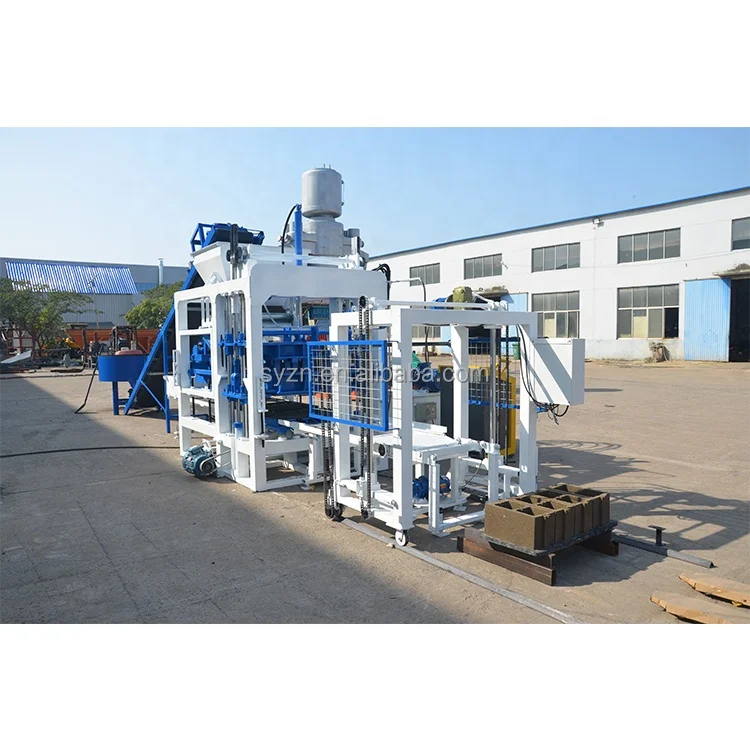
Line-wide cycle synchronization — the QT4-18 press, JQ350 mixer, pallet feeder and conveyor are specified as one timed sequence, so the press never idles waiting for pallets or material to arrive.
Technical Specifications
| Parameter | Value |
|---|---|
| Model | QT4-18 |
| Product Type | Automatic Hydraulic Concrete Block Making Machine |
| Overall Dimensions (L×W×H) | 3900×1600×2300 mm |
| Total Weight | 3 T |
| Rated Power | 24 kW |
| Vibration Force | 40-50 KN |
| Molding Cycle | 15-25 s |
| Pallet Size | 850×550×25 mm |
| Mixer Model | JQ350 |
| Control System | PLC control system |
| Hydraulic System | Hydraulic station included |
| Automation Level | Automatic (pallet feeder, brick conveyor, block sweeper) |
| Output — Hollow Block 400×200×200 mm | 1200-1680 pcs/hr (basis: 400×200×200mm hollow block) |
| Output — Hollow Block 400×150×200 mm | 1800-2400 pcs/hr (basis: 400×150×200mm hollow block) |
| Output — Solid Brick 240×115×53 mm | 3240 pcs/hr (basis: 240×115×53mm solid brick) |
| Applied Products | Paver, solid block, hollow block, curbstone |
| Raw Materials | Crushed stones, sand, cement, dust, fly ash |
| Included Equipment | Block making machine, hydraulic station, PLC control system, pallet feeder, brick conveyor, block sweeper, manual hydraulic trolley, spare parts and tools |
| Voltage & Frequency | Configurable to buyer’s local grid (basis to be confirmed) |
Application Suitability
| Application | Material or Output |
|---|---|
| Hollow block production for building walls | Crushed stone, sand, cement, fly ash — 400×200×200 mm and 400×150×200 mm formats |
| Solid brick manufacturing for masonry | Cement and fine aggregate — 240×115×53 mm standard format |
| Paver production for walkways and yards | Crushed stone and cement mix — interlocking and rectangular formats |
| Curbstone forming for road edges | High-density concrete with coarse aggregate — standard kerb profiles |
| On-site contractor production | Local sand and stone with cement — self-contained line with manual hydraulic trolley for curing transport |
What "Pieces per Hour" Means When the Rest of the Line Is Missing
A block making machine production line is only as fast as its slowest station — and the slowest station is usually the one nobody quoted.
I have watched plant owners receive a press that cycles every twenty seconds while pallets are still being carried by hand from the curing yard. The press sits idle. The quoted output of the block making machine production line drops to less than half. The frustration is never about the press itself — it is about the gap between what was ordered and what was actually needed to keep material moving. When I plan a turnkey concrete block plant, I start from the curing rack and work backward to the mixer, because that is where the real bottleneck hides [NEED_CITE: common bottlenecks in concrete block production lines].
How the Stations Connect From Mixer to Curing Zone
The JQ350 mixer feeds raw material into the QT4-18 press hopper on a timed cycle managed by the PLC. Once the press completes a molding cycle of 15-25 seconds, the pallet feeder delivers a fresh 850×550×25 mm pallet into position while the brick conveyor moves the finished pallet out. The block sweeper clears residual material before the next cycle begins. Every one of these movements is sequenced so that no station waits on another. This is the core logic of a matched block making machine production line — the press, feeder and conveyor share one control loop rather than running as independent machines.
Pallet Flow and Why It Dictates Your Daily Output
The manual hydraulic trolley included in this line carries wet blocks from the conveyor end to the curing zone. Pallet circulation speed determines how many cycles the press can actually run per shift. If your curing area is far from the press, or your trolley capacity is too small, the press will pause regardless of its mechanical cycle time. In desert project sites I have visited, the curing zone was often placed two hundred meters away with no powered transport in between — pallets piled up at the conveyor end and the turnkey concrete block plant ran at half its rated rhythm [NEED_CITE: pallet handling logistics in remote block production sites].
Reading the Specs That Actually Shape Your Line Layout
The vibration force of 40-50 KN works together with hydraulic pressure to compact the mix into a dense block. Higher vibration alone does not guarantee strength — the hydraulic station must hold pressure long enough for the aggregate to lock. The 24 kW rated power covers the press, hydraulic pump and feeder motors running simultaneously, which matters when you are sizing your site transformer. The 850×550×25 mm pallet size sets the dimensions of your curing racks and the fork spacing on your forklift. Order pallets that do not match your existing racks and you will rebuild the curing zone before the first production run. The PLC control system coordinates all station timing and can be configured for the operator’s language before dispatch.
The Cost of Treating the Press as a Standalone Purchase
When the pallet feeder and conveyor are sourced separately, their cycle timers do not talk to the press PLC. Operators end up adjusting delays manually every shift. Inconsistent pallet arrival causes the press to double-feed or skip cycles, which damages moulds and wastes raw material. I have seen lines where the mixer ran continuously but the press hopper overflowed because nobody matched the JQ350 batch size to the QT4-18 cycle count. Those mismatches do not show up in a quotation — they show up on the first production day [NEED_CITE: integration failures in multi-supplier block lines].
Why Buyers Plan the Full Line Here
Block machinery is our single focus, so the QT4-18 press, JQ350 mixer, pallet feeder and conveyor are specified as one system from the start. We set the configuration against your actual mix design and local aggregate rather than a catalogue default. Pallet size is chosen to fit your curing area and forklift, not picked from a standard list. Mould design covers the formats your market actually sells, including custom drawings when needed. The automation level is selectable — start with the included pallet feeder and conveyor, then add automatic stacking later. Line layout drawings show every station position before production begins.
Documentation & Verification
- Line layout drawing showing QT4-18 station positions, pallet flow path and curing rack arrangement
- Capacity calculation sheet stating the block format assumed for each output figure
- Pallet specification matched to your curing area dimensions and forklift fork spacing
- Voltage, frequency and PLC display language confirmation before production starts
- Factory test record running your target block format with your specified mix
- Hydraulic and electrical schematic for the complete line including feeder and conveyor circuits
Installation, Commissioning & Support
- Foundation plan based on 3900×1600 mm press footprint and 3 T operating weight
- Power supply sizing for 24 kW total draw with dedicated circuit for the hydraulic station
- JQ350 mixer positioned and timed to the QT4-18 hopper feed cycle during commissioning
- PLC language and parameter set confirmed on-site before first production run
- Pallet feeder and conveyor belt alignment checked against 850×550 mm pallet tolerance
- Operator training covering mould change, cycle adjustment and daily maintenance checkpoints
What We Need to Configure Your Line
To size this block making machine production line correctly, share your target block format and required daily output so we can calculate cycle counts per shift. Confirm your local voltage and frequency so the hydraulic station and PLC are wired before shipment. Tell us your curing area dimensions and the forklift you already have — that determines pallet material and rack spacing. If you have an existing mixer or conveyor, let us know the model so we can check timing compatibility.
Frequently Asked Questions
Q: How do cycle times at the mixer, press and pallet feeder need to match?
A: The JQ350 mixer must deliver a fresh batch before the QT4-18 hopper runs empty, which typically means one mix cycle per two to three press cycles. The pallet feeder must place a new pallet within the press molding window of 15-25 seconds. If any station falls behind, the PLC pauses the line to prevent double-feeding or dry pressing.
Q: What pallet size is specified and does it fit existing curing racks?
A: The line uses 850×550×25 mm pallets. Before production we confirm your curing rack slot width and forklift fork spacing to ensure these pallets load without modification. If your racks are sized differently, we adjust the pallet specification and mould layout accordingly rather than forcing a mismatch.
Q: Is stacking and curing rack handling included in the line scope?
A: This configuration includes the press, pallet feeder, brick conveyor, block sweeper and a manual hydraulic trolley for wet block transport to the curing zone. Automatic stacking and cubing are available as an upgrade. We confirm the handling scope during the layout stage so no manual gaps remain on the production floor.
Q: What voltage and PLC language options are confirmed before shipment?
A: Voltage and frequency are set to match your local grid — this must be confirmed before the electrical panel is wired. The PLC display language is selected from available options during the order stage. We document both in the pre-production confirmation sheet so there are no delays at commissioning.
Q: What is the plant footprint including mixer, press and curing zone?
A: The QT4-18 press alone occupies roughly 3900×1600 mm, but the full line footprint depends on JQ350 mixer placement, conveyor length and your curing rack layout. We provide a scaled line drawing showing every station and the pallet return path so you can verify clearance against your site dimensions before ordering.



