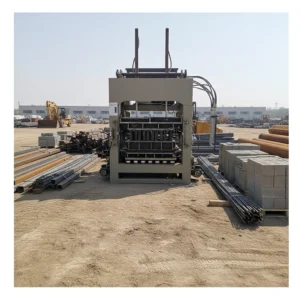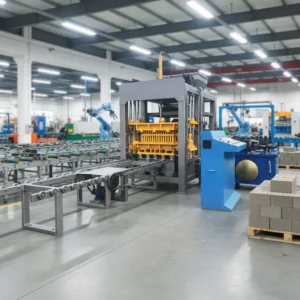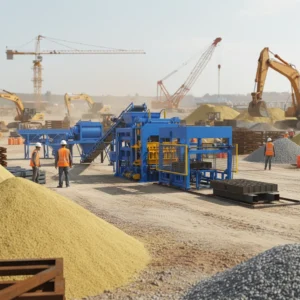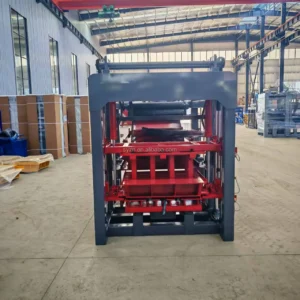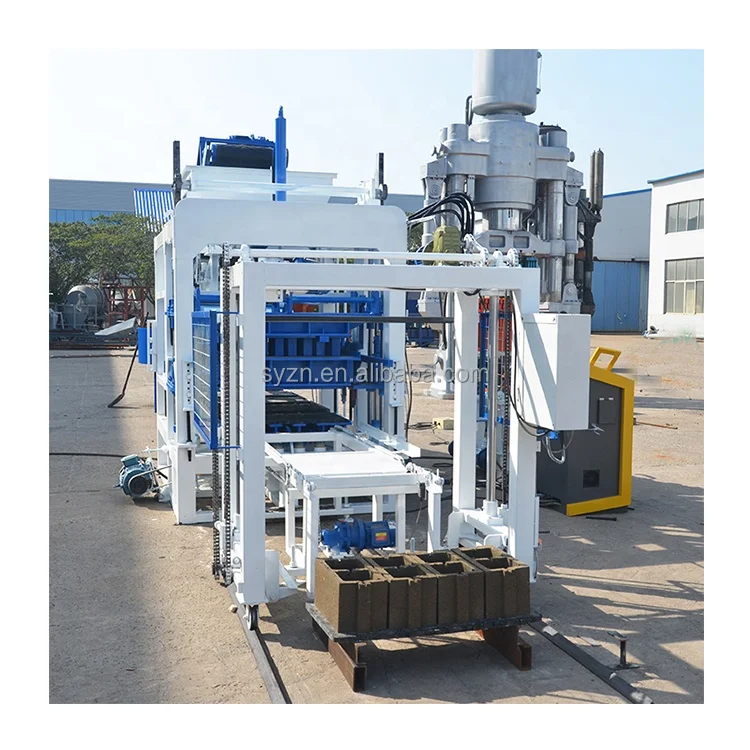
Matched System Design — every pallet feeder, conveyor and stacker cycle is timed to the QT4-18 press so the line runs without one station waiting on another.
Technical Specifications
| Parameter | Value |
|---|---|
| Model | QT4-18 |
| Product Type | Concrete Block Making Machine |
| Overall Dimensions (L×W×H) | 3900×1600×2300 mm |
| Molding Cycle | 15-25s |
| Vibration Force | 40-50 kN |
| Rated Power | 24 kW |
| Mixer Model | JQ350 |
| Pallet Size | 850×550×25 mm |
| Net Weight | 3T (source value — verify against manufacturer catalog) |
| Control System | PLC control system |
| Hydraulic Station | Included |
| Included Equipment | Block making machine, hydraulic station, PLC control system, pallet feeder, brick conveyor, block sweeper |
| Automation Level | Semi-automatic with pallet feeder and brick conveyor |
| Stacking Method | Self-loading stacker |
| Mould Change | Supported for paver, solid, hollow, curbstone formats |
| Output Capacity | 1200-1680 pcs/hr (based on 400×200×200mm hollow block) |
| Output Capacity | 1800-2400 pcs/hr (based on 400×150×200mm hollow block) |
| Output Capacity | 3240 pcs/hr (basis not stated in source — confirm block format / material / thickness) |
Application Suitability
| Application | Material or Output |
|---|---|
| Hollow block production for wall construction | Crushed stones, sand, cement, fly ash |
| Solid brick manufacturing for load-bearing structures | Sand, cement, dust, crushed stones |
| Paver production for walkways and driveways | Crushed stones, sand, cement |
| Curbstone forming for road and landscape edging | Crushed stones, sand, cement |
| On-site block production for housing projects | Locally available aggregate, cement, sand |
Why the Pallet Feeder Question Comes Before the Price
A concrete block making machine production line is only as fast as its slowest station.
I used to source block plants on the buyer side, and I watched lines stall because the pallet feeder could not keep up with the press cycle. The operator stands idle watching the press wait for the next pallet, and the quoted output number becomes fiction. When the concrete block making machine production line includes a pallet feeder and brick conveyor matched to the 15-25 second molding cycle, the press runs continuously instead of pausing every few strokes. [NEED_CITE: common causes of output shortfall in block production lines]
How Feeding, Pressing and Stacking Stay in Sync
The QT4-18 concrete block making machine production line connects raw material feeding through the JQ350 mixer to the press, then moves finished blocks via the brick conveyor to the self-loading stacker. Each station’s cycle is set against the 15-25 second molding window so material arrives before the press finishes its current stroke. The PLC control system coordinates these timings rather than leaving each station to run independently.
What Happens When Line Stations Are Specified Separately
When a buyer assembles a press from one supplier, a mixer from another and a pallet system from a third, the cycle times rarely align without on-site adjustment. The concrete block making machine production line approach here specifies every station together — pallet feeder, brick conveyor, block sweeper and stacker ship as one scope. This removes the commissioning delay where technicians spend days tuning station handoffs that should have been matched at the factory. [NEED_CITE: integration challenges in multi-supplier block lines]
Reading the Specifications That Actually Matter
The vibration force of 40-50 kN works with the hydraulic station to compress the mix into consistent density across every block format. The 850×550×25 mm pallet size determines how many blocks fit per cycle and what curing rack dimensions the plant needs. The 24 kW rated power covers the press, hydraulic station and feeder motors together — confirming this before shipment avoids undersized electrical supply on arrival. The JQ350 mixer capacity must match the press consumption rate across different block formats, because hollow blocks consume less mix per piece than solid bricks.
The Hidden Cost of an Incomplete Line Scope
A quotation that covers only the press leaves the buyer sourcing pallet handling, stacking and conveying separately, often at higher total cost and longer lead time. When pallet size is chosen without considering the curing area and the forklift the buyer already owns, new pallets arrive and cannot be stacked in the available racks. The block sweeper and self-loading stacker eliminate manual handling between the press and the curing yard, which matters when daily output runs into thousands of pieces. [NEED_CITE: manual handling injuries in block production]
Why Sourcing the Full Line Here Makes Sense
The machine, mould, pallet and handling equipment are specified as one matched system rather than assembled from separate suppliers, so cycle times are coordinated before the line ships. Configuration is set against the buyer’s actual mix design, local aggregate and target block format instead of a catalogue default. Mould design covers the formats the buyer’s market sells, including custom drawings for pavers, solid blocks, hollow blocks and curbstones. Automation level starts at semi-automatic with the pallet feeder and brick conveyor, leaving room to add full automatic stacking and cubing later. Installation and commissioning support includes operator training on the PLC control system and station coordination.
Documentation & Verification
- Line layout showing pallet feeder, conveyor and stacker positions relative to the press
- Capacity calculation stating which block format each output figure assumes
- Pallet specification matched to 850×550 mm size and 25 mm thickness
- Hydraulic and electrical schematic covering the full line, not the press alone
- Voltage, frequency and PLC display language confirmation before production
- Factory test record on buyer’s target block format before dispatch
Installation, Commissioning & Support
- Foundation pad sized for 3900×1600 mm footprint with vibration isolation
- 24 kW supply with dedicated circuit for hydraulic station and press motors
- Machine dismantled for container loading, reassembled on-site with alignment check
- First-run parameter setting on PLC for buyer’s mix design and block format
- Operator training covering mould change, pallet feeder timing and stacker operation
- Wear parts list covering hydraulic seals, vibration components and mould surfaces
What to Share with Your Inquiry
Tell us the block formats your market sells, the daily output you need per format, and the local aggregate available at your site. Share your workshop dimensions, curing yard layout and any existing forklift capacity so pallet size can be matched. Confirm your local voltage, frequency and preferred PLC display language so the electrical system is built correctly before shipment.
Frequently Asked Questions
Q: How are cycle times matched across feeding, pressing and stacking so the press is not left idle?
A: The PLC control system sets the pallet feeder and brick conveyor timing against the 15-25 second molding cycle. Each station’s response time is confirmed during factory testing so the next pallet arrives before the press completes its current stroke. This coordination happens at specification stage, not during on-site commissioning.
Q: What is included in the line scope versus what must be sourced separately?
A: The standard scope covers the QT4-18 press, hydraulic station, PLC control system, pallet feeder, brick conveyor, block sweeper and self-loading stacker. The JQ350 mixer is included. Curing racks, yard forklifts and raw material storage bins are typically sourced by the buyer based on local site conditions.
Q: How does pallet size affect curing rack layout and forklift requirements?
A: The 850×550 mm pallet determines rack slot width and forklift tine spacing. If your existing curing racks or forklift are sized differently, the pallet specification can be adjusted during the configuration stage so the line integrates with your current yard setup rather than requiring new equipment.
Q: Can the line start semi-automatic and upgrade to full automatic stacking later?
A: Yes. The semi-automatic configuration includes the pallet feeder and brick conveyor as standard. Full automatic stacking and cubing can be added later by extending the PLC program and installing additional handling stations, without replacing the press or hydraulic station.
Q: How is the JQ350 mixer capacity matched to press output across different block formats?
A: Hollow blocks consume less mix per piece than solid bricks or pavers. The mixer batch size and cycle are set against the target format so the press never waits for the next batch. When multiple formats are planned, the mixer is sized for the most demanding format in the production schedule.