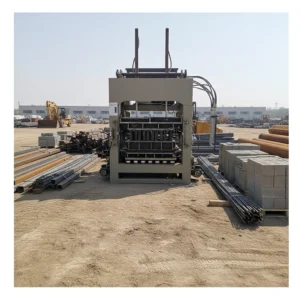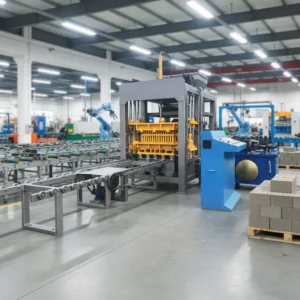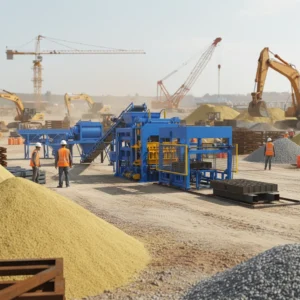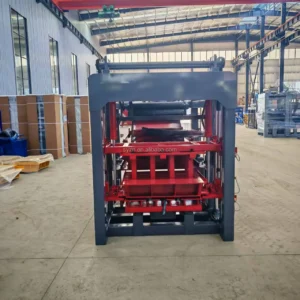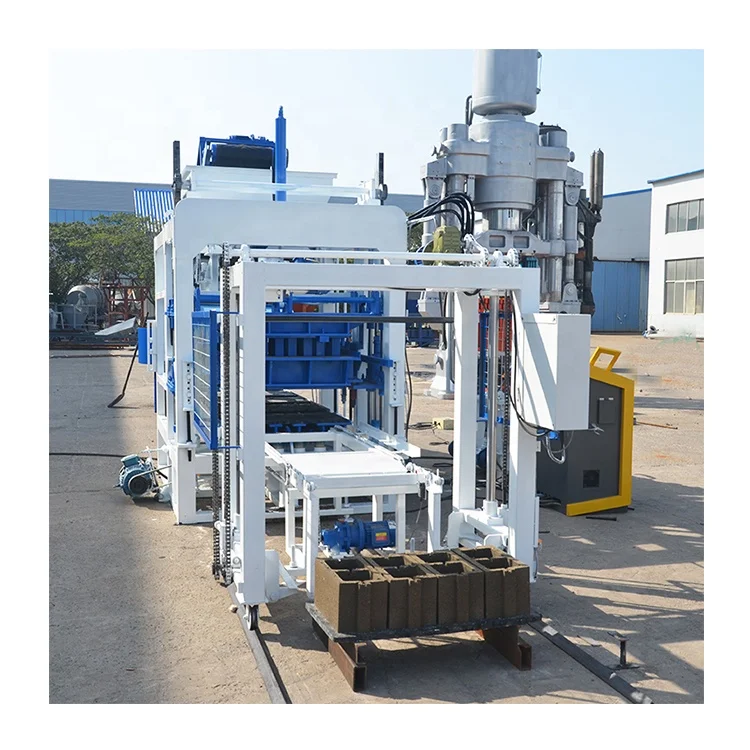
Matched Line Synchronization — every station from the JQ350 mixer through the pallet feeder to the brick conveyor is timed to the 15–25 s press cycle so the QT4-18 never idles waiting for the next pallet or mix batch.
Technical Specifications
| Parameter | Value |
|---|---|
| Product Type | Fully Automatic Hydraulic Concrete Block Making Machine |
| Model | QT4-18 |
| Overall Dimensions (L×W×H) | 3900 × 1600 × 2300 mm |
| Total Weight | 3 T |
| Rated Power | 24 kW |
| Vibration Force | 40–50 kN |
| Molding Cycle | 15–25 s |
| Pallet Size | 850 × 550 × 25 mm |
| Mixer Model | JQ350 |
| Control System | PLC control system |
| Hydraulic Station | High-pressure hydraulic system (included) |
| Applied Products | Paver, solid block, hollow block, curbstone (via mould change) |
| Raw Materials | Crushed stone, sand, cement, dust, fly ash |
| Output Capacity (Hollow block 400×200×200 mm) | 1200–1680 pcs/h, 9600–13440 pcs/8hr |
| Output Capacity (Hollow block 400×150×200 mm) | 1800–2400 pcs/h, 14400–19200 pcs/8hr |
| Output Capacity (Solid brick 240×115×53 mm) | 3240 pcs/h, 16200–19440 pcs/8hr |
| Included Equipment | Block making machine, hydraulic station, PLC control system, pallet feeder, brick conveyor, block sweeper |
| Automation Level | Full auto (with pallet feeder, conveyor, sweeper) |
| Voltage & Frequency | Configurable to site requirement (basis to be confirmed) |
| PLC Display Language | Configurable to operator preference (basis to be confirmed) |
| Standards | CE (specific certification to confirm) |
Application Suitability
| Application | Material or Output |
|---|---|
| Hollow block production for masonry walls | Crushed stone, sand, cement, fly ash (400×200×200 mm and 400×150×200 mm formats) |
| Solid brick manufacturing for load-bearing structures | Sand, cement, stone dust (240×115×53 mm format) |
| Paver and curbstone production for infrastructure | Aggregate, cement, pigment (via dedicated mould change) |
| On-site block production for housing projects | Locally sourced aggregate and cement matched to mix design |
| Building material distributor adding block formats | Multiple formats from a single line with pallet and conveyor handling |
Why the Mixer Must Never Lag Behind the Press
A block press that waits for material is a block press that misses its quoted output.
I once configured a fully automatic line where the mixer discharged half a beat too slow for the press cycle. The operator watched the hopper run dry every third cycle, and by end of shift the daily tally fell roughly two thousand blocks short of what the quotation promised. The buyer called, frustrated, because the press itself was performing exactly as specified — the bottleneck was upstream. That mistake reshaped how I scope every subsequent line: the JQ350 mixer in the QT4-18 block making machine production line is sized so its discharge rate sustains the 15–25 s molding cycle across all listed block formats without starvation. [NEED_CITE: typical mixer discharge rates versus press demand in small-to-medium block plants]
When a plant owner evaluates a quotation, the first number that catches the eye is hourly capacity. But that figure assumes a continuous feed of mixed material, a pallet always in position, and a conveyor clearing cured blocks at the same rhythm. Drop any one of those conditions and the press cycles per hour decline accordingly.
How Each Station Connects to the Press Cycle
The QT4-18 block making machine production line is built around a single timing logic: the PLC control system coordinates pallet feeding, hydraulic pressing, vibration, block sweeping, and brick conveying in one continuous loop. Each station receives its start signal only after the preceding station confirms completion, which prevents pallets from colliding on the conveyor and keeps the press table clear for the next mold descent.
Where Line Bottlenecks Typically Hide
Bottlenecks rarely appear during the factory test because every station runs under ideal conditions with a single block format. They surface weeks after commissioning, when the buyer switches to a denser mix or a smaller block that shortens the press cycle, suddenly demanding faster pallet turnover than the feeder can deliver. Specifying the pallet feeder, block sweeper, and brick conveyor as one matched set — rather than sourcing them separately — keeps those transition points inside a single control logic. [NEED_CITE: common causes of cycle mismatch in multi-station block lines]
Reading the Specs That Actually Govern Daily Output
The 40–50 kN vibration force works together with the high-pressure hydraulic station to compact the mix into the mould cavity; insufficient force on a stiff, low-slump mix leaves voids inside hollow blocks, while excessive force on a wet mix can cause edge spalling. The 850 × 550 × 25 mm pallet dimension determines how many blocks sit on each board and, by extension, how many boards fit the buyer’s existing curing racks and forklift forks — a mismatch here forces manual restacking that erases the automation advantage. The 24 kW rated power covers the hydraulic pump, vibration motors, and conveyor drives simultaneously, so the electrical supply must sustain that draw continuously, not just at startup. Molding cycles of 15–25 s vary with block height and mix stiffness; a 400×200×200 mm hollow block sits at the longer end of that range, while a thinner paver may complete nearer the 15 s mark, directly affecting which output row in the specification table applies to the buyer’s primary format.
The Cost of Treating the Press as a Standalone Purchase
When the pallet feeder is sourced from a different supplier than the press, the PLC has no direct handshake with the feeder motor, so pallets arrive either too early and stack up, or too late and the press idles. I have walked into plants where the conveyor belt speed was set manually and never adjusted after a mould change, leaving half the blocks unswept and damaged before reaching the stacking area. These are not machine failures — they are integration gaps that a line-level scope prevents. [NEED_CITE: integration issues when block plant stations are sourced from multiple vendors]
Why Sourcing the Line as One Package Matters Here
Block machinery is our single focus, which means the press, mould, pallet, and handling equipment are specified as one matched system rather than assembled from separate catalog pages. Configuration is set against the buyer’s actual mix design and local aggregate, not a generic default, so the JQ350 mixer output and the QT4-18 hopper capacity are balanced before the line ships. Moulds for hollow block, solid brick, paver, and curbstone formats are designed in-house, including custom drawings when the buyer’s market demands a non-standard size. Automation level is selectable, so a buyer can start with the full-auto pallet feeder and conveyor included here and add automatic stacking or cubing later without rewiring the PLC logic. Installation support covers the full line footprint — 3900 × 1600 × 2300 mm for the press alone, plus conveyor run and mixer placement — and operator training addresses cycle timing adjustments when switching between formats.
Documentation & Verification
- Line layout drawing showing pallet feeder, press, conveyor, and mixer placement with dimensions
- Capacity calculation stating the block format and cycle time assumed for each output figure
- Hydraulic and electrical schematic covering the complete line, not just the press
- Pallet specification sheet matched to the buyer’s curing rack spacing and forklift capacity
- Factory test record documenting cycle times across at least two block formats before dispatch
- Voltage, frequency, and PLC display language confirmation signed off before production
Installation, Commissioning & Support
- Foundation plan sized to the 3 T press weight plus dynamic vibration load from the 40–50 kN force
- Dedicated electrical circuit rated for the 24 kW continuous draw with voltage and frequency confirmed to site supply
- Assembly sequence for the press, pallet feeder, brick conveyor, and block sweeper with station-by-station alignment checks
- First-run commissioning covering PLC cycle timing, hydraulic pressure setting, and mould change procedure
- Operator training on format switching, mould change, and daily maintenance of hydraulic and vibration components
- Wear parts list with reorder intervals for hydraulic seals, vibration springs, and mould liners
What to Share Before Requesting a Quotation
To scope the QT4-18 block making machine production line accurately, we need the primary block format you intend to produce, the target daily output based on your shift length, and the raw materials available locally including aggregate grading. Confirm your site voltage, frequency, and the language your operators will use on the PLC display. Share the curing area dimensions and forklift capacity so the pallet specification aligns with your existing handling infrastructure.
Frequently Asked Questions
Q: How are the pallet feeder, press, and conveyor cycle times matched so the press is not left waiting?
A: The PLC control system governs every station in the QT4-18 block making machine production line. The pallet feeder releases a board only after the brick conveyor clears the previous one, and the press initiates its cycle once the pallet is confirmed in position. This handshake logic is programmed around the 15–25 s molding cycle and adjusted during commissioning for each block format.
Q: What block format is assumed in the quoted output, and how does capacity change across formats?
A: Each output figure in the specification table is tied to a specific block dimension — for instance, 1200–1680 pcs/h applies to the 400×200×200 mm hollow block, while the 240×115×53 mm solid brick reaches 3240 pcs/h. Cycle time shifts with block height and mix density, so the format you produce most determines which capacity row applies to your daily planning.
Q: Is the JQ350 mixer sufficient to keep up with the press at full cycle speed for every format?
A: The JQ350 is specified within this line so its batch volume and discharge rate sustain the QT4-18 press across the listed hollow and solid formats. If the buyer adds a high-demand paver format with a shorter cycle, we reassess mixer capacity against the new press tempo and recommend an adjustment if needed.
Q: Which line stations are included and which need separate specification?
A: The scope covers the press, hydraulic station, PLC system, pallet feeder, brick conveyor, and block sweeper. Automatic stacking, cubing, and curing rack handling are not included but can be added as extension modules. The PLC architecture supports these additions without replacing the existing controller.