
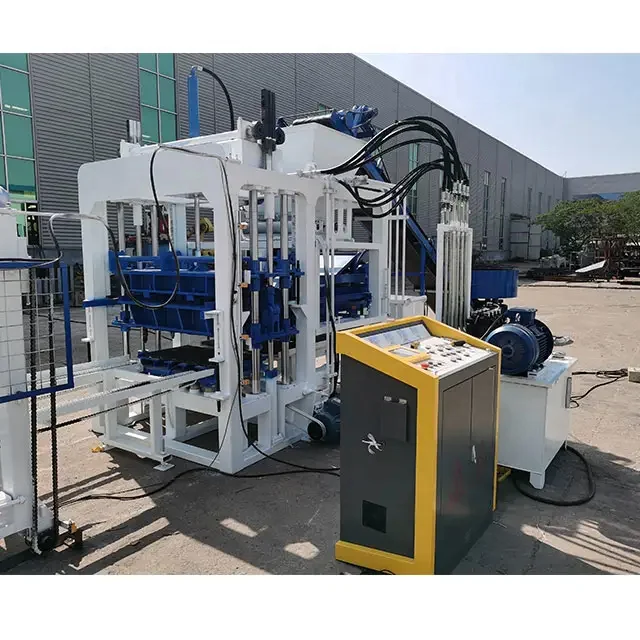
Matched Line Engineering — Every station from the JQ500 pan mixer through the belt conveyor, pallet feeder, press, block conveyor and stacker is timed against the QT4-18 moulding cycle so the host is never left waiting for material or pallets.
Technical Specifications
| Parameter | Value |
|---|---|
| Model | QT4-18 |
| Product Type | Automatic Concrete Block Making Machine |
| Overall Dimensions | 2500×1750×2200 mm |
| Rated Pressure | 16 MPa |
| Vibration Form | Platform Vibration |
| Pallet Size | 950×550 mm |
| Molding Cycle | 18–25 s (basis not stated in source — confirm block format, material and thickness before quoting) |
| Overall Power | 27.5 kW |
| Control System | PLC with frequency converter, Schneider electrical components |
| Mould Lifting Mechanism | Double-sided synchronous gears |
| Material Feeder | Distribution belt hopper |
| Automation Level | Automatic with pallet feeder, block conveyor, hydraulic station and electronic console |
| Supporting Equipment Options | JQ500 concrete pan mixer, 6 m or 8 m belt conveyor, stacker, block clamper, cement silo, batching plant, trolley |
| Voltage & Frequency | Configurable to site supply (confirm before order) |
| CE Declaration | Available where applicable (verify with supplier for specific market) |
Application Suitability
| Application | Material or Output |
|---|---|
| Hollow block production for load-bearing and partition walls | Crushed stone, sand, cement and fly ash blends |
| Solid brick production for masonry and infill | Graded aggregate with cement binder |
| Paving block and interlocking paver for walkways and yards | High-strength concrete mix with fine aggregate |
| On-site contractor block production for housing projects | Locally sourced aggregate matched to mix design |
What "18-Second Cycle Time" Actually Means on a Full Line
A cycle time only matters when every upstream and downstream station keeps pace.
The QT4-18 block making machine production line can complete a moulding cycle in 18 to 25 seconds, but that number assumes the mixer discharges fast enough, the belt conveyor delivers material without bottleneck, and the pallet feeder is synchronized to return pallets before the press needs them. In the field, a mismatched mixer or an undersized conveyor cuts actual daily output well below what the cycle time suggests [NEED_CITE: common causes of output shortfall in small block plants]. Buyers who evaluate the press alone often discover after installation that supporting equipment is where the real losses occur.
How Stations Connect Around the Press
A block line is a chain of timed events, and the QT4-18 block making machine production line is no exception. The JQ500 pan mixer batches material and feeds it onto the 6 m or 8 m belt conveyor, which delivers it to the distribution belt hopper above the press. If the mixer batch time exceeds the press consumption rate, the hopper runs empty and the press idles. Matching the mixer output to the press appetite is the first step in line layout.
Where Pallet Handling Dictates Real Output
Once the press completes a cycle, the moulded block on its pallet must travel to the stacker, and the empty pallet must return to the pallet feeder for the next cycle. The QT4-18 uses a hydraulic-cylinder-driven pallet feeder synchronized with the demould sequence. If the stacker cannot keep up or the pallet recycle path is obstructed, the press waits [NEED_CITE: pallet handling as a bottleneck in semi-automatic block lines]. Including the stacker, block clamper and trolley in the quotation means the line reaches the curing yard without manual intervention.
Reading the Specification Sheet Against Your Mix and Format
The 16 MPa rated pressure and platform vibration work together to compact the concrete into the mould cavity. Higher vibration force helps with drier, zero-slump mixes, while hydraulic pressure ensures the block holds its shape during demoulding. The 950×550 mm pallet size determines how many blocks fit per cycle and must match the curing racks and forklift already on site. The double-sided synchronous gear mould lifting mechanism keeps the mould halves aligned during extraction, reducing wear and preventing block corner damage. Voltage and frequency must be confirmed against the local grid before the control cabinet is wired, because the PLC and Schneider frequency converter are configured for a specific supply at the factory.
The Cost of Skipping Line-Level Configuration
Ordering a press without specifying the mixer capacity, conveyor length and stacker speed leaves the most expensive machine in the line dependent on whatever supporting equipment happens to arrive. A mixer that is too small forces the press to idle between batches. A conveyor that is too short limits the distance between the mixing station and the press, cramping the workshop layout [NEED_CITE: layout constraints in compact block production sites]. These problems surface only after the line is bolted down, when changes mean re-piping, re-wiring and lost production days.
Why Configuration Starts at the Line, Not the Press
Block machinery is our single focus, so the QT4-18 is specified as one matched system rather than a press sold alongside third-party accessories. The line layout and capacity calculation state which block format each station’s cycle time assumes, so buyers can see the throughput for hollow blocks versus paving blocks before committing. Mould design covers the formats the buyer’s market actually sells, with custom mould drawings available to buyer specifications. Automation level is selectable — a buyer can start with manual pallet handling and add automatic stacking later without replacing the press. Installation support includes operator training so the crew understands not just the press but the entire sequence from mixer discharge to curing yard.
Documentation & Verification
- Line layout drawing with cycle time per block format for each station
- Machine specification sheet confirming voltage, frequency and PLC language
- Mould drawing and format list with custom design option to buyer drawings
- Pallet specification matched to curing rack dimensions and forklift capacity
- Factory test record run on buyer’s target block format before dispatch
- Hydraulic and electrical schematic for on-site maintenance reference
Installation, Commissioning & Support
- Foundation plan based on 2500×1750 mm press footprint and 27.5 kW total line power
- Dedicated electrical circuit matching confirmed voltage and frequency before cabinet build
- Press, mixer and conveyor shipped dismantled with container loading plan for the full line
- On-site commissioning with cycle time verification against buyer’s mix design and block format
- Operator training covering PLC interface, mould change procedure and daily greasing schedule
- Wear parts and mould list supplied with first-shipment spare recommendations
What to Include in Your Inquiry
To size the QT4-18 block making machine production line accurately, share your target block formats with dimensions, the daily output you need per format, and the local aggregate and cement you plan to use. Include your workshop length and ceiling height so the conveyor run and stacker height can be planned. Confirm the site voltage, frequency and the language you need on the PLC display. If you already have curing racks or a forklift, send the pallet dimensions they accept so the 950×550 mm pallet can be verified or adjusted.
Frequently Asked Questions
Q: How is line capacity calculated per block format, and which format does the quoted cycle time assume?
A: Capacity is calculated by multiplying the number of blocks per pallet by the number of cycles per hour, but the cycle time varies with block height, mix stiffness and vibration setting. Our quotation states the assumed block format and its specific cycle, so the daily output figure is tied to a real product rather than a generic rating.
Q: Which supporting stations are included, and where must cycle times be matched?
A: The standard line includes the JQ500 pan mixer, belt conveyor, pallet feeder, press, block conveyor, stacker and trolley. The mixer batch time must be shorter than the press consumption rate, and the stacker must clear pallets faster than the press produces them to avoid idle time at the host.
Q: What pallet size does the line require, and is it compatible with my existing curing setup?
A: The QT4-18 uses a 950×550 mm pallet. Before ordering, share your curing rack spacing and forklift fork width so we confirm compatibility. Pallet material — bamboo, PVC or steel — is selected based on your block weight and curing environment.
Q: Can the automation level be staged from manual to automatic over time?
A: Yes. A buyer can start with manual pallet handling and add the automatic stacker and block clamper later. The press control system and hydraulic station are specified to accept these additions without a full retrofit, provided the upgrade path is planned at the initial order.
Q: What is the lead time for a fully configured line versus a press-only order?
A: A press-only order ships faster because supporting equipment does not need factory matching. A full line requires assembly and cycle-time verification across all stations before dispatch, adding typical multi-week lead time. Container loading is planned for the complete set so everything arrives together.


