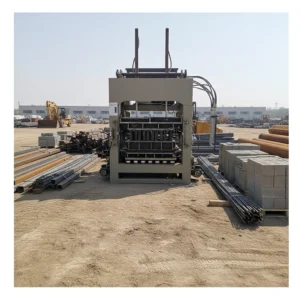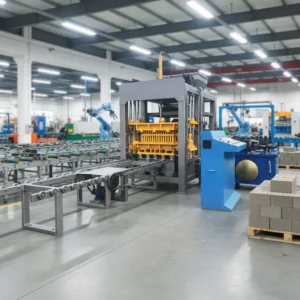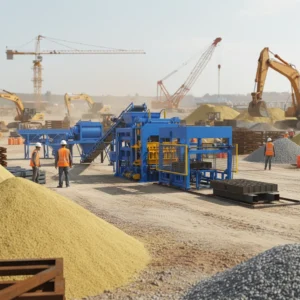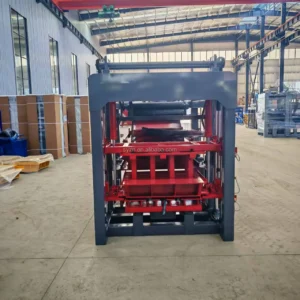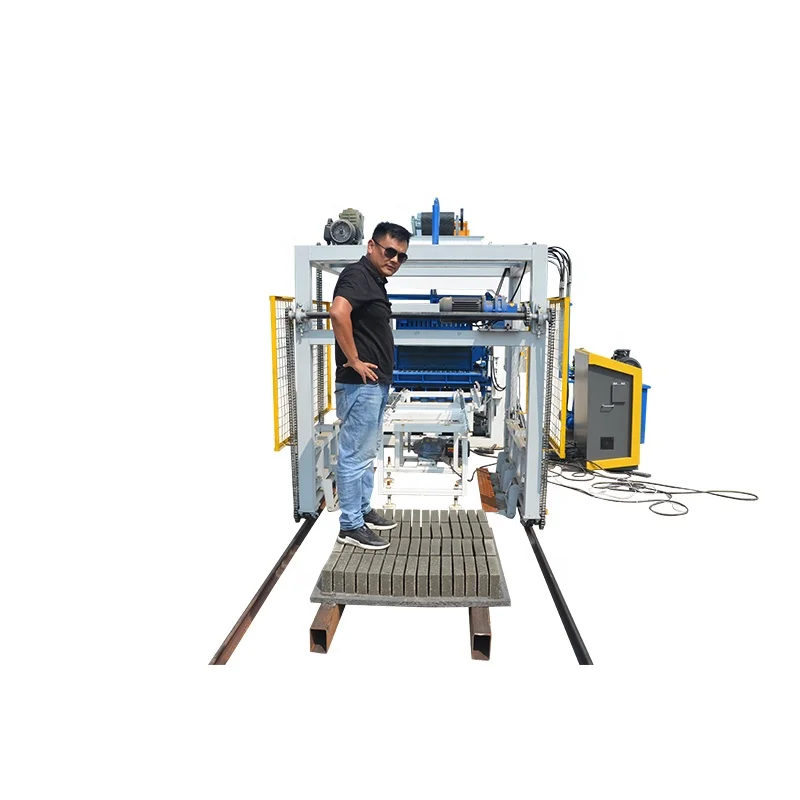
Matched system design — every station from mixer to stacker is sized against the press cycle so the line runs at rated pace without upstream or downstream bottlenecks.
Technical Specifications
| Parameter | Value |
|---|---|
| Model | QT4-15B |
| Product Type | Fully Automatic Concrete Block Making Machine |
| Control System | Computer controlled, fully automatic |
| Vibration Mode | Multiaxis synchronizer vibration, vertically downward |
| Hydraulic System | High thermal efficiency, low heat generation |
| Mixer System | Multiaxis forced mixer, adaptable to varied raw materials |
| Guide Bearing | Long-period over-length guide bearing for upper mould and mould box alignment |
| Rack Construction | High-strength steel with special welding technique, vibration-shock resistant |
| Automation Level | Fully automatic |
| Output Capacity (Hollow Block 400×200×200 mm, 4 pcs/mould) | 900–1,200 pcs/h (15–20 s cycle) |
| Output Capacity (Hollow Block 400×150×200 mm, 5 pcs/mould) | 1,080–1,440 pcs/h (15–20 s cycle) |
| Output Capacity (Hollow Block 400×100×200 mm, 8 pcs/mould) | 1,440–1,920 pcs/h (15–20 s cycle) |
| Output Capacity (Paving Block 200×100×60 mm, 16 pcs/mould) | 2,880–3,840 pcs/h (15–20 s cycle) |
| Output Capacity (Solid Brick 240×115×53 mm, 28 pcs/mould) | 5,930–6,720 pcs/h (15–20 s cycle) |
| Cycle Time | 15–20 s per mould |
| Warranty | 1 year for whole machine (excluding spare parts) |
Application Suitability
| Application | Material or Output |
|---|---|
| Hollow block production | Crushed stone, sand, cement, fly ash aggregates (400×200×200, 400×150×200, 400×100×200 mm formats) |
| Paving block production | High-density concrete mixes with fine aggregate (200×100×60 mm interlocking and standard formats) |
| Solid brick production | Standard brick clay substitutes, stone dust and cement blends (240×115×53 mm format) |
| On-site project production | Locally sourced aggregate for development and housing project contractors |
Why a Concrete Block Making Machine Production Line Fails Before the Press Does
The bottleneck is rarely the block press itself — it is the station that cannot keep up.
When a mixer takes 90 seconds to discharge but the press cycles every 15 to 20 seconds, the press sits idle for half its shift. Pallet feeders that jam, stackers that cannot match the output rhythm, and curing racks that fill up before the operator can clear them all create the same result: a concrete block making machine production line that produces far fewer blocks per day than the quoted cycle rate suggests. I have walked onto sites where the owner blamed the press for low throughput, only to find the mixer was undersized and the pallet return conveyor was missing entirely [NEED_CITE: common causes of throughput shortfall in block production lines].
How Station-to-Station Timing Holds the Line Together
A fully automatic line only stays automatic when every station hands off to the next without a pause. The QT4-15B press completes a cycle in 15 to 20 seconds, which means the multiaxis forced mixer must discharge a full batch within that same window, the pallet feeder must position a fresh pallet before the mould drops, and the stacker must clear cured blocks before the next pallet arrives. If any one of these stations runs slow, the press controller either waits or faults.
The computer-controlled system coordinating these stations monitors each handoff point. When the line is specified as a matched set rather than assembled from standalone units, the timing logic is built around the actual cycle time of the target block format, not a generic default.
Where Mixer Capacity Meets Press Demand
The multiaxis forced mixer on this concrete block making machine production line handles a range of raw materials — from coarse crushed stone to fine fly ash blends. What matters for line speed is not just the mixer’s batch volume but its discharge rate. A forced mixer that holds enough material for two press cycles but takes too long to empty creates a starvation gap every other cycle [NEED_CITE: mixer discharge rate and press cycle synchronization in block plants].
This is where line layout drawings earn their place. A drawing that shows the mixer positioned directly above the feed hopper with a gravity discharge chute eliminates the conveyor lag that slows down belt-fed setups. The raw material feed configuration confirmed at inquiry stage determines whether the mixer keeps the press fed continuously or forces it into intermittent stops.
Reading the Specs That Actually Matter on Site
The multiaxis synchronizer vibration, directed vertically downward, works together with the hydraulic system to compact the mix into the mould. Vibration alone does not determine block density — the hydraulic pressure must be matched to the buyer’s specific mix design and local aggregate grading. A line configured for a sand-heavy mix will produce weak blocks if the buyer’s local quarry supplies a coarse gravel blend. The vibration force and pressure rating should therefore be confirmed against a sample mix before the machine enters production.
The high-strength welded rack absorbs the repeated shock of vibration cycles. In a line running 15 to 20 second cycles across an eight-hour shift, that rack endures thousands of impact loads per day. The long-period over-length guide bearing keeps the upper mould and mould box aligned through those cycles, which directly affects block dimensional consistency. Misalignment accumulates as uneven wear, showing up weeks after commissioning as blocks that vary in height by several millimetres.
The hydraulic system’s thermal efficiency rating addresses a problem that surfaces only during sustained operation: heat buildup. As hydraulic fluid temperature rises through a long shift, pressure drops and cycle times lengthen. A system designed for high thermal efficiency maintains consistent pressure across the full shift, which is what keeps block strength uniform from the first pallet to the last.
What Gets Left Off the Quotation
Pallet handling, stacking, and curing rack systems are frequently excluded from the base quotation. The buyer receives a press that produces blocks at the rated cycle speed, then discovers that pallets must be fed by hand, wet blocks must be stacked manually, and curing racks must be moved with a forklift that was not specified for the pallet size. The real daily output falls well short of the quoted figure because the human stations around the press cannot keep pace [NEED_CITE: impact of manual pallet handling on daily block output].
Pallet size and material chosen without regard to the curing area dimensions and the forklift already on site create a second layer of wasted capacity. If the pallets do not fit the existing curing racks, the buyer must either rebuild the curing area or replace the pallets — both costly corrections that delay production start.
Why the Line Is Specified as One System
The QT4-15B is quoted as a matched set: press, mixer, pallet feeder, stacker, and curing rack handling are each sized to the same cycle target. This eliminates the scenario where one supplier delivers a press rated for 15-second cycles and another delivers a mixer that needs 40 seconds to discharge.
Configuration is set against the buyer’s actual mix design, local aggregate, and target block format. The capacity calculation states which block format the output figure assumes, so daily production planning starts from a known baseline rather than a best-case catalogue number.
Mould design covers the formats the buyer’s market actually sells, and custom mould drawings are available when standard formats do not match local building codes. The automation level is selectable — a buyer can commission the line in semi-automatic mode and add stacking automation later as production volume justifies the investment.
Installation support includes operator training on the full line, not just the press. This covers mixer loading sequences, pallet feeder adjustment, stacker timing, and fault diagnosis across every station.
Documentation & Verification
- Line layout drawing showing every station with cycle time matching confirmed per block format
- Capacity calculation stating the exact block format and cycle assumption for each output tier
- Pallet specification sheet matched to the buyer’s curing area dimensions and forklift capacity
- Hydraulic and electrical schematic with voltage, frequency, and PLC display language confirmed
- Factory test record on the buyer’s target block format before dispatch
- Wear parts and mould list with replacement intervals for each component
Installation, Commissioning & Support
- Foundation plan aligned to the rack footprint and vibration load of the QT4-15B press station
- Dedicated power circuit sized to the rated power draw, with voltage and frequency confirmed pre-production
- Machine shipped in sections for container loading, with reassembly sequence documented on site
- Commissioning run on the buyer’s local aggregate and mix design to verify block strength and cycle time
- Operator training covering mixer loading, pallet feed adjustment, stacker timing, and mould change procedure
- Wear parts supply schedule for hydraulic seals, guide bearings, and mould wear surfaces
What to Confirm Before Requesting a Quote
Share the block formats your market sells and the daily volume you need for each. Include your local aggregate type and any existing mix design data, along with your site dimensions and curing area layout. Confirm your local voltage, frequency, and the PLC display language your operators will need.
Frequently Asked Questions
Q: How is the output capacity verified for each block format on the line?
A: Each capacity figure is calculated from the mould cavity count and the 15–20 second cycle time for that specific format. The line layout document states which block size each output tier assumes, so daily throughput expectations are tied to the actual products in your production plan rather than a single headline number.
Q: Which supporting stations are included beyond the block press itself?
A: The line specification covers raw material feeding, the multiaxis forced mixer, pallet feeding, the press, automatic stacking, and curing rack handling. Each station’s cycle time is matched to the press so no single point creates a bottleneck that holds up the rest of the concrete block making machine production line.
Q: How is pallet size selected to fit my existing curing setup?
A: Pallet dimensions and material are chosen based on your curing area layout, rack spacing, and forklift capacity. Confirming these details at inquiry stage ensures the pallets shipped with the line work with the infrastructure already on your site without modification.
Q: What electrical details need confirming before the line enters production?
A: Voltage, frequency, and PLC display language are confirmed with the buyer before production begins. This avoids commissioning delays caused by mismatched power supply or an interface language the operators cannot read when the line arrives on site.
Q: What installation and training support covers the full line?
A: On-site commissioning includes assembling every station, running test cycles on your local mix, and training operators on mixer loading, pallet feed adjustment, stacker timing, and mould changes. Wear parts and mould support continues after the initial commissioning period.