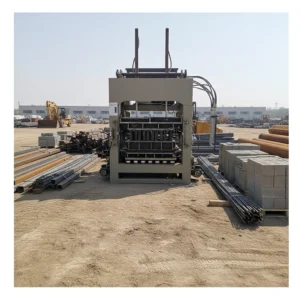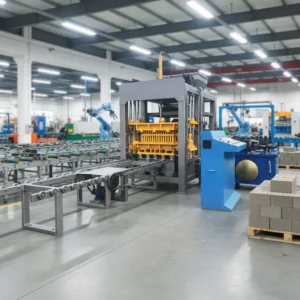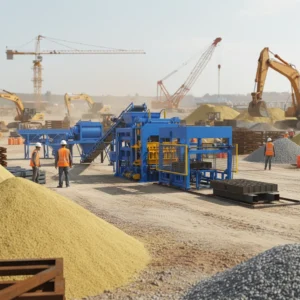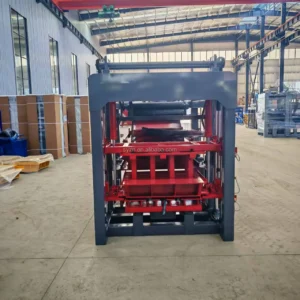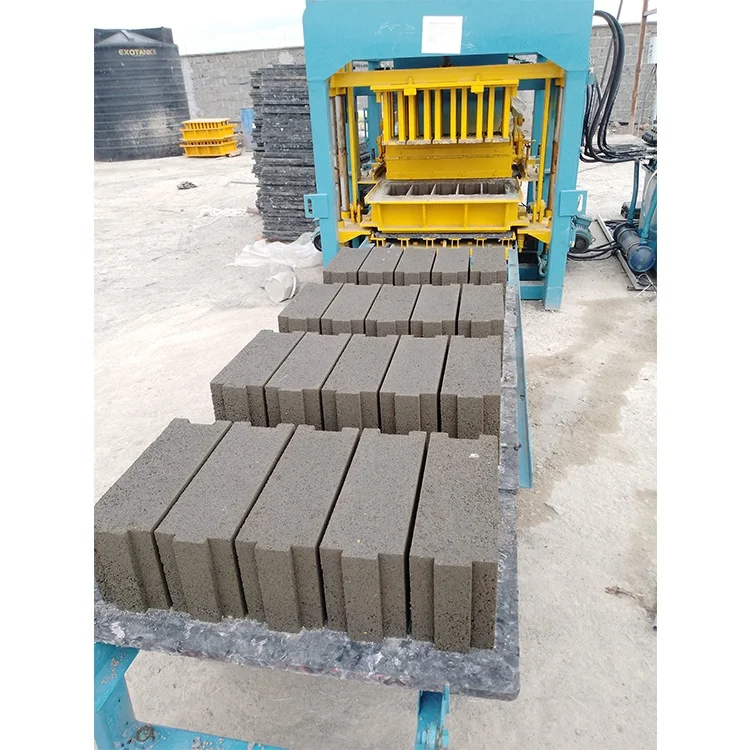
Matched System Engineering — Every station in the QT4-15A line is timed against the press cycle so the hydraulic block making machine production line never idles waiting for upstream feed or downstream clearing.
Technical Specifications
| Parameter | Value |
|---|---|
| Model | QT4-15A |
| Product Type | Hydraulic Block Making Machine |
| Overall Dimensions (L×W×H) | 7100×1600×2610 mm |
| Molding Cycle | 15-25s (basis not stated in source — confirm block format) |
| Vibration Frequency | 4600 r/min |
| Vibration Force | 40-50 KN |
| Total Power | 18.45 kW (rated or peak not specified) |
| Mixer Model | JQ350 |
| Pallet Size | 850×550×25 mm |
| Total Weight | 3 T |
| Control System | PLC control system |
| Hydraulic Station | Included |
| Included Equipment | Block making machine, hydraulic station, PLC control system, pallet feeder, brick conveyor, block sweeper |
| Output (Hollow Block 400×200×200mm) | 408 pcs/hr, 3264 pcs/8hr |
| Output (Hollow Block 400×150×200mm) | 510 pcs/hr, 4080 pcs/8hr |
| Output (Solid Brick 240×115×53mm) | 2100 pcs/hr, 17000 pcs/8hr |
| Applied Products | Paver, solid block, hollow block, curbstone |
| Free Accessories | Manual hydraulic trolley, spare parts and tools |
Application Suitability
| Application | Material or Output |
|---|---|
| Hollow block production for building walls | Crushed stone, sand, cement, fly ash |
| Solid brick manufacturing for load-bearing structures | Cement, sand, dust, crushed aggregate |
| Paver production for walkways and yards | Cement, fine aggregate, pigment additives |
| Curbstone forming for road and landscaping edges | Coarse aggregate, cement, sand blends |
| On-site block production for housing projects | Locally sourced sand and stone with cement |
What "15-25 Second Cycle Time" Leaves Out When Stations Are Not Timed
A cycle time is only real if the pallet feeder, conveyor and mixer all match it.
I once watched a block press sit idle for nearly a third of every shift because the mixer discharged slower than the press demanded. The hydraulic block making machine production line had a fast press but a slow feeder, and the daily output dropped well below the quoted number. When the pallet feeder lags behind the molding stroke or the brick conveyor cannot clear finished blocks fast enough, the press simply waits [NEED_CITE: line synchronization principles in concrete block production]. The QT4-15A package addresses this by including the pallet feeder, brick conveyor and block sweeper in the same scope, so each station is specified against the same cycle window rather than sourced independently and mismatched on site.
How Supporting Stations Keep the Press Running
The pallet feeder loads boards into the press at a rate that matches the 15-25 second molding cycle, removing manual pallet handling from the operator’s task list. The brick conveyor carries finished blocks away from the press area immediately after ejection, preventing a backlog that would force the press to pause. The block sweeper cleans pallet surfaces before they re-enter the feeder loop, reducing residue build-up that causes sticking or misalignment. Together, these three stations form a closed loop around the press so the hydraulic block making machine production line runs continuously without manual intervention at each station.
Where the Mixer Meets the Press Demand
The JQ350 mixer sits upstream of the press and must deliver a fresh batch before the hopper runs empty. If the mixer capacity is too small for the press throughput, the press starves and cycle time stretches beyond the rated window [NEED_CITE: mixer-to-press capacity matching in block lines]. Pairing the JQ350 with the QT4-15A means the mixing volume and discharge speed are checked against the press consumption rate at the quotation stage, not left as an assumption. This prevents the common situation where a buyer adds a second mixer after commissioning because the first one could not keep up.
Reading the Specs That Matter on Site
The vibration force of 40-50 KN combined with the hydraulic station determines how densely the concrete is compacted in the mould, which directly affects block strength and surface finish. A vibration frequency of 4600 r/min ensures the aggregate particles settle tightly within each cycle. The pallet size of 850×550×25 mm must match the curing racks and forklift tines the buyer already has — ordering pallets in a different size after arrival disrupts the entire handling chain. The PLC control system governs the sequence of pallet feed, vibration, hydraulic press and ejection, so the operator sets the cycle once and the line repeats it. Total power of 18.45 kW across all stations means the buyer must confirm the site supply can handle sustained draw at this level.
The Cost of Buying the Press Alone
When a quotation covers only the press, the buyer must source pallets, conveyors and feeders separately, often from different suppliers who do not coordinate cycle times [NEED_CITE: equipment integration challenges in block production]. The result is a line where each station works at its own pace, and the press spends a portion of every hour idle. Pallets arrive late, finished blocks pile up on the press table, and the operator manually clears the area — all of which erode the output the buyer was promised. The QT4-15A avoids this by shipping as a single package where the supporting equipment is already matched.
Why Buyers Source This Line Here
Block machinery is our single focus, so the press, mould, pallet and handling equipment are specified as one system rather than assembled from separate suppliers. The configuration is set against the buyer’s actual mix design, local aggregate and target block format instead of a catalogue default. Mould design covers the formats the buyer’s market sells, and custom drawings are available for non-standard sizes. The automation level starts at semi-automatic with hydraulic and PLC control, leaving room to add automatic stacking later. Installation includes operator training so the crew understands how each station connects to the next.
Documentation & Verification
- Line layout drawing with capacity calculation per block format
- Machine specification sheet with hydraulic and electrical schematic
- Pallet specification matched to buyer’s curing area dimensions
- Voltage, frequency and PLC display language confirmation record
- Factory test record showing cycle timing across all stations
- Operation and maintenance manual with wear parts list
Installation, Commissioning & Support
- Foundation plan based on the 7100×1600 mm footprint and 3 T operating weight
- Electrical supply verified against 18.45 kW total draw before the line ships
- Machine arrives in modular sections for site reassembly and alignment
- PLC parameters set during commissioning to match local aggregate and mix ratio
- Pallet feeder timing adjusted on site against actual mould cycle
- Operator training covers mould change, daily greasing and conveyor belt tensioning
- Spare parts kit included for first replacements of hydraulic seals and vibration mounts
What We Need to Quote This Line Accurately
Tell us which block format you intend to produce and the daily output you need so we can confirm the capacity calculation against that specific product. Share your site voltage, frequency and preferred PLC display language so the electrical and control package is configured before production starts [NEED_CITE: voltage and frequency standards by export market]. If you have existing curing racks or forklifts, send the dimensions so we match the pallet size accordingly.
Frequently Asked Questions
Q: How are the pallet feeder, conveyor and sweeper timed to match the press cycle?
A: Each station is controlled by the same PLC system that governs the press. The pallet feeder triggers a new board into position as soon as the finished block is ejected onto the brick conveyor. The block sweeper cleans the pallet during the return loop. This shared control eliminates gaps between stations that would otherwise leave the press waiting for the next pallet or force manual clearing of finished blocks.
Q: What block format is assumed in the quoted output figures?
A: The output of 408 pcs/hr is based on a 400×200×200mm hollow block, while 2100 pcs/hr assumes a 240×115×53mm solid brick. Switching formats changes the number of cavities per mould and the pressing time, so the actual hourly output shifts accordingly. We provide a capacity table listing output per format at the quotation stage so you know the realistic number for your product.
Q: Is the JQ350 mixer large enough for continuous operation with this press?
A: The JQ350 is paired with the QT4-15A based on its batch volume and discharge speed relative to the press consumption rate at the target cycle time. For formats with shorter cycles or higher density mixes that require longer blending, we review whether a larger mixer is needed. This check happens during line configuration, not after the equipment arrives on site.
Q: How are voltage, frequency and PLC language confirmed before shipment?
A: We request your site electrical specifications and preferred control language during the quotation stage. These details are written into the production order so the hydraulic block making machine production line ships with the correct motor windings, transformer settings and PLC interface. A confirmation document is signed off before the factory test begins.
Q: What supporting equipment falls outside the line scope?
A: The QT4-15A package includes the press, hydraulic station, PLC, pallet feeder, brick conveyor and block sweeper. Curing racks, automatic stacking systems, raw material silos and forklifts are specified separately based on your site layout. We provide a line layout drawing that shows where these items connect so you can plan the full production area before the equipment arrives.