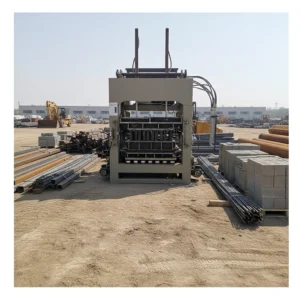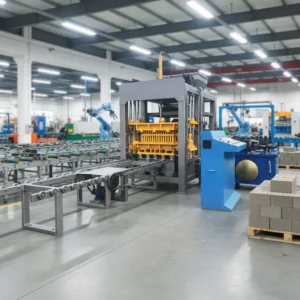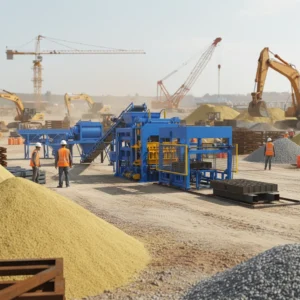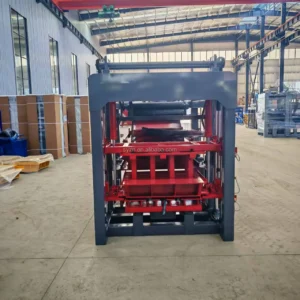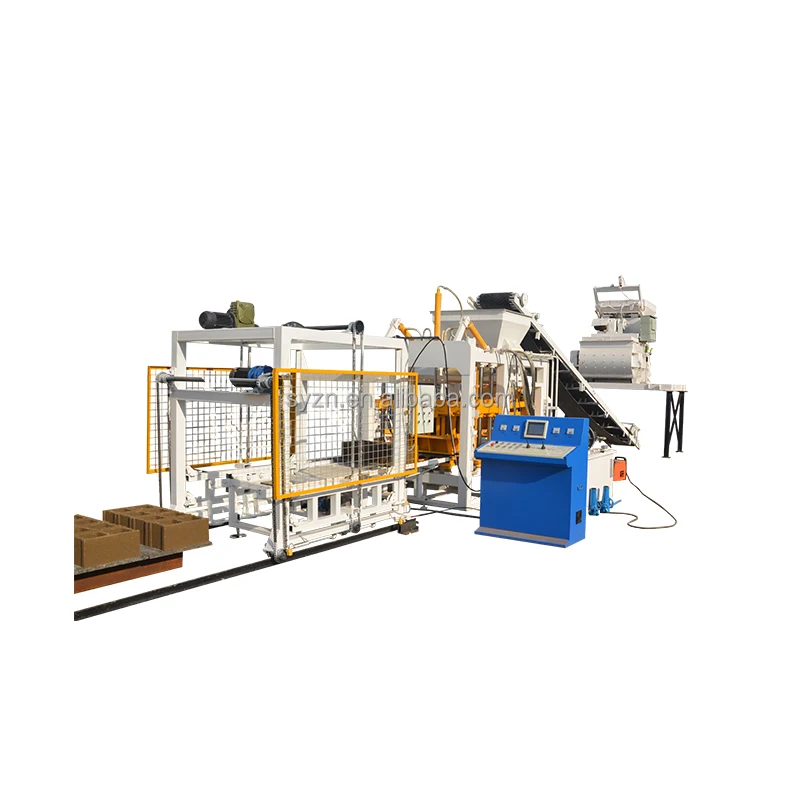
Matched Line Flow — the QT4-15A pairs press cycle with feeder and conveyor timing so the main unit is never left waiting between moulds.
Technical Specifications
| Parameter | Value |
|---|---|
| Model | QT4-15A |
| Product Type | Automatic Concrete Block Making Machine |
| Overall Dimensions (L×W×H) | 7100×1600×2610 mm |
| Vibration Frequency | 4600 r/min |
| Vibration Force (Exciting Power) | 40-50 kN |
| Total Power | 18.45 kW |
| Mixer Model | JQ350 |
| Pallet Size | 850×550×25 mm |
| Total Weight | 3 T |
| Control System | PLC control system |
| Hydraulic Station | Included (high pressure) |
| Output Capacity (Hollow Block 400×200×200 mm) | 3,264 pcs per 8-hour shift (based on 400×200×200 mm format) |
| Output Capacity (Solid Brick 240×115×53 mm) | 17,000 pcs per 8-hour shift (based on 240×115×53 mm format) |
| Included Equipment | Block making machine, hydraulic station, PLC control system, pallet feeder, brick conveyor, block sweeper |
Application Suitability
| Application | Material or Output |
|---|---|
| Standard masonry construction | Hollow blocks from crushed stone, sand, and cement |
| Paving and landscaping | Interlocking pavers from fine aggregates and fly ash |
| Infrastructure curbs | Kerbstones formed with dense concrete mixes |
| Load-bearing wall units | Solid bricks produced with high hydraulic pressure |
What "Continuous Flow" Actually Means for Your Block Plant
The press is only productive when the pallet is in place and the cured block is cleared.
Many quotations focus entirely on the press cycle time while ignoring the seconds lost to manual pallet feeding or hand-stacking at the exit. That gap between theoretical cycles and actual daily output is where most automatic block making machine production line investments fall short. I have seen operators on sites where the press sat idle for nearly half its shift simply because the pallet feeder could not keep up with the mould cycle, or because workers were still clearing the previous batch by hand. When the upstream mixer and the downstream conveyor operate on a different rhythm than the press itself, the entire line bottlenecks [NEED_CITE: synchronization of stations in concrete block production].
Synchronizing the Press with Upstream and Downstream Stations
The QT4-15A configuration includes a dedicated pallet feeder and a brick conveyor alongside the main press. This means the line does not rely on a separate worker to slide pallets into position or to pull finished blocks off the vibration table. The automatic block making machine production line is designed so that each station completes its task within the window the press allows, preventing the common scenario where a faster press is throttled by slower surrounding equipment.
Mixer Capacity Relative to Press Consumption
The JQ350 mixer included in this line must deliver enough mixed material per batch to keep the press hopper from running empty mid-cycle. If the mixer batch size is too small or the mixing time too long, the press starves and cycle times stretch. A balanced automatic block making machine production line treats the mixer as a timed component of the system, not an afterthought sourced independently [NEED_CITE: mixer sizing for continuous concrete block lines].
Interpreting Vibration and Pressure for Your Aggregate
The 40-50 kN vibration force and the hydraulic station work together during the moulding phase. Vibration compacts the mix into the mould cavity, while hydraulic pressure applies the final densification from above. On a site using lightweight volcanic aggregate instead of standard river sand, the vibration frequency of 4600 r/min may need adjustment to achieve target block density. I once spent five days in Lima retuning these parameters after a customer’s local aggregate failed to compact at default settings, which is why raw material samples should always precede the final configuration decision.
The Hidden Cost of an Undersized Supporting Line
When pallet handling and block conveying are left out of the initial purchase, the buyer ends up hiring extra labour to fill those gaps manually. Over a year, the wages for two or three additional workers typically exceed the cost of the pallet feeder and conveyor that should have been in the original quotation. Beyond wages, manual handling introduces inconsistent pacing — the press waits, then rushes, producing uneven block density across the shift [NEED_CITE: labour costs in manual versus semi-automatic block plants].
Why Sourcing the Full Line from One Supplier Matters
Every component in the QT4-15A line — press, mixer, pallet feeder, conveyor, sweeper — is specified against the same cycle time target. When these stations come from separate vendors, interface mismatches become the buyer’s problem to solve on-site. The PLC control system manages the sequence across stations, and having one supplier responsible for the logic eliminates finger-pointing when a timing fault occurs. Pallet dimensions of 850×550×25 mm are confirmed at quotation stage, allowing the buyer to prepare curing racks and forklift capacity before the machine arrives. Configuration is set against the buyer’s actual mix design and target block format rather than a default catalogue entry. Factory testing covers the full line running together, not the press in isolation.
Documentation & Verification
- Line layout drawing showing station spacing for the QT4-15A footprint
- Capacity calculation sheet stating block format assumed for each output figure
- Hydraulic and electrical schematic for local maintenance reference
- Voltage, frequency, and PLC display language confirmation document
- Factory test record with the buyer’s specified mould installed
- Pallet specification sheet matched to curing area planning
Installation, Commissioning & Support
- Foundation plan based on the 7100×1600 mm press footprint and vibration load
- Power connection sized for 18.45 kW total draw with dedicated circuit breaker
- Pallet feeder and conveyor alignment verified during on-site commissioning
- PLC parameter tuning against the buyer’s local aggregate and mix proportions
- Operator training covering mould change procedure and daily maintenance points
- Wear parts list identifying hydraulic seals and vibration components for first reorder
Preparing Your Line Inquiry
To size the supporting equipment correctly around the QT4-15A, share your target block formats and the daily volume you need per format. Include your local raw material type and any available sample data, along with the voltage and frequency standard at your site. If you already have curing racks or forklifts in place, send their dimensions so the 850×550 mm pallet specification can be confirmed or adjusted before production begins.
Frequently Asked Questions
Q: How is the line capacity calculated and which block format does each figure assume?
A: Every output figure is tied to a specific block size and an 8-hour shift. For example, 3,264 hollow blocks assumes the 400×200×200 mm format, while 17,000 solid bricks assumes 240×115×53 mm. A capacity calculation document is provided with your quotation showing the assumed format for every number listed.
Q: What supporting equipment is included beyond the press itself?
A: The QT4-15A line includes the JQ350 mixer, pallet feeder, brick conveyor, block sweeper, and hydraulic station. The PLC control system sequences all stations together so the press operates continuously without manual pallet handling between cycles.
Q: How do cycle times across stations align to prevent bottlenecks?
A: Each supporting station — feeder, mixer discharge, conveyor — is timed to complete its task within the press moulding window of 15-25 seconds. This prevents the press from waiting on upstream material or downstream pallet clearance, keeping actual output close to the rated figure.
Q: What voltage, frequency, and PLC language options are confirmed before shipment?
A: Voltage and frequency are confirmed in writing against your site supply before production begins. The PLC display language is also specified at the quotation stage so operators can read the interface on day one without translation delays.
Q: How should the curing area and forklift be planned around the pallet size?
A: The standard pallet measures 850×550×25 mm. Your curing rack spacing and forklift tine width should be planned around this dimension. We provide the pallet specification sheet early so your site preparation is complete before the machine arrives.