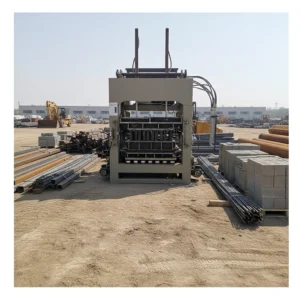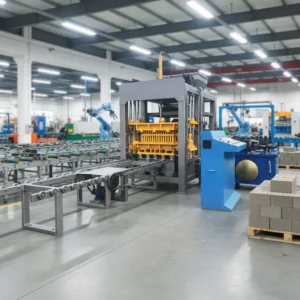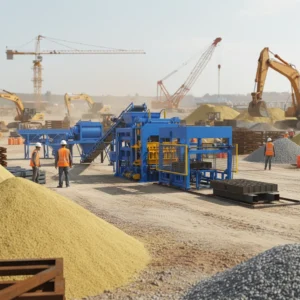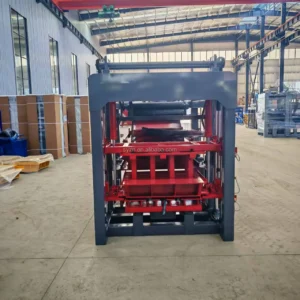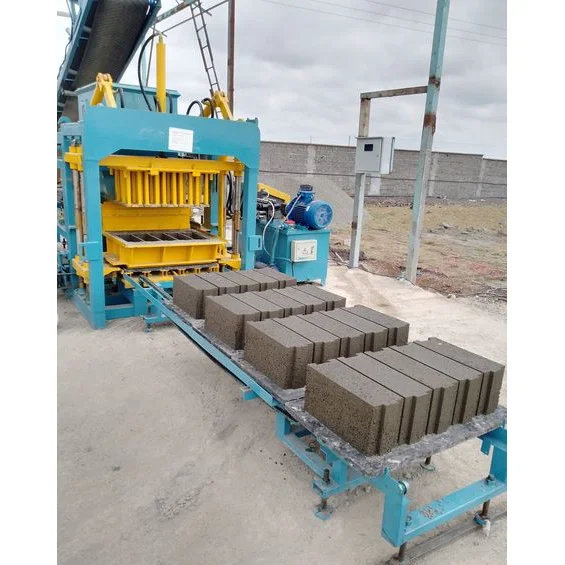
Matched Line Integration — the QT4-15A ships with pallet feeder, brick conveyor and block sweeper specified against the press cycle, so upstream and downstream stations do not bottleneck the molding station.
Technical Specifications
| Parameter | Value |
|---|---|
| Product Type | Hydraulic Block Making Machine |
| Model | QT4-15A |
| Overall Dimensions (L×W×H) | 7100×1600×2610mm |
| Molding Cycle | 15-25s |
| Vibration Frequency | 4600 r/min |
| Vibration Force | 40-50kN |
| Total Power | 18.45kW |
| Mixer Model | JQ350 |
| Pallet Size | 850×550×25mm |
| Total Weight | 3T |
| Control System | PLC control system |
| Hydraulic Station | Included |
| Automation Level | Semi-automatic (pallet feeder, brick conveyor, block sweeper included) |
| Output Capacity | 408 pcs/hr (basis: 400×200×200mm hollow block, 4 pcs/mould) |
| Output Capacity | 510 pcs/hr (basis: 400×150×200mm hollow block, 5 pcs/mould) |
| Output Capacity | 2100 pcs/hr (basis: 240×115×53mm solid brick, 18 pcs/mould) |
| 8-Hour Shift Output | 3264 pcs (basis: 400×200×200mm hollow block) |
| 8-Hour Shift Output | 4080 pcs (basis: 400×150×200mm hollow block) |
| 8-Hour Shift Output | 17000 pcs (basis: 240×115×53mm solid brick) |
| Mould Format Coverage | Paver, solid block, hollow block, curbstone (mould change required) |
| Raw Materials | Crushed stone, sand, cement, dust, fly ash |
| Voltage & Frequency | Confirm before production |
| PLC Display Language | Confirm before delivery |
Application Suitability
| Application | Material or Output |
|---|---|
| Hollow block production for masonry walls | Crushed stone, sand, cement at 400×200×200mm or 400×150×200mm formats |
| Solid brick manufacturing for load-bearing and partition work | Sand, cement, fly ash at 240×115×53mm format |
| Paving block production for driveways and walkways | Crushed stone, sand, cement with colour pigment where required |
| Curbstone forming for road and site perimeter work | Coarse aggregate, sand, cement in heavy-section moulds |
| On-site block production for housing and development contractors | Locally sourced aggregate matched to mix design |
What "Pieces per Hour" Leaves Out About Block Line Equipment
A press rated at 408 pieces per hour is meaningless if the pallet feeder runs slower or the conveyor backs up.
I once watched a QT4-15 class press sit idle for nine seconds per cycle because the pallet feeder could not keep up. The buyer had compared quotations on press speed alone, ignoring the block production line equipment around it. [NEED_CITE: mismatched cycle times between press and feeder stations reduce effective daily output]. The supporting stations — feeder, conveyor, sweeper — must be specified to the same cycle window, or the press capacity quoted on paper never reaches the curing yard. This block making machine with supporting equipment arrives with those stations included and timed to the 15-25 second molding window, so the line moves as one unit rather than a collection of mismatched speeds.
How the Supporting Stations Connect to the Press
Every block production line equipment setup has a sequence: raw material feeds the mixer, mixed material drops into the press hopper, the press molds on a pallet, the pallet moves to the conveyor, the sweeper cleans the block surface, and the pallet returns for the next cycle. If any station in that chain is slower than the press, the press waits. The QT4-15A line includes the pallet feeder, brick conveyor and block sweeper as part of the base configuration, so these three stations are specified to match the 15-25 second cycle rather than sourced separately and hoping they keep pace.
Where the Line Ends and the Buyer Takes Over
The press and its immediate supporting stations are covered, but a complete block making machine with supporting equipment setup extends beyond the sweeper. Curing racks, stacking, forklift handling and the raw material batching plant sit outside this package. The JQ350 mixer is included, but buyers planning higher output or multiple mix designs should verify mixer batch volume against daily throughput targets. [NEED_CITE: block plant layout requirements for curing area relative to daily production volume]. Defining the boundary between included stations and buyer-supplied equipment before the order is placed prevents gaps that stall the line after commissioning.
Reading the Specs Against Your Block Format
The vibration force of 40-50kN at 4600 r/min works with hydraulic pressure to compact the mix into the mould. For hollow blocks at 400×200×200mm, the press produces 4 pieces per mould, reaching 408 pcs/hr and 3264 pieces in an 8-hour shift. Switching to the smaller 400×150×200mm hollow format raises that to 510 pcs/hr because the mould holds 5 pieces. For solid bricks at 240×115×53mm, the mould holds 18 pieces, pushing output to 2100 pcs/hr. These figures assume the stated format — they are not interchangeable. The pallet size of 850×550×25mm must also match the curing racks and forklift tines already on site, or pallets will not stack correctly in the yard.
When the Supporting Equipment Is Missing from the Quote
Buyers who select a press on vibration force and cycle time alone often discover after delivery that pallet handling was never quoted. The blocks leave the press but pile up at the end of the conveyor with no sweeper to finish the surface and no pallet return system to feed the next cycle. [NEED_CITE: hidden costs of sourcing pallet handling and conveying separately from the block press]. Workers end up lifting wet blocks by hand, pallets go missing, and the daily output falls to a fraction of what the press alone could deliver. The block production line equipment approach here packages the feeder, conveyor and sweeper with the press so those gaps do not surface on the first production day.
Why This Line Is Configured as a System
The QT4-15A is built around block machinery as a single focus, meaning the press, mould, pallet and handling stations are specified together rather than assembled from unrelated suppliers. The configuration starts from the buyer’s actual mix design and target block format — not a catalogue default. [NEED_CITE: importance of matching vibration force and hydraulic pressure to local aggregate characteristics]. Mould design covers the formats the buyer’s market actually sells, including custom drawings where standard formats do not fit. The semi-automatic level allows a buyer to start here and add automatic stacking or cubing later. Installation includes operator training so the crew understands cycle timing across every station, not just the press controls.
Documentation & Verification
- Line layout drawing showing pallet feeder, conveyor and sweeper positions relative to the press
- Capacity calculation stating which block format each pcs/hr figure assumes
- Hydraulic and electrical schematic with voltage and frequency confirmed for your site
- Factory test record showing cycle time per mould format before dispatch
- Pallet specification sheet checked against your curing rack dimensions and forklift capacity
- Operation and maintenance manual covering all included stations
Installation, Commissioning & Support
- Foundation must support 3T total weight across the 7100×1600mm line footprint with level tolerance for pallet tracking
- Power supply must deliver 18.45kW at the confirmed voltage and frequency with a dedicated circuit breaker
- Line arrives in modular sections for reassembly — press, feeder, conveyor and sweeper bolt together on site
- PLC display language confirmed before shipment so operators read alarms and cycle data in their working language
- First production run includes cycle time verification per mould format with the buyer’s local aggregate
- Wear parts list covers hydraulic seals, vibration springs and mould liners with reorder intervals
What to Prepare Before Requesting a Quotation
Send the target block format and dimensions you sell most, the daily output you need from an 8-hour shift, and the raw materials available locally — especially the aggregate type and maximum particle size. Confirm the voltage and frequency at your site, the PLC language your operators will use, and the pallet size your existing curing racks and forklift can handle. If you have a mixer or batching plant already in place, share its model and batch capacity so the JQ350 can be evaluated against your throughput.
Frequently Asked Questions
Q: How is line capacity calculated for each block format?
A: Each pcs/hr figure assumes a specific mould cavity count and block dimension. The 408 pcs/hr rating applies to 400×200×200mm hollow blocks with 4 cavities per mould. Switching to a different format changes cavity count and cycle time, so output shifts accordingly. Always check which format a capacity figure references before comparing lines.
Q: Which supporting stations are included and what must I add separately?
A: The pallet feeder, brick conveyor, block sweeper, JQ350 mixer and PLC cabinet are included. Buyers supply the curing racks, stacking area, forklift and any raw material silos or batching systems beyond the mixer. This keeps the block production line equipment package transparent about where included stations end.
Q: How do feeder and conveyor cycle times match the press?
A: The pallet feeder and brick conveyor are specified to complete their movements within the 15-25 second molding window. If either station took longer, the press would idle until the pallet arrived or cleared. Matching these times is why the block making machine with supporting equipment is quoted as one line rather than separate items.
Q: What electrical details must be confirmed before shipment?
A: Voltage, frequency and PLC display language must all be confirmed before production starts. A 380V/50Hz press shipped to a 440V/60Hz site will not commission without motor and transformer changes. The PLC language determines whether your operators can read cycle data and fault codes on day one.
Q: How does the JQ350 mixer capacity align with press output?
A: The JQ350 batch volume must cover the material consumed per cycle across the chosen block format. For solid brick output at 2100 pcs/hr, material consumption is higher than for hollow blocks at 408 pcs/hr. Buyers targeting the higher-output formats should verify that mixer batch frequency keeps pace with the press hopper demand.