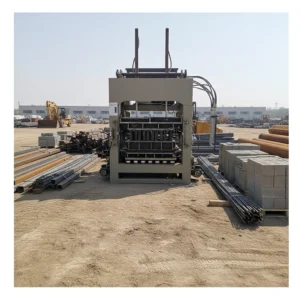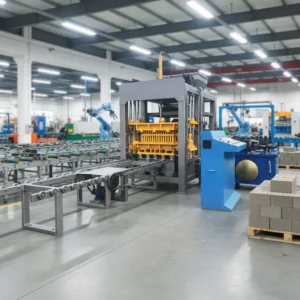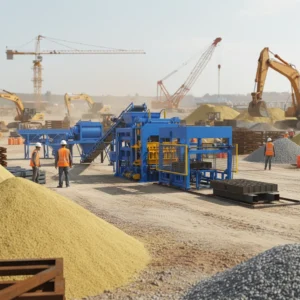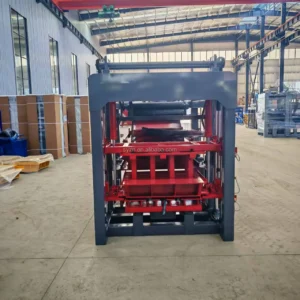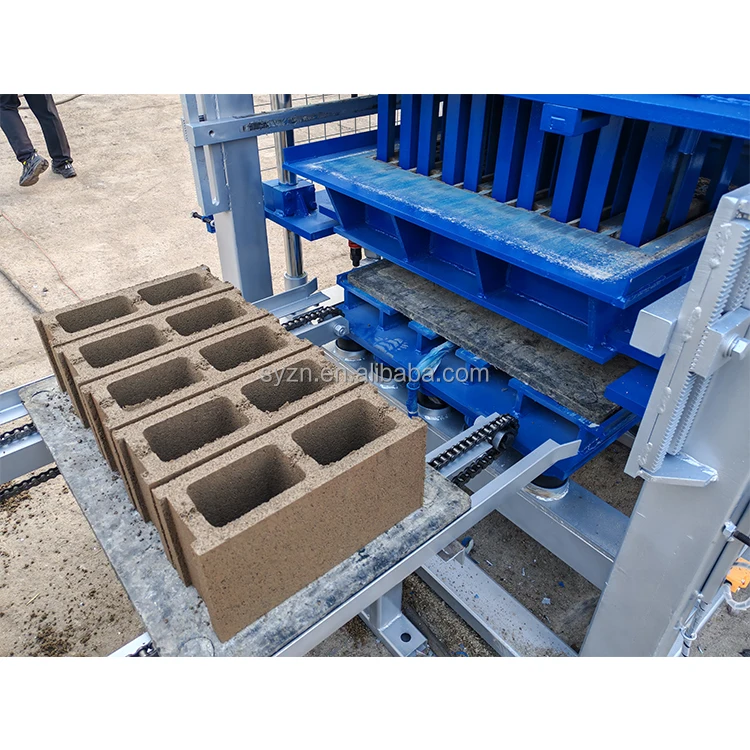
Coordinated Line Design — every station from the mixer through the stacker is timed so the QT4-15A press never sits idle waiting for a pallet or a batch.
Technical Specifications
| Parameter | Value |
|---|---|
| Model | QT4-15A |
| Product Type | Fully Automatic Concrete Block Making Machine |
| Overall Dimensions (L×W×H) | 4100×1600×2600 mm |
| Rated Pressure | 16–21 MPa |
| Main Vibration Form | Platform Vibration |
| Vibration Frequency | 4200 r/min |
| Vibration Force | 55 kN |
| Pallet Size | 880×550 mm |
| Molding Cycle | 25–30 s (basis to be confirmed by block format, material, and thickness) |
| Overall Power | 18.45 kW |
| Total Mass | 4 T |
| Demolding Method | Hydraulic |
| Automation Level | Fully automatic |
| Factory Area Required | 300 m² |
| Applied Products | Concrete blocks, hollow/solid blocks, pavers, interlocking blocks, curbstone, colored pavers |
| Raw Material | Crushed stone, sand, cement, fly ash, gravel, slag |
| Container Loading | 1×40HQ (for basic equipment) |
Application Suitability
| Application | Material or Output |
|---|---|
| Hollow block production for building walls | Crushed stone, sand, and cement |
| Solid block production for load-bearing structures | Gravel, sand, and cement |
| Paver and interlocking brick production | Fly ash, sand, and cement with pigment |
| Kerbstone and curb production | Coarse aggregate and cement |
| Porous brick for permeable paving | Graded aggregate and cement |
Why "Cycles Per Hour" Misses the Real Output of an Automatic Block Making Machine Production Line
A press is only as fast as the slowest station feeding it.
Many buyers compare machines solely on the press cycle time, only to find the actual daily output far below the quoted figure once the line is running. The bottleneck is rarely the press itself; it is usually the pallet return system, the mixer discharge, or the stacker waiting for a forklift. When an automatic block making machine production line is not balanced from raw material infeed to the curing rack, the press sits idle for several seconds every cycle, and those gaps accumulate into thousands of missing blocks per shift [NEED_CITE: typical output shortfall from unbalanced block line stations].
Balancing Every Station Around the Press
The QT4-15A is configured as part of a complete block production setup where the pallet feeder, press, and stacker share a common cycle logic. The automatic block making machine production line must ensure that a fresh pallet arrives at the press the instant the previous one exits, and that the wet stacker clears the finished pallet before the next one is pushed out. This coordination removes the idle seconds that silently cut daily volume.
Matching Pallet Size to the Curing Area and Forklift
An 880×550 mm pallet is not an arbitrary choice; it is selected to fit the curing rack dimensions and the fork spread of the forklift already on site. When the pallet size is confirmed against the buyer’s existing handling equipment, the line avoids the costly workaround of buying a new forklift or rebuilding the curing zone after arrival [NEED_CITE: pallet and curing rack coordination in block plants].
Reading the Specifications That Matter for Block Density
The platform vibration at 4200 r/min delivers a 55 kN force, and the hydraulic system applies 16–21 MPa of pressure. Together, these two values determine how tightly the aggregate is compacted inside the mould. If vibration is strong but pressure is low, the block surface may be smooth but the core remains porous. If pressure is high but vibration is weak, the aggregate cannot settle into the mould corners. The QT4-15A pairs both systems so the block achieves consistent density across its full cross-section, which is critical for load-bearing hollow blocks and interlocking pavers alike. The 25–30 second molding cycle applies to a specific block format and mix; buyers should confirm the cycle with their target product before calculating daily output.
The Hidden Cost of Leaving Supporting Equipment to Chance
When pallet handling, stacking, and curing rack systems are sourced separately or omitted from the quotation, the line may run, but the press will frequently wait for manual intervention. Workers pulling pallets by hand or stacking wet blocks on the floor introduce delays that no press cycle chart captures [NEED_CITE: manual pallet handling impact on block line throughput]. The result is a line that technically works but produces well below the capacity the buyer planned and financed.
What Makes This Line Configuration Different
The machine, mould, pallet, and handling equipment are specified as one matched system, not assembled from separate suppliers with mismatched cycle times. The line layout includes a capacity calculation that states the block format assumed, so the buyer knows exactly what output to expect. Mould design covers the formats the buyer’s market actually sells, and custom moulds can be produced from buyer drawings. The automation level is selectable, allowing a buyer to start semi-automatic and upgrade the stacker or pallet feeder later without replacing the press. Voltage, frequency, and PLC display language are confirmed before production, avoiding the commissioning delays that happen when a control panel arrives in a language the operators cannot read.
Documentation & Verification
- Line layout and capacity calculation stating the block format assumed for the quoted cycle
- Machine specification sheet with hydraulic and electrical schematic for the 18.45 kW power configuration
- Mould drawing and format list covering hollow, solid, paver, and interlocking block options
- Pallet specification for 880×550 mm boards matched to curing rack and forklift dimensions
- Voltage, frequency, and PLC display language confirmation record signed before production
- Factory test record on the buyer’s target block format before dispatch
Installation, Commissioning & Support
- Foundation plan for the 4100×1600 mm press footprint and 300 m² factory area requirement
- Dedicated power circuit specification for the 18.45 kW overall load and local voltage
- Dismantling and container loading plan for 1×40HQ shipment of basic equipment
- On-site assembly and first-run parameter setting for the hydraulic and vibration systems
- Operator training on PLC controls, mould change procedure, and daily maintenance schedule
- Wear parts list and mould maintenance guide for ongoing production
Before You Request a Quote
To size this automatic block making machine production line correctly, share the block formats your market sells and the target daily output for each format. Specify the raw materials available locally, including aggregate grading and any fly ash or slag you plan to use. Confirm the voltage and frequency at the site, the control panel language your operators need, and the pallet and forklift dimensions already in your curing area.
Frequently Asked Questions
Q: How is the line cycle time balanced so the press, pallet feeder, and stacker operate without idle gaps?
A: Each station’s cycle is mapped against the QT4-15A press cycle so the pallet feeder delivers a board and the stacker clears a finished pallet within the same window. The PLC coordinates these movements, and the layout document shows the timing sequence for the buyer’s chosen block format.
Q: What supporting equipment is included in the quotation?
A: The scope covers raw material feeding, mixing, pallet feeding, the press, automatic stacking, and curing rack handling. Each item is listed with its cycle time so the buyer can verify the line is balanced before confirming the order.
Q: How is the pallet size selected to match the curing area and forklift?
A: The 880×550 mm pallet is checked against the buyer’s curing rack spacing and forklift fork width. If the existing equipment requires a different size, the pallet specification and mould are adjusted before production to avoid handling problems on site.
Q: What automation level is recommended, and what is the upgrade path?
A: The QT4-15A is fully automatic, but buyers can start with manual pallet handling and add the automatic stacker or pallet feeder later. The press and PLC are configured to accept these additions without a full control replacement.
Q: How are voltage, frequency, and control language confirmed before shipment?
A: A confirmation document listing the site voltage, frequency, and PLC display language is signed before production begins. This prevents the common delay where the machine arrives and the control panel does not match the local power supply or operator language.