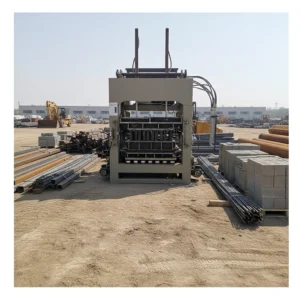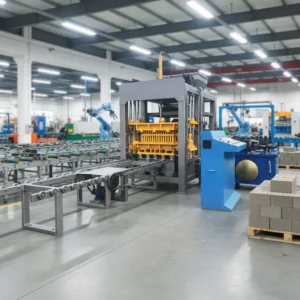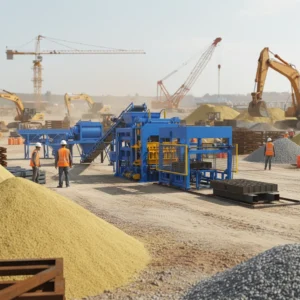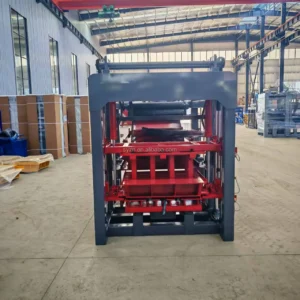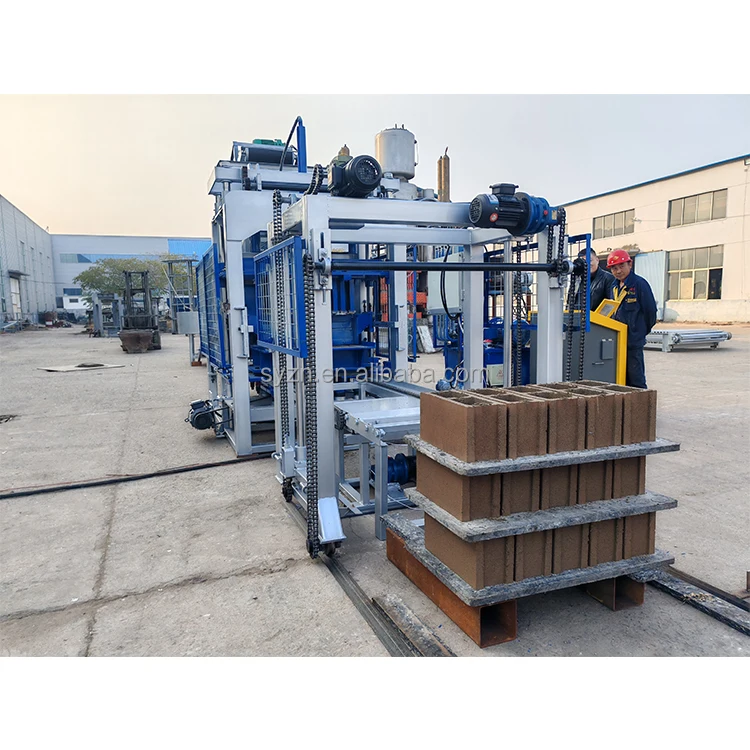
Matched Line Integration — every station from raw material feeding through curing rack handling is cycle-balanced so the press never idles waiting for upstream or downstream equipment.
Technical Specifications
| Parameter | Value |
|---|---|
| Model | QT4-15A |
| Product Type | Fully Automatic Concrete Block Making Machine |
| Overall Dimensions (L×W×H) | 4100×1600×2600 mm |
| Rated Pressure | 16–21 MPa |
| Main Vibration Form | Platform Vibration |
| Vibration Frequency | 4200 r/min |
| Vibration Force | 55 kN |
| Pallet Size | 880×550 mm |
| Molding Cycle | 25–30 s (basis not stated in source — confirm block format / material / thickness) |
| Overall Power | 18.45 kW (source value — verify against manufacturer catalog) |
| Total Mass | 4 T |
| Demolding Method | Hydraulic |
| Factory Area Requirement | 300 m² |
| Applied Products | Concrete blocks, hollow/solid blocks, pavers, interlocking blocks, curbstone, colored pavers |
| Raw Material | Crushed stone, sand, cement, dust, fly ash, gravel, slag |
| Automation Level | Fully automatic |
| Control System | To be confirmed at order |
| Voltage & Frequency | To be confirmed at order |
| Warranty | 1 year |
Application Suitability
| Application | Material or Output |
|---|---|
| Hollow block production for building walls | Crushed stone, sand, cement, fly ash blends |
| Solid block manufacturing for load-bearing structures | Gravel, cement, slag aggregates |
| Paving block production for walkways and driveways | Colored aggregates, sand, cement |
| Interlocking block forming for retaining walls | Crushed stone, dust, cement mixes |
| Curbstone production for road edges | Coarse gravel, cement, sand |
| On-site block production for housing projects | Locally sourced aggregate and cement |
What a "25–30 Second Cycle" Actually Means for Your Line
The press cycle is only one station — upstream mixing and downstream stacking must keep the same pace or the entire fully automatic concrete block making machine production line stalls.
I once configured a block line where the host press ran a consistent cycle, but the mixer discharge could not keep up. The press sat idle for seconds at a time, and over a shift that added up to thousands of missing blocks. The quotation had stated a cycle figure without naming the block format it assumed, so the buyer expected daily output that the line could never deliver. When planning a fully automatic concrete block making machine production line, the cycle number must be tied to a specific block format, wall thickness, and mix design — otherwise it is a number without meaning. [NEED_CITE: block format and cycle time relationship in concrete block production]
How Upstream Feeding and Mixing Must Match the Press Rhythm
The QT4-15A completes a molding cycle in 25–30 seconds, but that figure depends on the block format and material being formed. For a fully automatic concrete block making machine production line to hold that pace, the raw material batching and mixing station must discharge a fresh batch before each cycle begins. If the mixer is undersized or the feeding conveyor runs too slowly, the press waits — and waiting presses produce nothing. Line planning starts by calculating the exact volume of mixed material each cycle consumes, then sizing the mixer and feeder to deliver that volume within the cycle window.
Pallet Circulation as the Hidden Bottleneck
Pallets carry every molded block from the press through curing and into stacking. The 880×550 mm pallet size on the QT4-15A determines how many blocks ride on each board, which in turn dictates how many pallets must be in circulation at any moment. If the pallet return conveyor is too slow or the curing rack system cannot accept pallets fast enough, the press has nowhere to place molded blocks and must pause. A complete line specification accounts for pallet quantity, return speed, and curing rack capacity as one coordinated loop rather than treating pallets as an afterthought. [NEED_CITE: pallet circulation rate and block line throughput dependency]
Reading the Numbers That Shape Block Density
The QT4-15A pairs platform vibration at 4200 r/min with 55 kN vibration force and 16–21 MPa hydraulic pressure. In concrete block forming, vibration compacts the mix into the mould while hydraulic pressure locks that compaction in place. If vibration force is high but hydraulic pressure is low, blocks emerge with a smooth surface but low internal density — they crack under load. If pressure is high but vibration is weak, the mix does not flow fully into the mould corners, leaving incomplete edges. Both parameters must be matched to the buyer’s specific aggregate gradation and cement ratio, which is why line configuration begins with a sample of the local raw material rather than a catalog default. The 4 T total mass of the machine provides the structural rigidity needed to absorb repeated vibration cycles without frame fatigue, and the 4100×1600×2600 mm footprint must be read alongside the 300 m² factory area requirement that includes material storage, curing zone, and handling equipment.
When Supporting Equipment Gets Left Out of the Quote
A quotation that covers only the press leaves the buyer responsible for sourcing mixers, pallet feeders, stackers, and curing racks separately — and those separately sourced stations rarely match the press cycle. The result is a line that never reaches its stated output, with workers manually stacking blocks because the automatic stacker was never included. Pallet size may not fit the buyer’s existing forklift or curing racks, forcing an unplanned equipment purchase. These gaps do not show up until installation day, when the line layout on paper meets the physical reality of the factory floor. [NEED_CITE: common block line integration gaps in equipment quotations]
Why Sourcing the Full Line From One Supplier Changes the Outcome
Block machinery is our single focus, so the QT4-15A press, moulds, pallets, and handling stations are specified as one matched system rather than assembled from separate vendors. Line configuration is set against your actual mix design, local aggregate, and target block format — not a catalog default. Pallet size and material are cross-checked against your curing area dimensions and forklift capacity before the order is finalized. Voltage, frequency, and PLC display language are confirmed during production so commissioning is not delayed after the equipment arrives. Mould design covers the formats your market actually sells, including custom drawings when standard moulds do not fit your product range. Every supporting station is cycle-balanced to the press so no single point constrains the output you planned for.
Documentation & Verification
- Line layout drawing showing every station from feeder to stacker with cycle times noted
- Capacity calculation stating the exact block format behind the 25–30 s cycle figure
- Pallet specification sheet cross-referenced to your curing rack and forklift dimensions
- Hydraulic and electrical schematic for the complete line, not the press alone
- Factory test record run on your confirmed block format before dispatch
- Voltage, frequency, and control language confirmation document signed before production
Installation, Commissioning & Support
- Foundation plan sized to the 4100×1600 mm press footprint plus conveyor runs
- Power circuit rated for 18.45 kW total draw with voltage confirmed before wiring
- Machine arrives partially dismantled; reassembly plan covers press, feeder, and stacker
- First-run commissioning includes cycle timing verification across every station
- Operator training covers mould change, pallet loading, and PLC navigation in your language
- Wear parts list identifies hydraulic seals and vibration components with replacement intervals
What We Need to Configure Your Line
To size the supporting equipment around the QT4-15A, share your target block format and dimensions, the daily output your project or market requires, and a sample or description of your locally available aggregate. Let us know your factory’s voltage and frequency standard, the control display language your operators need, and the dimensions of your existing curing area and forklift so pallets and racks are matched from the start.
Frequently Asked Questions
Q: How is line capacity calculated and which block format is the cycle based on?
A: The 25–30 second cycle figure must be tied to a specific block format, wall thickness, and mix design. We calculate line capacity by multiplying confirmed cycles per hour by the number of blocks per pallet for your chosen format, then factoring in mixer discharge rate and stacking speed so every station keeps pace.
Q: What supporting equipment is included in the quotation?
A: A complete quotation covers raw material feeding, mixing, pallet circulation, automatic stacking, and curing rack handling alongside the QT4-15A press. Each station is listed with its cycle time so you can verify that no single point bottlenecks the line output you expect.
Q: How do upstream and downstream cycle times stay matched to the press?
A: We calculate the material volume each press cycle consumes and the pallet discharge rate it produces, then size the mixer, feeder, and stacker to meet or slightly exceed those rates. This prevents the press from idling while waiting for mixed material or an available pallet.
Q: What electrical details must be confirmed before production begins?
A: Voltage, frequency, and PLC display language are confirmed and documented before the line is built. This ensures the control system matches your factory supply and your operators can read the interface on day one, avoiding commissioning delays after the equipment arrives on site.
Q: What is the total factory footprint including handling and curing?
A: The 300 m² figure covers the press, material storage, mixing station, pallet circulation, curing zone, and stacking area together. We provide a line layout drawing showing every station so you can verify the footprint fits your available floor space before the order is finalized.