
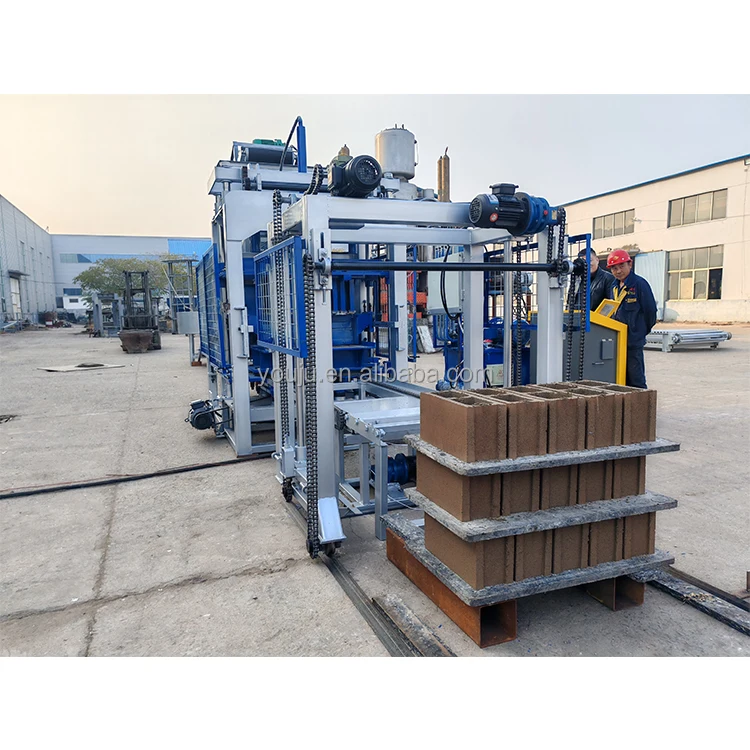
Matched System Line Design — the QT4-15 block production line is configured so upstream mixing, pallet circulation and downstream stacking are timed to the press cycle, preventing idle seconds that erase quoted daily output.
Technical Specifications
| Parameter | Value |
|---|---|
| Model | QT4-15 |
| Product Type | Hydraulic Block Making Machine |
| Molding Cycle | 15-30s |
| Pallet Size | 900×500 mm |
| Vibration Type | Platform vibration |
| Vibration Frequency | 50-70 Hz |
| Product Height Range | 50-220 mm |
| Overall Power | 24.5 kW |
| Demolding Method | Hydraulic |
| Control System | PLC |
| Output (hollow block 400×200×200 mm) | 900-1,200 pcs/h |
| Output (hollow block 400×150×200 mm) | 1,080-1,440 pcs/h |
| Output (hollow block 400×100×200 mm) | 1,440-1,920 pcs/h |
| Output (paver 200×100×60 mm) | 2,880-3,840 pcs/h |
| Output (solid brick 240×115×53 mm) | 5,930-6,720 pcs/h |
| Mould Qty per Cycle (hollow 400×200×200 mm) | 4 pcs |
| Mould Qty per Cycle (hollow 400×150×200 mm) | 5 pcs |
| Mould Qty per Cycle (hollow 400×100×200 mm) | 8 pcs |
| Mould Qty per Cycle (paver 200×100×60 mm) | 16 pcs |
| Mould Qty per Cycle (solid 240×115×53 mm) | 28 pcs |
| Compressive Strength of Blocks | >15 MPa |
| Raw Materials | Fly ash, slag, gangue, sand, crushed stone, cement, water |
| Automation Level | Automatic (PLC controlled, hydraulic powered) |
| Assembly State | Skid-mounted / stationary plant configuration |
| Voltage & Frequency | Configurable (basis to be confirmed with buyer) |
| Overall Dimensions | (source value — verify against manufacturer catalog) |
| Net Weight | (source value — verify against manufacturer catalog) |
| Hydraulic Pressure | (source value — verify against manufacturer catalog) |
| Vibration Force | (source value — verify against manufacturer catalog) |
| Mould Change Time | (source value — verify against manufacturer catalog) |
| Standards | CE (implied — verify per shipment) |
Application Suitability
| Application | Material or Output |
|---|---|
| Hollow block production for masonry walls | Crushed stone, sand, cement, fly ash blends |
| Paving block for roads, walkways and parking | High-aggregate mixes with fine sand gradation |
| Solid brick for structural and infill work | Cement, slag and gangue combinations |
| Industrial residue utilization | Fly ash, slag, gangue as primary aggregate |
| Small-to-medium stationary block plants | Daily volume scaled to pallet circulation rate |
What "Pieces per Hour" Hides About a Block Production Line
A press rated at a given cycle time will never reach its stated output if pallets are not arriving and cured blocks are not clearing the exit.
I have watched a QT4-15 hydraulic block making machine sit idle for forty seconds between cycles because the upstream mixer discharged slower than the press consumed. Over a ten-hour shift, those dead seconds add up to thousands of missing blocks. The buyer then questions whether the press was mis-sold, when in fact the press was simply waiting for the rest of the block production line to catch up. Matching every station’s cycle to the press is what separates a quoted number from a real daily tally. [NEED_CITE: cycle time matching across block plant stations]
Station-by-Station Timing Across the QT4-15 Line
A block production line is only as fast as its slowest station. Raw material batching, mixing, belt conveying, pallet feeding, the press cycle itself, wet block transfer, stacking and curing-rack handling must each complete their task within the QT4-15’s 15-30 second molding window. If the mixer batch size is too small for one press charge, the press waits. If the pallet return conveyor runs slower than the press advance, pallets bottleneck at the press infeed. Every station is specified against the actual block format the buyer intends to run, because a paver cycle at the lower end of the range leaves more margin than a hollow block cycle at the upper end.
Where the Pallet Loop Becomes the Real Bottleneck
The 900×500 mm pallet is the unit that links press output to the curing yard. Pallets must travel from the press exit, through the stacking or transfer station, onto curing racks, and back to the press infeed in a closed loop. If curing rack spacing does not match pallet dimensions, forklift operators spend extra time aligning each layer. If the rack capacity is less than one full day’s production, pallets pile up on the floor and the loop stalls. Planning the pallet quantity, rack layout and return path before the press arrives is what keeps a block production line running without interruption. [NEED_CITE: pallet circulation planning in stationary block plants]
Reading the Specs That Actually Shape Daily Output
Platform vibration at 50-70 Hz compacts the concrete mix from below, while hydraulic demolding applies vertical pressure to release the block without cracking. Together they determine the compressive strength, rated above 15 MPa, and the surface finish buyers see on every block. The mould format — four 400×200×200 mm hollow blocks or sixteen 200×100×60 mm pavers per cycle — sets the volume that exits the press every 15-30 seconds. Overall power of 24.5 kW covers the vibration motor, hydraulic pump and conveyor drives; buyers should verify that their site supply can sustain continuous draw at this level alongside the mixer and batching equipment. The PLC coordinates material feed, vibration duration, hydraulic pressure and pallet advance as a single timed sequence, meaning any change to one parameter — such as switching from hollow blocks to pavers — requires a cycle-time adjustment across the whole block production line.
The Hidden Cost of Ignoring Line Integration
Buyers who purchase the QT4-15 as a standalone press and source mixers, conveyors and stacking stations from separate suppliers often discover that the PLC signal interface does not align. The press sends a "ready for pallet" pulse, but the external pallet feeder operates on a different timing logic, creating micro-stops every few cycles. Over a production day these micro-stops compound into meaningful lost volume. [NEED_CITE: PLC signal synchronization between press and auxiliary equipment] Separately, when voltage and frequency are not confirmed before production, the control cabinet arrives wired for a supply the site does not have, delaying commissioning by weeks while replacement transformers or contactors ship.
Why Sourcing the Whole Line From One Supplier Matters
Shiyue Intelligent Machinery configures the QT4-15 not as an isolated press but as the center of a complete block production line, so material feeding, mixing, pallet circulation, stacking and curing are specified as one matched system. Machine settings are adjusted against the buyer’s actual mix design and local aggregate, not a catalog default. Mould design covers the formats the buyer’s market sells, with custom drawings when standard shapes do not fit. Automation level is selectable, allowing a buyer to start with semi-automatic pallet handling and add automatic stacking and cubing later without replacing the press. Installation support includes operator training on the integrated PLC sequence so the crew understands how each station’s timing affects the next. [NEED_CITE: CE machinery directive requirements for integrated production lines]
Documentation & Verification
- Line layout drawing with capacity stated per block format, not a single headline figure
- Pallet specification sheet matched to curing rack spacing and forklift capacity
- Voltage, frequency and PLC display language confirmation signed before production
- Factory test record run on the buyer’s target mould format before dispatch
- Hydraulic and electrical schematic for on-site troubleshooting
- Operation and maintenance manual covering press and all auxiliary stations
Installation, Commissioning & Support
- Foundation plan sized to the QT4-15 skid footprint and vibration load
- Dedicated power circuit rated for 24.5 kW continuous draw plus mixer and conveyor loads
- Pallet return conveyor aligned on-site to match curing rack entry height
- PLC cycle parameters tuned to the buyer’s confirmed mix design during commissioning
- Operator training on mould change procedure and daily wear-part inspection
- Spare mould and hydraulic seal list provided with first shipment
Before You Request a Quote
To size the block production line around your actual site conditions, please share the block formats you plan to produce and the daily volume target for each. Include your local aggregate type, available curing yard area, and existing forklift capacity so pallet and rack dimensions can be matched. Confirm your site voltage, frequency and preferred PLC display language to avoid commissioning delays once the QT4-15 arrives.
Frequently Asked Questions
Q: How is daily output calculated per block format across the full line, not just the press cycle?
A: We take the QT4-15 molding cycle for each format — for example 900-1,200 hollow blocks 400×200×200 mm per hour — and verify that upstream mixing discharge, pallet feeding rate, stacking speed and curing-rack capacity can all sustain that pace for a full shift. The quoted daily figure reflects the slowest station, not the press alone.
Q: What upstream equipment must match the QT4-15 cycle time to avoid press idle time?
A: The mixer batch volume, discharge gate speed, belt conveyor rate and batching accuracy must together deliver one full charge of concrete within the 15-30 second press cycle. We specify mixer capacity and conveyor speed against the heaviest mix design the buyer will run so the press never waits for material.
Q: How are pallet size, curing rack layout and stacking equipment coordinated?
A: The 900×500 mm pallet is selected to fit standard curing rack spacing and the buyer’s existing forklift fork width. Rack rows, stacking station height and pallet return conveyor speed are planned so wet blocks leave the press and return empty pallets without any manual transfer or floor storage buildup.
Q: What voltage, frequency and control language options are available, and when must they be confirmed?
A: Voltage and frequency are configurable to the buyer’s site supply, and the PLC display language is set during production. All three must be confirmed in writing before the control cabinet is wired, because rewiring after arrival delays commissioning and may require replacement components that take weeks to source.
Q: Can the line be configured in stages, starting semi-automatic and adding automation later?
A: Yes. The QT4-15 can ship with manual pallet handling and basic PLC control, then accept automatic pallet feeding, stacking and cubing modules later. The press frame and hydraulic system are specified to accommodate the upgrade path so no structural modification is needed when automation stations are added.


