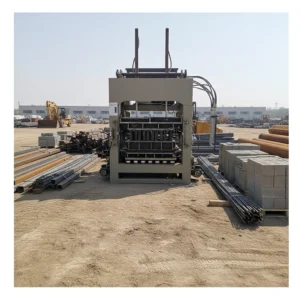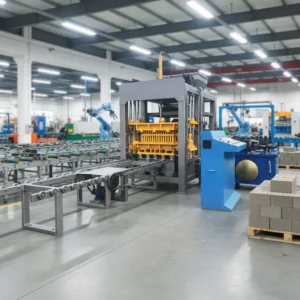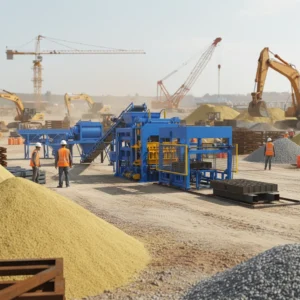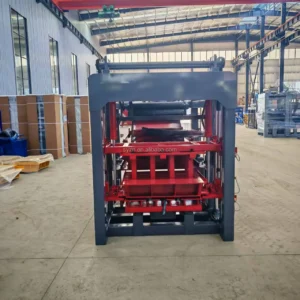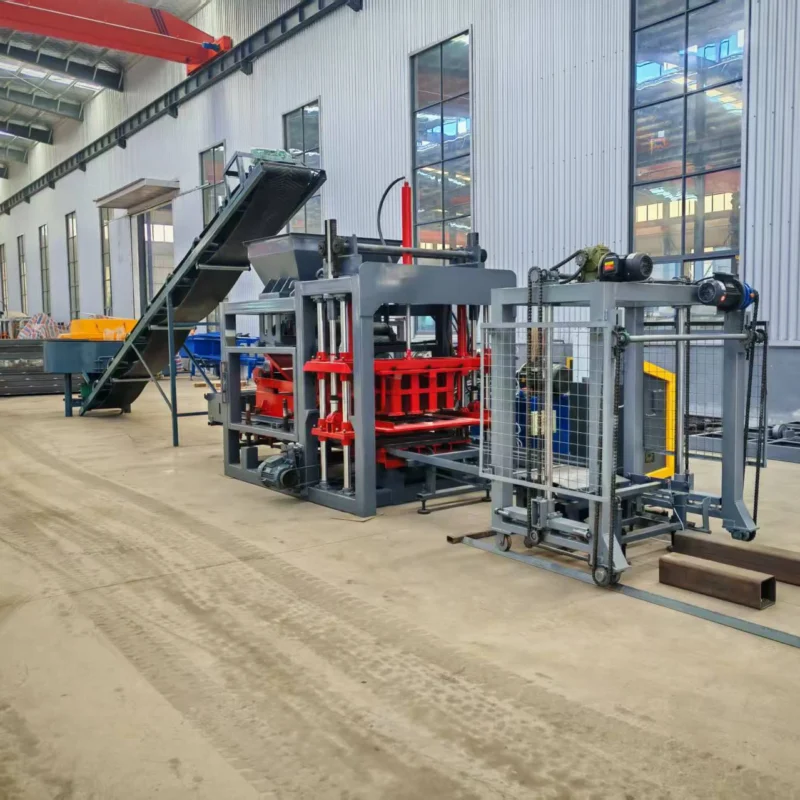
Matched System Design — the QT4-15A is specified as the centre of a coordinated block production line where mixer output, pallet return speed, and stacking capacity are calculated together so no station waits on another.
Technical Specifications
| Parameter | Value |
|---|---|
| Model | QT4-15A |
| Product Type | Fully Automatic Concrete Block Making Machine |
| Overall Dimensions (L×W×H) | 4100×1600×2600 mm |
| Rated Pressure | 16–21 MPa |
| Main Vibration Form | Platform Vibration |
| Vibration Frequency | 4200 r/min |
| Vibration Force | 55 kN |
| Pallet Size | 880×550 mm |
| Molding Cycle | 25–30 s (basis not stated in source — confirm block format / material / thickness) |
| Overall Power | 18.45 kW |
| Total Mass | 4 T |
| Demolding Method | Hydraulic |
| Factory Area | 300 m² |
| Applied Products | Concrete blocks, hollow/solid blocks, pavers, interlocking blocks, curbstone, colored pavers |
| Raw Material | Crushed stone, sand, cement, dust, fly ash, gravel, slag |
| Automation Level | Fully automatic |
| Control System | To be confirmed (PLC brand / language) |
| Voltage & Frequency | To be confirmed (target market voltage) |
| Warranty | 1 year (whole machine, excluding spare parts) |
| Loading | 1×40HQ container (for basic equipment) |
Application Suitability
| Application | Material or Output |
|---|---|
| Hollow block production for residential and commercial walls | Crushed stone, sand, cement, fly ash |
| Solid concrete block manufacturing | Gravel, sand, cement, slag |
| Interlocking and paving block runs for roads and walkways | Fine aggregate, cement, pigment for colored pavers |
| Kerbstone and curb production for infrastructure projects | Coarse aggregate, cement, sand |
| On-site block production for housing and development projects | Locally sourced sand, crushed stone, cement |
Why "Cycles per Hour" Tells Only Part of the Story
A press cycle means nothing if the pallet return loop or the stacking station cannot keep pace.
Buyers routinely receive quotations that highlight a fast press cycle while leaving out the time needed for pallets to travel back, for green blocks to be stacked, and for the mixer to deliver the next batch. When these upstream and downstream stations are undersized, the press sits idle between cycles and real daily throughput drops to a fraction of the quoted figure. I have watched a block production line QT4-15A sit waiting for pallets because the return conveyor was spec’d for a slower machine, cutting actual output nearly in half [NEED_CITE: common line bottlenecks in concrete block production].
Line Integration Starts Before the Press Arrives
When planning a turnkey concrete block plant equipment setup, the first calculation should map every station’s cycle against the press cycle. The QT4-15A completes a molding stroke in 25–30 seconds, which means the pallet feeder must deliver a fresh pallet within that window, the mixer must discharge a batch in time, and the stacker must clear cured pallets before they queue up. Miss any one of these and the entire block production line QT4-15A slows to the pace of its weakest link.
Pallet Handling as the Hidden Bottleneck
The 880×550 mm pallet size on the QT4-15A was chosen to balance block format range with curing rack dimensions. If the buyer’s existing forklift or curing area is sized for a different pallet, the mismatch shows up on day one — pallets pile up on the floor, green blocks crack during manual handling, and the automatic stacking station cannot index correctly. Specifying pallet material, return conveyor speed, and curing rack capacity alongside the press prevents these cascading delays [NEED_CITE: pallet handling impact on block plant throughput].
Reading the Numbers That Actually Matter
The 55 kN vibration force at 4200 r/min works together with 16–21 MPa hydraulic pressure to compact the mix into a dense block. Higher vibration alone will not produce a strong block if the hydraulic head pressure is too low to squeeze out air voids; too much pressure without enough vibration leaves the mix unconsolidated at the core. The 18.45 kW total power covers the press, hydraulic pump, and vibration motors — confirming that the buyer’s site transformer and dedicated circuit can sustain continuous draw at this level is a prerequisite before the line is energized. Pallet size and vibration frequency together determine which block formats can run without edge cracking, so any format change must be checked against both values rather than assumed from the mould drawing alone.
The Cost of Skipping Line-Level Coordination
When the mixer is too small for the press appetite, the QT4-15A pauses between every other cycle waiting for concrete. When the stacking station is manual but the press runs fully automatic, labour costs climb and blocks are damaged before they reach the curing racks. Voltage and frequency mismatches discovered after the machine arrives can delay commissioning by weeks while transformers or variable-frequency drives are sourced locally. These are not warranty issues — they are specification gaps that surface only when the line is expected to run as a single system [NEED_CITE: cost of line mismatch in block manufacturing plants].
What a Matched-Line Supplier Does Differently
Block machinery as a single focus means the QT4-15A press, its moulds, pallets, and handling equipment are specified as one system rather than assembled from unrelated vendors. Configuration is set against the buyer’s actual mix design and local aggregate, not a catalogue default. Mould design covers the formats the buyer’s market sells, including custom drawings for non-standard blocks. Automation level is selectable, so a buyer can start with semi-automatic pallet handling and add a stacker later without replacing the press. Installation support includes operator training on the full line, not just the press controls.
Documentation & Verification
- Line layout and capacity calculation stating which block format the daily output assumes
- Hydraulic and electrical schematics with confirmed voltage, frequency, and PLC display language
- Pallet specification sheet matching size, material, and return system to site conditions
- Factory test record covering full-line cycle coordination, not the press alone
- Mould drawing and format list showing every block type the line can produce
- Operation and maintenance manual with wear parts and mould replacement intervals
Installation, Commissioning & Support
- Foundation plan accounts for 4100×1600 mm footprint and vibration isolation requirements
- Dedicated 18.45 kW circuit with confirmed voltage and frequency before the QT4-15A is energized
- Machine arrives dismantled in one 40HQ container; reassembly sequence provided in the manual
- First-run parameter setting covers hydraulic pressure, vibration timing, and mould alignment
- Operator training addresses full-line coordination from raw material infeed to stacking
- Wear parts list identifies hydraulic seals, vibration springs, and mould liners with reorder codes
What to Prepare Before Requesting a Quotation
To size a block production line QT4-15A accurately, share your target block formats with dimensions, the daily output you need per format, and the local raw materials you plan to use. Include your site voltage and frequency, the curing area dimensions you have available, and any existing upstream or downstream equipment the new line must connect to. If you have a preferred PLC display language, state it early so the control panel is built to match before the line ships.
Frequently Asked Questions
Q: How is line-level daily output calculated from the QT4-15A press cycle time?
A: Press cycle alone does not define daily output. We calculate throughput by mapping every station — mixer discharge rate, pallet feeder speed, stacking cycle, and curing rack capacity — against the 25–30 second press cycle for each specific block format. The resulting figure states the format assumed, so buyers can verify the number before placing an order.
Q: Which stations are included in the turnkey concrete block plant equipment quotation?
A: The quotation lists every station from raw material feeding through to stacking, with clear labels for included and optional items. Pallet handling, curing rack systems, and cubing stations are specified alongside the QT4-15A press so the buyer sees the complete line cost and can decide which stations to add now or later.
Q: How does pallet size affect my existing curing area and forklift?
A: The 880×550 mm pallet must fit the curing rack spacing and the forklift fork width already on site. We confirm pallet dimensions against the buyer’s curing layout and material-handling equipment before production starts, preventing a situation where new pallets cannot be stacked or moved with existing hardware.
Q: What happens when the press cycle is faster than the pallet return speed?
A: The press waits, and daily output drops. We resolve this by matching pallet return conveyor speed to the QT4-15A cycle during line design. If the buyer’s budget requires a slower return system, we adjust the capacity calculation honestly rather than quoting a figure the line cannot sustain.
Q: Which voltage, frequency, and PLC language are confirmed before production?
A: We request the buyer’s site voltage, frequency, and preferred PLC display language during the inquiry stage and confirm them in writing before the QT4-15A enters production. This avoids commissioning delays caused by mismatched electrical components or an interface the operators cannot read.