
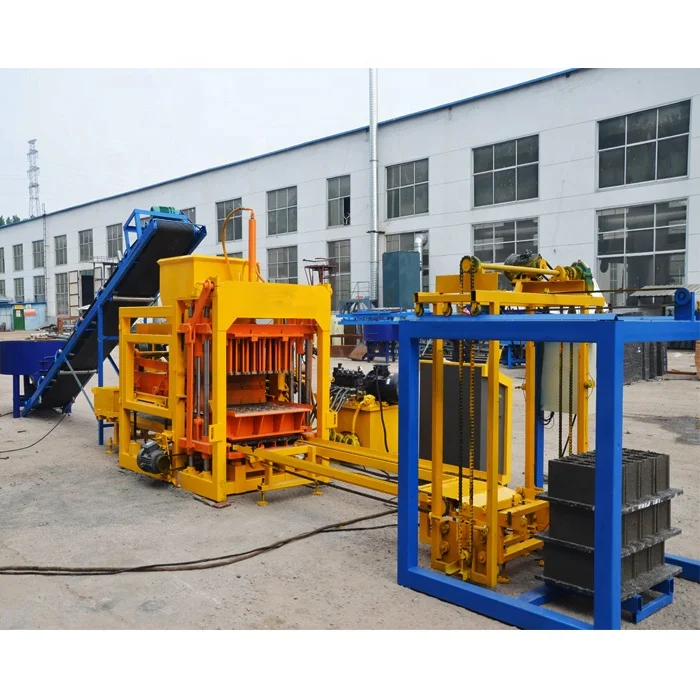
Matched Line Integration — the QT4-15 hollow block making machine is specified alongside its JS500 mixer, pallet handling, and curing coordination so the press never waits on upstream or downstream stations.
Technical Specifications
| Parameter | Value |
|---|---|
| Model | QT4-15 |
| Product Type | Hollow Block Making Machine |
| Host Machine Power | 27.5 kW |
| Moulding Cycle | 15 s (basis not stated in source — confirm block format, material, and thickness) |
| Dimension of Host Machine | 7100 × 1600 × 2610 mm |
| Pallet Size | 1020 × 570 mm |
| Weight of the Host Machine | 5 T |
| Vibration Force | 40 kN |
| Mixer Model | JS500 |
| Voltage | 380 V (frequency to be confirmed) |
| General Water Consumption | 4 T per day (source value — verify against manufacturer catalog) |
| Workers Required | 3–4 |
| Workshop Area | 150 m² |
| Motor Brand | Siemens Motor |
| Control System | Computer controlled directional vibration with frequency and brake system |
| Feeding System | Hopper with swing-type cutting device for uniform material distribution |
| Vibration Method | Table and mould vibrating together, low-frequency feeding and high-frequency vibrating |
| Photoelectric Control | Host keeping material controlled by photoelectric sensor |
Application Suitability
| Application | Material or Output |
|---|---|
| High-strength hollow block production | Cement, crushed stone, sand, and aggregate mixes |
| Cement brick manufacturing | Fly ash, slag, and cement blends |
| Concrete block format expansion | Standard and custom concrete mixes for building masonry |
| On-site block production for construction projects | Locally sourced aggregate and cement |
What "15-Second Cycle Time" Leaves Out About Your Hollow Block Making Machine Production Line
A moulding cycle is only meaningful when tied to a specific block format, material, and thickness.
Many buyers receive a quote stating a cycle time without knowing which block the figure assumes. When the actual product differs, the press rhythm desynchronizes from the mixer output and pallet feed, leaving operators waiting between cycles. I have watched a stationary block machine sit idle because the batching station could not keep up with the press, turning a theoretical throughput into a fraction of the promised number [NEED_CITE: block machine cycle time assumptions by format]. The hollow block making machine production line must be calculated per format to avoid this gap.
Mixer-to-Press Coordination Across the Line
The JS500 mixer paired with the QT4-15 is selected so that batch discharge timing aligns with the press hopper demand. When the mixer finishes a batch while the press is still consuming the previous one, material cools and loses workability. When the press runs dry, the vibration cycle produces inconsistent density block after block. This hollow block making machine production line configuration addresses that mismatch by sizing the mixer capacity to the press consumption rate.
Pallet Size and Curing Zone Alignment
The 1020 × 570 mm pallet defines how many blocks travel through the press per cycle, how they move to the curing area, and which forklift dimensions work for transport. If the curing racks on site are built for a different pallet dimension, every pallet must be manually transferred before stacking. Matching pallet specification to existing handling equipment prevents a bottleneck that no amount of press speed can overcome [NEED_CITE: pallet handling compatibility in block plants].
How Vibration Force and Hydraulic Pressure Shape Block Density
The 40 kN vibration force combined with computer controlled directional vibration determines how tightly aggregate particles compact inside the mould cavity. Low-frequency feeding spreads material evenly before high-frequency vibrating consolidates it, reducing voids and producing uniform wall thickness in hollow blocks. The hopper with swing-type cutting device ensures each mould fill receives a consistent material volume, which directly affects the dimensional tolerance of the finished block. The Siemens Motor delivers the torque required to sustain vibration intensity throughout long production runs without overheating.
The Cost of Ignoring Upstream and Downstream Timing
When a buyer purchases the press alone and sources the mixer, pallet system, and stacking separately, cycle time mismatches accumulate at every station. The press waits for material, the pallet feeder jams because blocks are not cleared fast enough, and the curing area backs up. These disruptions do not show up in a single-machine quotation but appear on the first day of production. Buyers end up paying for integration work that should have been addressed before shipment [NEED_CITE: hidden costs of unmatched block line equipment].
Why Line-Level Planning Matters for This Configuration
Block machinery is our single focus, which means the QT4-15 is specified together with its JS500 mixer, pallet dimensions, and handling stations as one matched system. Configuration is set against the buyer’s actual mix design and local aggregate rather than a catalog default, so vibration force and feeding parameters reflect real material behavior. Automation level is selectable, allowing a plant to start with manual pallet handling and add automatic stacking later. Installation support includes operator training on the complete line, not just the press controls.
Documentation & Verification
- Line layout and capacity calculation stating the block format assumed for the 15 s cycle time
- Machine specification sheet covering host power, vibration force, and pallet dimensions
- Mould drawing and format list for every block type in the production plan
- Hydraulic and electrical schematic for on-site maintenance and troubleshooting
- Voltage and control language confirmation document before dispatch
- Factory test record on the buyer’s target block format prior to shipment
Installation, Commissioning & Support
- Workshop area of 150 m² allocated for mixing, pressing, and curing zones with clear access paths
- 380 V power supply with dedicated circuit matching the 27.5 kW host machine load and mixer demand
- Host machine arrives at 5 T weight requiring appropriate foundation and overhead clearance for the 2610 mm height
- Computer controlled directional vibration system calibrated on site to the buyer’s specific aggregate and mix
- Operator training covers photoelectric sensor adjustment, mould change procedure, and daily maintenance schedule
- Wear parts list and mould inventory provided for first replacement cycle planning
Planning Your Line Starts With the Right Questions
Before requesting a quotation, prepare the block format you intend to produce, the daily output target for that specific format, and the dimensions of your available workshop space. Share the local voltage and frequency at your site, the control system language your operators require, and whether you already have curing racks and forklifts that the pallet system must match. This information allows the hollow block making machine production line to be configured around your actual conditions rather than generic defaults.
Frequently Asked Questions
Q: How do I verify the 15-second moulding cycle applies to my specific hollow block format?
A: The 15 s cycle is a reference value that changes with block dimensions, wall thickness, and material composition. Request a capacity calculation that states the exact format assumed. We provide this calculation per block type so you can compare quoted throughput against your actual product range before committing to the line.
Q: What supporting equipment stations connect to the QT4-15 press?
A: The JS500 mixer feeds the press hopper, which uses a swing-type cutting device for material distribution. Downstream, the pallet system carries formed blocks to the curing area. Each station must match the press cycle time so no station waits on another. We specify all stations together to prevent timing gaps.
Q: Is the 1020 × 570 mm pallet compatible with my existing curing racks and forklift?
A: Compatibility depends on the rack slot width and forklift tine spacing already on your site. Share your current equipment dimensions so we confirm alignment before production. A mismatch means manual pallet transfer at the curing zone, which adds labor and slows throughput across the entire line.
Q: How should I allocate the 150 m² workshop area for the complete line?
A: The space covers the mixing station, press area, pallet return path, and initial curing zone. Ceiling height must accommodate the 2610 mm host machine plus clearance for maintenance access. We provide a line layout drawing that positions each station to minimize material travel distance and keep pallet circulation continuous.
Q: What voltage and control language options are available for my market?
A: The standard configuration is 380 V, but frequency and control display language must be confirmed before production. Specify your local power grid standard and the language your operators read. This confirmation prevents commissioning delays and ensures the photoelectric control and vibration system interface are immediately usable on arrival.


