
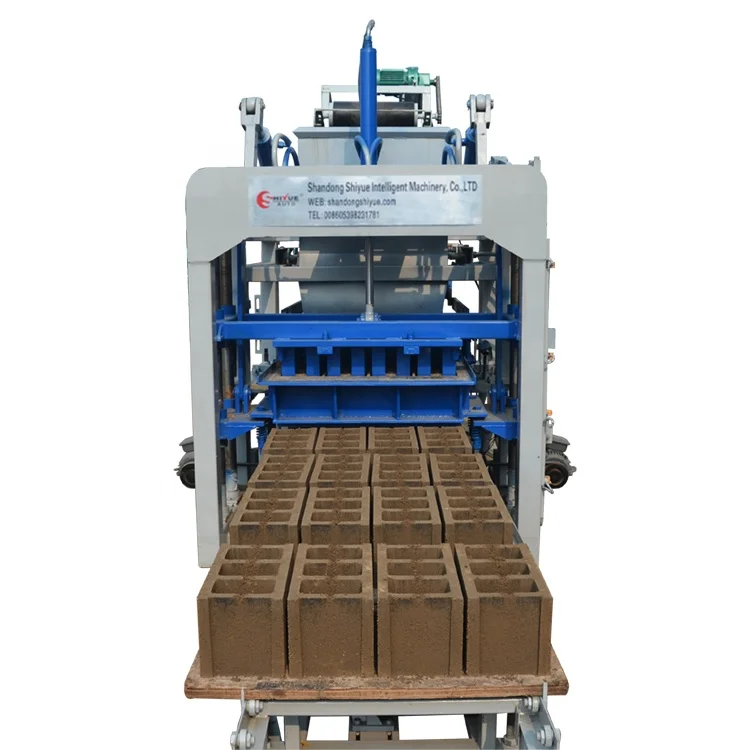
Line-Sized Configuration — raw material feeding, mixing, pallet circulation, and stacking stations are matched to the QT4-15 cycle time so no station waits on another.
Technical Specifications
| Parameter | Value |
|---|---|
| Model | QT4-15 |
| Product Type | Fully Automatic Concrete Block Making Machine |
| Overall Dimensions (L×W×H) | 7100×1600×2610 mm |
| Net Weight | 5800 kg |
| Rated Power | 27.5 kW |
| Voltage & Frequency | 380V or according to buyer needs (frequency to be confirmed) |
| Control System | PLC (brand and language options to be confirmed) |
| Vibration Force (Exciting Force) | 60 kN |
| Hydraulic Pressure | To be confirmed |
| Pallet Size | 1020×850×40 mm |
| Pallet Material | To be confirmed |
| Mould Format | Hollow block, solid block, interlocking block, paving block |
| Automation Level | Fully automatic (stacking and cubing degree to be confirmed) |
| Output Capacity | 960 pcs/h (based on 400×200×200 mm hollow block, 4 pcs/mould); 1440 pcs/h (based on 400×150×200 mm block, 6 pcs/mould); 3840 pcs/h (based on 225×112.5×53 mm solid brick, 16 pcs/mould) |
| Daily Output | 7680 pcs/day (400×200×200 mm); 11520 pcs/day (400×150×200 mm); 30720 pcs/day (225×112.5×53 mm) (working hours per day to be confirmed) |
| Color Options | According to buyer request |
| Warranty | 1 year |
| Standards | ISO 9001:2008, CE |
Application Suitability
| Application | Material or Output |
|---|---|
| Block and paver production plants | Continuous production of hollow blocks, solid bricks, interlocking pavers from local aggregate, sand, and cement |
| Construction contractors producing on-site | On-site hollow block and solid brick production using locally sourced crushed stone and cement |
| Concrete product manufacturers expanding formats | Switching between hollow block, paving block, and interlocking formats on a shared pallet circulation system |
| Development and housing project contractors | Localized block production for project-specific volumes, fitted to available yard and curing area |
What "960 Pieces per Hour" Leaves Out When the Mixer Can’t Keep Up
A press rate only matters if every upstream and downstream station matches it.
I once stood next to a QT4-15 block making machine production line in a yard outside Riyadh where the host ran smoothly, but the mixer discharged slower than the press consumed. The hopper starved, the press idled, and the daily tally dropped by nearly a third compared to the quoted figure. That gap between catalogue capacity and actual output is almost never the press itself [NEED_CITE: common causes of block plant output shortfall]. It is the feeding, mixing, pallet return, or stacking station that was never sized against the host cycle.
How the QT4-15 Block Making Machine Production Line Stations Connect
The QT4-15 block making machine production line is built around the principle that the press cycle sets the tempo for every other station. Raw material feeding and mixing must discharge a batch within the window the press takes to consume the previous one. If the mixer holds up, the press waits, and the entire line loses cycles that cannot be recovered later in the shift.
Synchronizing Pallet Circulation with Press Output
Once blocks leave the press on a 1020×850×40 mm pallet, that pallet must travel through the curing area and return to the press in time for the next cycle. If the pallet return path is too long or the forklift cannot move cured racks fast enough, the press runs out of empty pallets and stops. Line layout must account for the curing yard footprint and the forklift capacity the buyer already has on site [NEED_CITE: pallet circulation planning for block production lines].
Reading the Specs That Actually Shape Your Output
Vibration force at 60 kN works together with hydraulic pressure to compact the mix into a dense block. If the pressure is too low for a given aggregate, the block leaves the mould weak and crumbles during pallet transfer. The pallet size of 1020×850×40 mm must fit the curing racks and the forklift tines already in use; a mismatch forces the buyer to replace an entire rack system. Output figures — 960 pcs/h on 400×200×200 mm hollow blocks, 1440 pcs/h on 400×150×200 mm, and 3840 pcs/h on 225×112.5×53 mm solid bricks — each assume a specific mould and block geometry. Quoting one number without naming the format leads to unrealistic daily targets.
The Hidden Cost of an Undersized Supporting Station
When a line quotation covers only the press, the buyer discovers on arrival that pallet handling, stacking, and curing rack movement still rely on manual labour. Output piles up at the press exit, waiting for someone to carry it away. The press then throttles itself to match the slowest human in the loop [NEED_CITE: labour bottleneck in semi-automated block plants]. What was sold as a fully automatic line behaves like a manual one until the missing stations are added at extra cost and weeks of delay.
Why Procurement Here Means the Whole Line Is Specified
Block machinery is a single focus for Shandong Shiyue Intelligent Machinery Co., Ltd, so the QT4-15 press, moulds, pallets, and handling equipment are specified as one matched system rather than assembled from separate suppliers. Configuration is set against the buyer’s actual mix design and local aggregate, not a catalogue default. Mould design covers the formats the buyer’s market actually sells, with custom drawings available. Automation level is selectable, allowing a buyer to start semi-automatic and add stacking or cubing stations later. Installation and commissioning support includes operator training on the full line, not just the press.
Documentation & Verification
- Line layout and capacity calculation stating the block format assumed for each output tier
- Machine specification sheet with hydraulic and electrical schematics for the 27.5 kW rated system
- Mould drawing and format list covering hollow, solid, interlocking, and paving blocks
- Pallet specification confirming 1020×850×40 mm dimensions and material grade
- Voltage, frequency, and PLC display language confirmation in writing before production
- Factory test record on the buyer’s target block format before dispatch
Installation, Commissioning & Support
- Foundation plan sized to the 7100×1600×2610 mm overall footprint and 5800 kg net weight
- Dedicated power circuit for 27.5 kW rated load at confirmed voltage and frequency
- PLC display language and control parameters set before commissioning begins
- Operator training on mould change, pallet feeding, and stacking station coordination
- Wear parts and mould list supplied at quotation so first replacements are on hand
What to Include with Your Inquiry
Provide the block formats your market sells and the daily volume you target for each, so the line layout can be calculated per format rather than as a single blanket number. Share your local aggregate type and cement source, along with the curing yard dimensions and forklift specifications you already operate. Confirm your site voltage, frequency, and preferred PLC display language so the QT4-15 block making machine production line commissions without electrical delays.
Frequently Asked Questions
Q: How is line capacity calculated, and which block format does each output figure assume?
A: Each capacity figure is tied to a specific block format and mould cavity count. For the QT4-15, 960 pieces per hour assumes a 400×200×200 mm hollow block with 4 cavities per mould, while 3840 pieces per hour assumes a 225×112.5×53 mm solid brick with 16 cavities. The line layout document states the format behind every number.
Q: How do raw material feeding and mixing stations match the press cycle time?
A: The mixer discharge rate and feeder belt speed are calculated so that a fresh batch arrives before the press hopper empties. If the press cycle is 15 to 20 seconds per mould, the upstream stations must deliver a full batch within that window, otherwise the press idles and daily output drops.
Q: What pallet size and material are specified, and how do they relate to my existing setup?
A: The standard pallet is 1020×850×40 mm. Before production, we confirm your curing rack slot width and forklift tine spacing so the pallets fit without modification. Material — wood, bamboo, or composite — is chosen based on your curing environment and expected pallet lifespan.
Q: What supporting equipment is included in the line quotation versus left out?
A: The quotation lists each station — raw material feeder, mixer, pallet feeder, stacker, and curing rack handler — as individual line items with their own cycle times. Anything not listed is explicitly noted so you know what remains manual before the machine ships.



