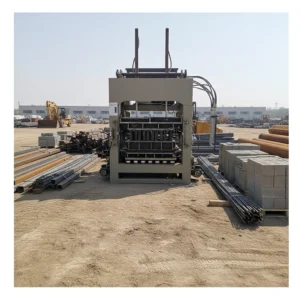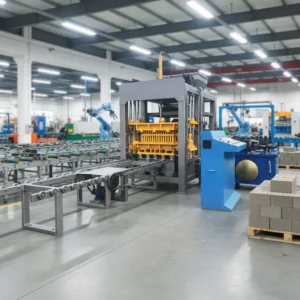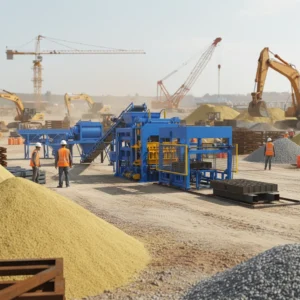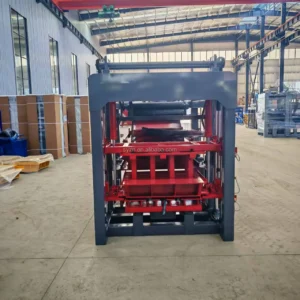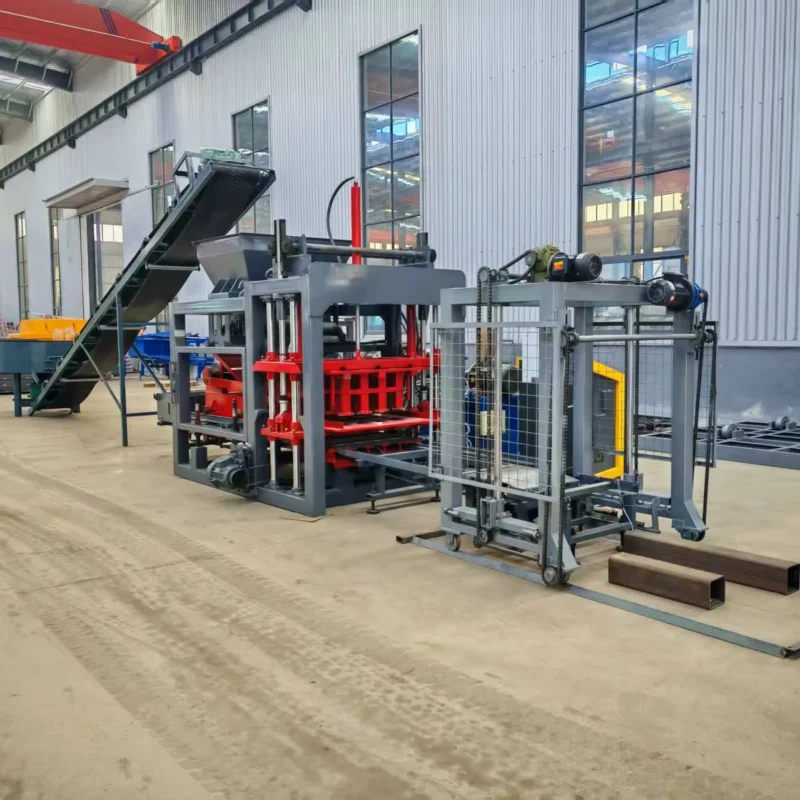
Synchronized Line Stations — every feeder, mixer and pallet return loop timed against the QT4-15 press cycle so the machine is never left idling.
Technical Specifications
| Parameter | Value |
|---|---|
| Product Type | Full Automatic Hydraulic Block Making Machine |
| Model | QT4-15 |
| Overall Dimensions (L×W×H) | 7100×1600×2610 mm |
| Host Machine Dimensions (L×W×H) | 2800×1800×2550 mm |
| Rated Hydraulic Pressure | 16 MPa |
| Main Vibration Form | Platform Vibration |
| Vibration Frequency | 4600 r/min |
| Vibration Force | 40 kN |
| Pallet Size | 950×550×20/25 mm |
| Molding Cycle | 15–25 s |
| Overall Power | 27.5 kW |
| Host Machine Power | 19.2 kW |
| General Water Consumption | 4 T/day |
| Total Mass | 5 T |
| Control System | Siemens PLC with customizable program |
| Motor | Siemens or ABB (buyer specified) |
| Hydraulic System | Double proportional hydraulic valve, Calyca or Youken brand |
| Output Capacity – Hollow Brick | 720–960 pcs/h (390×190×190 mm, 4 pcs/mold, 15–20 s cycle) |
| Output Capacity – Porous Brick | 2520–3360 pcs/h (240×115×90 mm, 14 pcs/mold, 15–20 s cycle) |
| Output Capacity – Standard Brick | 5930–6720 pcs/h (240×115×53 mm, 28 pcs/mold, 15–17 s cycle) |
| Automation Level | Full automatic |
| Warranty | 1 year for the whole machine (excluding spare parts) |
Application Suitability
| Application | Material or Output |
|---|---|
| Hollow block production for building walls | Crushed stone, sand, cement, fly ash |
| Standard solid brick manufacturing | River sand, gravel, cement binder |
| Porous brick runs for load-bearing structures | Lightweight aggregate, cement, fine sand |
| Paving block and road brick fabrication | Crushed granite, coarse aggregate, cement |
| On-site production for housing projects | Locally sourced aggregate, cement, water |
Why the Feeding Station Matters More Than the Press Itself
A block making machine production line only runs as fast as its slowest upstream station.
I once watched a fully automatic press sit idle for twelve seconds every cycle because the belt feeder could not deliver mixed material into the hopper fast enough. The press itself was rated well within its capability, but the raw material feeding station had been sized for a smaller machine. Over a ten-hour shift, those twelve-second gaps added up to thousands of missing blocks [NEED_CITE: material starvation as a primary cause of lost output in block plants]. When planning a turnkey block plant, the QT4-15 press cycle of 15–25 seconds must be matched by an equivalent throughput at the mixer discharge, the belt conveyor transfer rate, and the pallet feeding mechanism. Every station upstream and downstream has to arrive at the press at the same moment the press is ready, or the whole line stalls.
Station-to-Station Timing Across the Block Making Machine Production Line
The QT4-15 completes a molding cycle in 15 to 25 seconds depending on the block format and the target density. That window defines the tempo every other station must follow. The raw material batching and mixing station must discharge a fresh batch into the press hopper before the current charge is exhausted. The pallet feeder must present a clean, cured pallet under the mold exactly when the press table descends. If any single station runs even a few seconds late, the press waits and the entire block making machine production line loses that cycle permanently. Line layout calculations therefore start from the press cycle and work backward through each station’s transfer time [NEED_CITE: line balancing methodology in concrete product manufacturing].
Pallet Circulation and Curing Rack Synchronization
After pressing, the wet block sits on a 950×550 mm pallet that must travel through the curing area and return to the feed station. The pallet return loop includes a sweeper, a stacking elevator, and a return conveyor whose combined travel time must not exceed the press cycle multiplied by the number of pallets in circulation. When the QT4-15 runs standard bricks at a 15–17 second cycle, pallets move through the system quickly, and the curing rack handling station must accept and release racks at a matching pace. Mismatched pallet return speed forces the operator to stack blocks by hand off the press table — exactly the bottleneck the automatic line was supposed to eliminate.
Vibration Force, Hydraulic Pressure, and Block Density
The QT4-15 platform vibrates at 4600 r/min delivering 40 kN of force while the hydraulic system applies 16 MPa of pressure through a double proportional valve. Vibration compacts the aggregate into the mold cavity; hydraulic pressure then locks the compacted mass into shape before the mold lifts. If vibration force is too low for a coarse local aggregate, the block emerges with voids and fails compressive strength tests. If hydraulic pressure is too high relative to the mix water content, the block cracks on demolding. The two values must be tuned together against the buyer’s specific mix design and aggregate source.
What Happens When Line Stations Are Not Balanced
A common outcome of buying a press without its supporting stations specified together is that the machine arrives, the operator powers it on, and the mixer cannot keep up. Blocks are produced at the rate the feeder allows, not the rate the press can achieve. The buyer then believes the press is underperforming when the real constraint sits thirty feet upstream. I have seen plants add a second mixer after the fact, at considerable expense and floor space loss, to fix a problem that a matched line layout would have prevented from the start [NEED_CITE: cost of retrofitting unmatched stations in block plants]. Pallet size is another hidden mismatch — specifying pallets without checking the buyer’s existing forklift fork width or curing rack slot dimensions means pallets arrive but cannot circulate.
Why Specifying the Line as One System Matters
The QT4-15 is configured here as the center of a connected production line rather than a standalone press. Raw material feeding, mixing, pallet circulation, automatic stacking, and curing rack handling are specified against the same cycle target, so no station waits on another. Configuration is set against the buyer’s actual mix design and local aggregate, not a catalog default. Pallet size and material are chosen to align with the buyer’s curing area dimensions and existing forklift. Mould options cover the formats the buyer’s market actually sells, with custom drawings available. Automation level is selectable — a buyer can start with semi-automatic pallet handling and add stacking and cubing stations later without replacing the press.
Documentation & Verification
- Line layout and capacity calculation stating the block format assumed for each output figure
- Voltage, frequency, and PLC display language confirmation recorded before production
- Hydraulic and electrical schematic matching the as-built QT4-15 configuration
- Factory test record run on the buyer’s target block format before dispatch
- Pallet specification sheet matched to curing rack slot width and forklift capacity
- Wear parts and mould list with replacement intervals for hydraulic seals and vibration springs
Installation, Commissioning & Support
- Foundation plan sized for the 7100×1600 mm overall footprint and 5 T total mass
- Power supply confirmation for the 27.5 kW overall draw at buyer’s site voltage and frequency
- Machine arrives in modular sections for reassembly on the prepared foundation
- First-run parameter tuning of vibration force and hydraulic pressure against local aggregate
- PLC display language and batching program set to operator preference during commissioning
- Operator training covering mould change procedure and daily vibration spring inspection
Planning Your Block Line Inquiry
To size a complete block making machine production line around the QT4-15, share the target block formats you intend to sell, the daily output you need for each format, and the raw materials available locally including aggregate type and cement grade. Confirm your site voltage, frequency, and preferred PLC display language. Provide your curing area dimensions and the forklift model you plan to use so pallet size and stacking station height can be matched from the start.
Frequently Asked Questions
Q: How is daily output calculated across the full line, not just the press cycle time?
A: Daily output is derived from the press cycle time for a specific block format — for example, 720–960 hollow bricks per hour based on a 390×190×190 mm block with 4 cavities per mold and a 15–20 second cycle — then adjusted for the actual throughput of the feeder, mixer, and pallet return loop. The lowest station rate sets the line output.
Q: How do feeding, mixing, and pallet feeding stations synchronize so the press is never starved?
A: Each station’s transfer time is calculated backward from the QT4-15 cycle window. The mixer discharge rate, belt conveyor speed, and pallet feeder interval are set so that fresh material and a clean pallet arrive at the press table at the exact moment the mold lifts, preventing idle cycles.
Q: What pallet size and material is recommended based on my curing area and existing forklift?
A: The standard 950×550 mm pallet is the starting point. Material — bamboo, PVC, or steel — is selected based on the curing method and expected lifespan. Final dimensions are confirmed against your curing rack slot width and forklift fork spacing so pallets circulate without modification.
Q: Can the automation level start semi-automatic and upgrade to full stacking and cubing later?
A: Yes. The QT4-15 control system supports staged automation. A buyer can begin with manual pallet handling and add automatic stacking, cubing, and curing rack handling stations later. The press PLC program is updated to integrate the new stations without hardware replacement.
Q: What supporting equipment is included in the quotation versus what must be sourced separately?
A: The quotation covers the QT4-15 press, raw material feeder, mixer, pallet feeder, and stacking system as one matched line. Items such as the curing yard structure, forklifts, and cement silo are typically sourced locally. A full included and excluded equipment list is provided with every proposal.