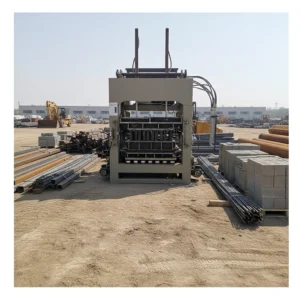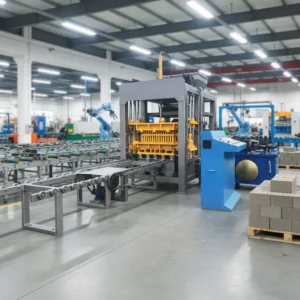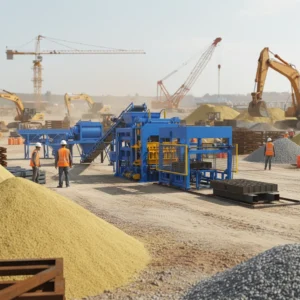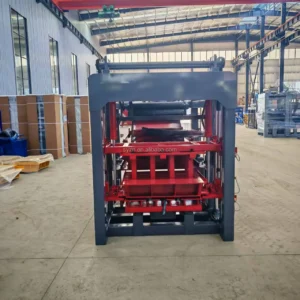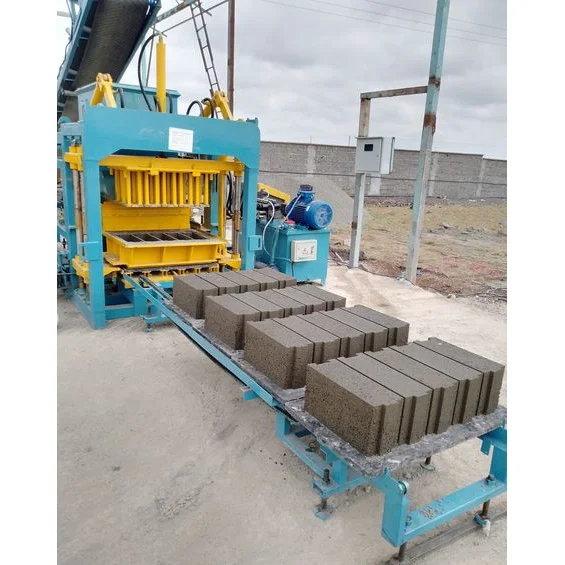
Balanced Station Cycle Times — the mixer, press, pallet feeder, and stacker are calculated together so the main unit never waits for material between stations.
Technical Specifications
| Parameter | Value |
|---|---|
| Model | QT4-15A |
| Product Type | Automatic Hydraulic Concrete Block Making Machine |
| Overall Dimensions (L×W×H) | 7100×1600×2610 mm |
| Molding Cycle | 15–25 s |
| Vibration Frequency | 4600 r/min |
| Vibration Force | 40–50 kN |
| Rated Power | 18.45 kW |
| Mixer Model | JQ350 |
| Pallet Size | 850×550×25 mm |
| Total Weight | 3 T |
| Vibration Type | Bed mould vertical vibration + upper mould compression vibration |
| Hydraulic System | Equipped (high pressure, stable operation) |
| Output (Hollow Block 400×200×200 mm) | 408 pcs/hr · 3264 pcs/8hr (4 pcs/mould) |
| Output (Hollow Block 400×150×200 mm) | 510 pcs/hr · 4080 pcs/8hr (5 pcs/mould) |
| Output (Solid Brick 240×115×53 mm) | 2100 pcs/hr · 17000 pcs/8hr (18 pcs/mould) |
| Automation Level | Semi-automatic |
| Applied Products | Paver, solid block, hollow block, curbstone |
| Raw Materials | Crushed stones, sand, cement, dust, fly ash |
| Certification | CE (where applicable) |
Application Suitability
| Application | Material or Output |
|---|---|
| Hollow block production for masonry walls | Crushed stone, sand, cement, fly ash blends |
| Solid brick manufacturing for load-bearing structures | Dense aggregate mixes with cement binder |
| Paving block runs for walkways and driveways | High-strength concrete with fine aggregate |
| Curbstone forming for road and site edging | Coarse aggregate with reinforced vibration |
| On-site production by building contractors | Locally sourced sand and crushed stone |
What a "Cycle Time of 15–25 Seconds" Actually Means on the Floor
A fast press cycle only matters when the entire QT4-15 block making machine production line feeds, presses, and stacks at the same rhythm.
Sellers often quote the shortest possible molding cycle and let buyers assume that number holds for every hour of every shift. In practice, the mixer must refill before the next press stroke, the pallet feeder must slide a fresh board into position, and the stacker must clear the finished layer — if any of these stations lag, the press sits idle and daily output drops noticeably. I once watched a plant in East Africa lose several hundred blocks in a single afternoon because the mixer was undersized for the press appetite; the operator kept running the press on half-batches and density suffered across every pallet. [NEED_CITE: common output losses from upstream bottlenecks in block plants]
When the JQ350 mixer, conveyor, press, and stacker are specified as one package, each station’s interval is matched to the press cycle. That is the difference between a quoted number and a number you can actually bank on at the end of a shift.
How the Line Stations Connect Around the Press
The press is the most expensive single piece of equipment, yet it is the station that waits the most. On this QT4-15 block making machine production line, the JQ350 mixer batches a charge sized to fill the mould in one cycle, the conveyor delivers it within the press interval, the pallet feeder positions a board in sync with the mould descent, and the stacker removes the loaded pallet before the next cycle begins. Every station has to clear its task inside the shortest cycle the press can run; if one station takes longer, the press pauses and throughput follows the slowest link rather than the fastest.
Where Bottlenecks Hide After Commissioning
Once the line is running, the first bottleneck to appear is usually pallet logistics. An 850×550 mm pallet is small enough to handle manually, but when the curing yard sits fifty metres from the press, operators spend more time ferrying boards than the stacker does lifting them. [NEED_CITE: pallet handling impact on block plant daily throughput] Planning the curing area, forklift routes, and pallet inventory before the line arrives prevents a situation where the press is technically capable but the output piles up on the floor because nobody can move it fast enough. This is why we treat pallet quantity and material as a line-level decision, not a spare-parts afterthought.
Reading the Specs That Decide Block Quality
The 40–50 kN vibration force combined with hydraulic compression determines how tightly the aggregate packs inside the mould cavity. Higher force drives particles closer together, producing denser blocks that meet compressive-strength targets; lower force leaves voids that weaken the finished product. The dual vibration system — vertical excitation under the bed mould plus compression vibration from the upper mould — works both ends of the block simultaneously, reducing density variation between the top face and the bottom face where cracks usually start.
The 4600 r/min vibration frequency is tuned for the particle sizes common in crushed stone and sand mixes. Frequencies that are too low leave fine cement slurry unsettled; frequencies that are too high can cause segregation where heavy aggregate sinks and lightweight cement rises. Molding cycles of 15–25 seconds give the hydraulic station time to reach full pressure and hold it through vibration, which is essential when forming hollow blocks with thin walls that need consistent compaction throughout the cavity depth. The 18.45 kW rated power covers the press motor, vibration motors, and hydraulic pump running simultaneously — a figure that matters when sizing the dedicated circuit at the plant to avoid voltage dips that shorten motor life.
The Hidden Cost of Treating the Line as Separate Purchases
When the mixer, pallet system, and stacker come from different suppliers, each vendor tests their equipment in isolation and declares it ready. At your site, the mixer discharge height may not align with the conveyor hopper, the pallet feeder timing signal may not match the press PLC output, and the stacker lifting speed may be slower than the press cycle. The result is a collection of working machines that together produce fewer blocks than any single station is rated for. [NEED_CITE: integration failures from multi-vendor block lines] Resolving these mismatches after installation means rewiring, reprogramming, and sometimes replacing entire components — costs that do not appear in any individual quotation.
Why Specifying the Full Line Here Matters
Block machinery is our single focus, so the press, mould, pallet, and handling equipment are designed and tested as one matched system rather than assembled from separate catalogues. Configuration is set against your actual mix design, local aggregate gradation, and the block formats your market sells — not a default catalogue setting that assumes materials you cannot source locally.
Mould design covers hollow block, solid brick, paver, and curbstone formats from one press platform, with custom mould drawings available when your project calls for a non-standard size. The semi-automatic configuration on this line keeps capital outlay manageable while leaving a clear upgrade path to full automatic stacking and cubing when production volume justifies the investment. Installation includes on-site commissioning with operator training, so your crew understands cycle-time relationships between stations from the first day rather than discovering bottlenecks weeks later.
Documentation & Verification
- Line layout drawing showing station spacing and pallet flow path for your site footprint
- Capacity calculation sheet stating the block format and mix assumed for each output figure
- Pallet specification listing size, material grade, and load rating matched to your curing racks
- Voltage and control language confirmation recorded before production begins
- Factory test record running your specified block format with cycle times logged per station
- Hydraulic and electrical schematic with component list for local maintenance sourcing
Installation, Commissioning & Support
- Foundation plan sized to the 7100×1600 mm footprint and 3 T operating weight with vibration isolation pads
- Dedicated electrical circuit rated for the 18.45 kW total load with voltage and frequency confirmed before dispatch
- Press, mixer, conveyor, and stacker shipped in matched container loads with dismantling sequence documented for site reassembly
- First-run commissioning covering mould alignment, hydraulic pressure calibration, and vibration force tuning on your local aggregate
- Operator training on cycle-time monitoring across all stations so the crew can spot bottlenecks before output drops
- Wear parts list covering hydraulic seals, vibration motor bearings, and mould liners with reorder part numbers
What We Need to Size Your Line Correctly
Tell us which block formats your market demands — hollow, solid, paver, curbstone — along with the daily output target for each format so we can calculate station cycle times accordingly. Share your local aggregate type and cement grade so the mix design aligns with the vibration and hydraulic settings on the press. Finally, confirm the voltage, frequency, and preferred PLC display language at your site so the electrical panel and control interface arrive ready for first-day commissioning without rewiring or reprogramming delays.
Frequently Asked Questions
Q: How is line capacity calculated for each block format?
A: Each output figure in the specification table assumes a specific block size and mould cavity count — for example, 408 hollow blocks per hour is based on the 400×200×200 mm format with four cavities per mould and a standard molding cycle. Different formats change both the cavity count and the cycle time, so we recalculate throughput for whichever block your project actually requires.
Q: How do I match pallet size and material to my curing setup?
A: The 850×550 mm pallet dimension must align with your curing rack spacing and the forklift fork width already in your yard. We confirm rack dimensions, stacking height, and forklift model before finalizing pallet material and thickness so boards fit existing handling equipment without requiring new infrastructure after arrival.
Q: What upstream and downstream equipment is included in the line?
A: The package covers the JQ350 mixer, material conveyor, press, pallet feeder, and stacker as one matched set. Cycle times at each station are calculated against the press interval so no single station becomes a bottleneck. Pallet return conveyors and curing rack trolleys can be added when site layout requires them.
Q: Can I start semi-automatic and add full stacking later?
A: Yes. The semi-automatic configuration handles pallet feeding and basic stacking while keeping the upgrade path open. When volume grows, automatic cubing and rack handling modules can be integrated into the existing control system without replacing the press or rewriting the base program logic.
Q: What electrical details must I confirm before shipment?
A: We need your site voltage, frequency, and preferred PLC display language before the electrical panel is wired. Confirming these details during the order stage prevents a situation where the machine arrives with a control interface your operators cannot read or a voltage mismatch that delays commissioning by weeks.