
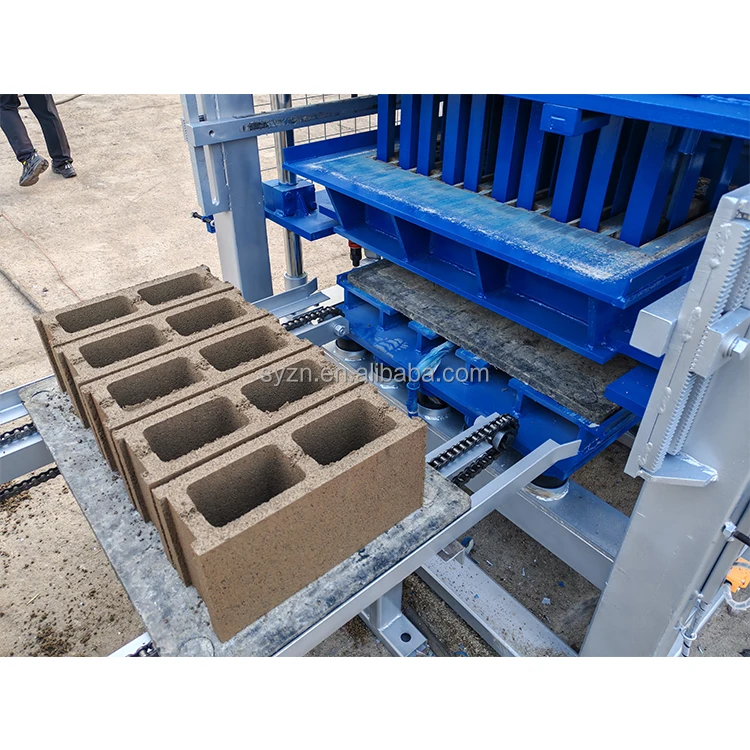
Complete line integration — The QT4-15A press anchors a fully synchronized production layout where raw material feeding, mixing, pallet circulation, and stacking are configured so no station forces the press to idle between moulding cycles.
Technical Specifications
| Parameter | Value |
|---|---|
| Product Type | Fully Automatic Concrete Block Making Machine |
| Model | QT4-15A |
| Overall Dimensions (L×W×H) | 4100×1600×2600 mm |
| Rated Pressure | 16–21 MPa |
| Main Vibration Form | Platform Vibration |
| Vibration Frequency | 4200 r/min |
| Vibration Force | 55 kN |
| Pallet Size | 880×550 mm |
| Molding Cycle | 25–30 s (basis not stated in source — confirm block format / material / thickness) |
| Overall Power | 18.45 kW (source lists "18.45W" — verify against manufacturer catalog) |
| Demolding Method | Hydraulic |
| Total Mass | 4 T |
| Factory Area | 300 m² |
| Applied Products | Concrete blocks, hollow/solid blocks, pavers, interlocking blocks, curbstone, colored pavers |
| Raw Material | Crushed stone, sand, cement, dust, fly ash, gravel, slag |
| Automation Level | Fully automatic |
| Voltage & Frequency | To be confirmed before commissioning |
| Control System / PLC | To be confirmed (make and language) |
| Mould Change Time | To be confirmed |
| Stacking Method | To be confirmed |
| Warranty | 1 year (excluding spare parts) |
| Loading | 1×40HQ container (basic equipment) |
Application Suitability
| Application | Material or Output |
|---|---|
| Block and paver production plants | Hollow and solid blocks from crushed stone, sand, and cement blends |
| Construction contractors producing blocks on-site | Interlocking blocks and curbstones using locally available aggregate |
| Concrete product manufacturers expanding format range | Pavers and colored paving units from fly ash and gravel mixes |
| Building material distributors and machinery importers | Standard hollow blocks for regional resale markets |
| Housing project contractors | Solid and hollow blocks produced locally to match daily build demand |
| Entrepreneurs setting up a first block plant | Entry-level automatic production of multiple block formats from common raw materials |
Why the Moulding Cycle Alone Does Not Define Your Daily Output
A 25–30 second cycle means nothing unless every upstream and downstream station keeps pace with the press.
I once configured an automatic block making machine production line where the mixer could not refill the hopper fast enough. The press sat idle for several seconds every third cycle while the operator waited for fresh material. The buyer had paid for a high-speed press but was running it at two-thirds capacity because the feeding rate was never matched to the moulding rhythm. That is the difference between quoting a cycle time and actually delivering daily output. The same applies to pallet return speed — if empty pallets do not arrive at the loading station before the press finishes its current stroke, the entire automatic block making machine production line stalls. [NEED_CITE: typical production bottlenecks in concrete block plants caused by station mismatch]
How Station Synchronization Prevents Press Idle Time
The QT4-15A completes a moulding stroke in 25–30 seconds. During that window, the mixer must have already delivered a fresh batch to the feed hopper, the pallet feeder must have positioned a clean pallet on the loading conveyor, and the wet-side stacker must have cleared the previous pallet of freshly pressed blocks. If any one of those three actions takes longer than the cycle, the press waits. The automatic block making machine production line is only as fast as its slowest station.
Matching the 300 m² Footprint to Your Existing Facility
A 300 m² factory area covers the press, mixer, pallet return conveyor, and curing rack footprint. That space must accommodate forklift travel lanes between the stacking station and the curing zone. When we layout a complete line, we place the pallet return path so cured blocks exit the racks without crossing the path of fresh pallets heading to the press. This prevents traffic bottlenecks that slow down the automatic block making machine production line during peak hours. [NEED_CITE: plant layout standards for concrete block production facilities]
Pressure and Vibration: Why Both Numbers Matter Together
The QT4-15A delivers 16–21 MPa of hydraulic pressure combined with 55 kN of platform vibration force at 4200 r/min. Pressure compacts the mix into the mould cavity; vibration eliminates air pockets and ensures the aggregate particles settle densely. If the vibration force is too low for a coarse aggregate blend, blocks emerge with honeycomb voids and fail compressive strength tests. If the hydraulic pressure is too high for a fine sand mix, the material over-compacts and cracks during demolding. Matching these two forces to the buyer’s actual aggregate gradation is what separates consistent block density from batch-to-batch variation. The 880×550 mm pallet size was chosen to align with standard curing rack dimensions and common forklift fork widths, so loaded pallets can move from press to rack without manual repositioning.
The Hidden Cost of Leaving Pallet Handling Out of the Quotation
When pallet feeding, stacking, and curing rack handling are excluded from the line specification, freshly pressed blocks sit on the pallet at the press exit until someone carries them away by hand. That means the automatic block making machine production line is only automatic up to the demolding station — everything after that is manual labor. Workers lifting loaded pallets slow the cycle, increase breakage, and introduce curing inconsistencies because blocks do not reach the racks on a predictable schedule. [NEED_CITE: labor cost impact of manual pallet handling in block production]
Why Procurement From a Line-Focused Supplier Changes the Outcome
Every configuration starts from the buyer’s actual mix design and local aggregate, not a catalog default. The QT4-15A is specified alongside its mixer capacity, pallet return conveyor, and stacking station so cycle times match across all stations. Mould design covers the specific hollow block, paver, and interlocking formats the buyer’s market demands, including custom drawings. Automation level is selectable — a buyer can begin with semi-automatic pallet handling and add full stacking later. Installation support includes operator training on the matched line, not just the press in isolation.
Documentation & Verification
- Line layout drawing showing every station and conveyor link for the QT4-15A configuration
- Capacity calculation stating the exact block format and pallet pattern assumed in the cycle time
- Machine specification sheet with hydraulic and electrical schematics for the 18.45 kW system
- Pallet specification covering material, thickness, and moisture resistance for the curing environment
- Factory test record on the buyer’s chosen block format before dispatch
- Voltage, frequency, and PLC display language confirmation sheet before shipment
Installation, Commissioning & Support
- 300 m² floor space preparation including level foundation for the 4 T press mass and mixer station
- Dedicated power circuit sized to the 18.45 kW total load with voltage and frequency confirmed pre-dispatch
- Machine dismantled for 1×40HQ container loading with reassembly guidance on site
- First-run commissioning covering hydraulic pressure calibration within the 16–21 MPa range
- Operator training on PLC controls, mould change procedure, and daily maintenance checks
- Wear parts and mould list supplied with reorder part numbers for hydraulic seals and vibration components
Before You Request a Quote
To size the QT4-15A line to your project, share the block formats you need to produce, your target daily output, the aggregate and cement types available locally, your existing curing area dimensions, and your facility’s voltage and frequency. If you already operate forklifts or curing racks, provide their specifications so the pallet size and stacking method can be matched accordingly.
Frequently Asked Questions
Q: How is the daily output calculated, and which block format is assumed in the cycle time?
A: The 25–30 second moulding cycle is listed without a stated block format. Daily output depends on whether the machine is producing hollow blocks, solid blocks, or pavers, because each format fills a different number of cavities per pallet. We calculate realistic output only after confirming the specific format, mix design, and pallet pattern you intend to run.
Q: Which stations are included in the quotation for the automatic block making machine production line?
A: The line can include raw material feeding, mixing, pallet feeding, automatic stacking, and curing rack handling. Each quotation specifies exactly which stations are covered so you know whether pallet return and stacking are part of the package or require separate procurement.
Q: What pallet size and material does the line require, and will it fit my existing setup?
A: The QT4-15A uses an 880×550 mm pallet. We confirm material type, thickness, and moisture resistance against your curing environment and verify that the pallet dimensions align with your existing curing racks and forklift fork spacing before finalizing the configuration.
Q: How do the mixer capacity and feeding rate match the press cycle?
A: The mixer must deliver a fresh batch to the feed hopper within the 25–30 second moulding window. We calculate the required mixer batch size and discharge rate based on your block format and mix density so the hopper never runs empty mid-cycle.
Q: What voltage, frequency, and PLC language are confirmed before dispatch?
A: Voltage, frequency, and PLC display language are confirmed with the buyer before production begins. This prevents commissioning delays caused by electrical mismatch or operators unable to read the control interface in their language.



