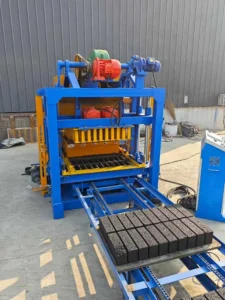
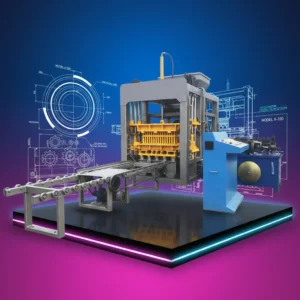
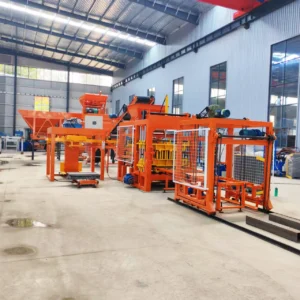
Integrated Line Engineering — every station from the multiaxis mixer to the curing rack is timed against the QT14-15 press cycle so the host machine is never left idling for material or pallets.
Technical Specifications
| Parameter | Value |
|---|---|
| Model | QT14-15 |
| Product Type | Automatic Concrete Block Making Machine |
| Vibration Mode | Multiaxis synchronizer vibration, vertically downward |
| Control System | Computer controlled, fully automatic (PLC brand and language options to be confirmed) |
| Hydraulic System | High thermal efficiency, low heat productivity design |
| Mixer System | Multiaxis forced mixer |
| Guide Bearing | Long-period over-length guide bearing for upper mould and mould box alignment |
| Rack Construction | High strength steel with special welding technique, vibration shock resistant |
| Moulding Cycle | 15–20 s (basis to be confirmed per block format) |
| Capacity — 400×200×200 mm Hollow Block | 4 pcs/mould, 900–1200 pcs/hour, 7200–9600 pcs/8 hr |
| Capacity — 400×150×200 mm Block | 5 pcs/mould, 1080–1440 pcs/hour, 8640–11520 pcs/8 hr |
| Capacity — 400×100×200 mm Block | 8 pcs/mould, 1440–1920 pcs/hour, 11520–15360 pcs/8 hr |
| Capacity — 200×100×60 mm Paving Block | 16 pcs/mould, 2880–3840 pcs/hour, 23040–30720 pcs/8 hr |
| Capacity — 240×115×53 mm Solid Brick | 28 pcs/mould, 5930–6720 pcs/hour, 47400–53700 pcs/8 hr |
| Automation Level | Fully automatic |
| Warranty | 1 year for whole machine (excluding spare parts) |
| Pallet Size | To be confirmed with buyer |
| Hydraulic Pressure | To be confirmed |
| Vibration Force | To be confirmed |
| Rated Power | To be confirmed |
| Voltage & Frequency | To be confirmed |
| Overall Dimensions | To be confirmed |
| Net Weight | To be confirmed |
Application Suitability
| Application | Material or Output |
|---|---|
| Hollow block production for load-bearing and partition walls | Crushed stone, sand, cement, fly ash blends |
| Multicellular brick manufacturing | Lightweight aggregate and cement mixes |
| Paving block production for roads and walkways | High-density concrete with fine aggregate |
| Standard solid brick production | Local sand, crushed stone, and cement |
| Kerbstone production for infrastructure projects | High-strength concrete with coarse aggregate |
Why Host Cycle Time Alone Does Not Define Line Output
The press sets the ceiling, but the slowest upstream or downstream station sets the floor.
I spent years walking block plants across the Middle East, and the most common cause of missed daily targets was not the press itself. A QT-class host machine pressing hollow blocks at full speed means little when the mixer batch takes longer to discharge than the moulding cycle, or when the pallet return conveyor backs up because the stacking station cannot keep pace. Buyers who focus only on host throughput frequently discover that their automatic concrete block making machine production line runs at a fraction of the quoted capacity once feeding, mixing, pallet handling, stacking, and curing are all factored in [NEED_CITE: typical block line bottleneck analysis across station cycle times].
Station-to-Station Timing Across the Full Line
Every station on this automatic concrete block making machine production line is specified against the 15–20 second moulding cycle of the QT14-15. The multiaxis forced mixer is sized so that a full batch discharges before the press completes its current mould set, preventing the hopper from running dry mid-cycle. Pallet feeding is paced to deliver a fresh board the instant the press table clears, eliminating the dead seconds that accumulate into lost shifts over a production day.
From Raw Feed to Cured and Cubed Output
The line does not end at the press exit. Automatic stacking lifts green blocks off the conveyor and places them onto curing racks in a pattern that matches the buyer’s kiln or yard geometry. Curing rack handling moves loaded racks into position and retrieves cured ones for the cubing station, where blocks are grouped for strapping and dispatch. When any one of these stations lags, the press waits — and the automatic concrete block making machine production line never reaches the daily figures on the quotation [NEED_CITE: curing rack handling impact on continuous block production throughput].
How Vibration, Pressure, and Mixer Design Shape Block Quality
The multiaxis synchronizer vibration directs force vertically downward, distributing compaction evenly across every pallet position so blocks at the centre and edges of the mould cure to the same density. The high thermal efficiency hydraulic system keeps oil temperature stable during long shifts, reducing the viscosity drift that causes inconsistent pressing force from the first mould to the five-hundredth. Long-period over-length guide bearings maintain alignment between the upper mould and mould box, preventing lip mismatches that force operators to discard entire pallets. The multiaxis forced mixer handles varied aggregate gradations, from fine sand to coarse crushed stone, so the mix arriving at the press hopper stays uniform regardless of the local raw material source.
What Happens When Line Stations Are Not Matched
I once visited a site where the owner had purchased a fast-cycle press but sourced the mixer and stacker separately to save on the initial order. Within weeks, semi-pressed blocks were backing up on the conveyor because the pallet return could not clear the table in time. The press sat idle for several seconds every cycle, and the daily output settled well below expectations. Mismatched voltage on the stacker motor then tripped the breaker twice a shift, adding unplanned downtime [NEED_CITE: electrical load balancing across block production line stations]. These are the hidden costs that never appear on a quotation that lists only the host machine.
Why Sourcing the Full Line From One Supplier Matters
Block machinery is our single focus, which means the press, moulds, pallets, and every handling station are specified as one matched system rather than assembled from separate vendors. We set the configuration against the buyer’s actual mix design, local aggregate, and target block format, not a catalogue default. Mould design covers the formats the buyer’s market actually sells, including custom drawings when standard moulds do not fit. Automation level is selectable, so a plant can start with semi-automatic pallet handling and add automatic stacking and cubing later without replacing the press. Installation support includes operator training on every station, not just the host.
Documentation & Verification
- Line layout drawing with capacity calculation stated per block format
- Machine specification sheet covering press, mixer, feeder, stacker, and curing rack as one system
- Mould drawing and format list matched to buyer’s target products
- Pallet specification confirming size and material against buyer’s curing area and forklift
- Voltage, frequency, and PLC display language confirmation before production
- Factory test record on buyer’s selected block format before dispatch
Installation, Commissioning & Support
- Foundation plan sized to the QT14-15 rack weight and vibration load
- Dedicated power circuit confirmed for the full line’s combined rated draw
- Machine dismantled for container loading with reassembly guidance on site
- First-run parameter setting across press, mixer, and stacker as one system
- Operator training covering mould change, pallet feed, and stacking sequence
- Wear parts and mould list supplied for the buyer’s initial production run
What We Need to Specify Your Line
Send us the block formats your market sells, the daily output you need per format, and the raw materials you can source locally. Tell us the voltage and frequency at your site, the PLC display language your operators read, and the dimensions of the curing area you already have. With those details, we can map every station’s cycle time against the QT14-15 and confirm what the automatic concrete block making machine production line will realistically produce.
Frequently Asked Questions
Q: How are cycle times matched across all stations so the press is never left waiting?
A: Each station — mixer discharge, pallet feed, stacker, and curing rack handler — is timed against the QT14-15 moulding cycle during line design. We calculate the slowest station and adjust conveyor speed, batch size, or rack travel distance so no station forces the press to idle between cycles.
Q: What is included in the line quotation beyond the press itself?
A: The quotation covers the multiaxis forced mixer, raw material feeder, pallet feeding system, automatic stacker, curing rack handling, and cubing station. Every component is listed with its own cycle time so buyers can see how the full automatic concrete block making machine production line connects.
Q: How is pallet size and material chosen for each buyer?
A: We confirm the dimensions of the buyer’s existing curing area and the forklift capacity before specifying pallets. A pallet that is too large wastes curing space; one that is too small reduces blocks per cycle. Material selection balances moisture resistance with the weight the forklift can handle.
Q: What electrical details are confirmed before production starts?
A: Voltage, frequency, and PLC display language are locked before the line enters build. Commissioning delays frequently trace back to a control panel set for the wrong supply or a display the local operators cannot read [NEED_CITE: common commissioning delays in exported block machinery].
Q: How does the line layout document capacity for each block format?
A: The layout drawing lists moulding cycle, mould cavity count, and hourly throughput separately for every block format the buyer plans to produce. This prevents the common gap where a single headline capacity figure does not match the format the plant actually runs.