
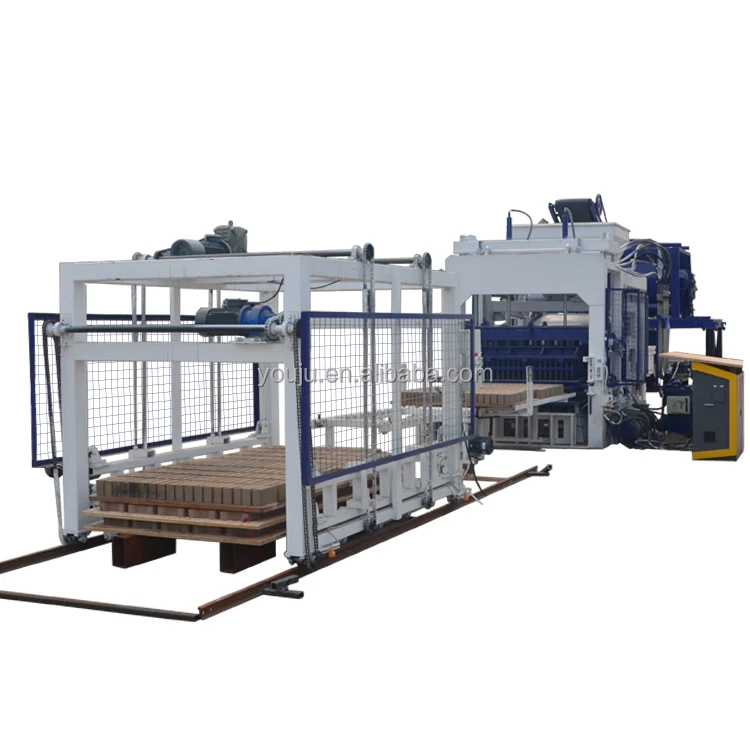
Matched line cycle times — The QT12-15 is configured as the press at the centre of a complete block production line, where raw material feeding, pallet circulation, stacking and curing rack handling are specified as one matched system rather than assembled from separate suppliers.
Technical Specifications
| Parameter | Value |
|---|---|
| Model | QT12-15 |
| Product Type | Automatic Concrete Block Making Machine |
| Overall Dimensions (L×W×H) | 7500×2500×3020 mm |
| Total Mass | 12 T |
| Pallet Size | 1220×900 mm |
| Molding Cycle | 15-20 s |
| Vibration Frequency | 0-60 Hz |
| Main Vibration Form | Platform Vibration |
| Vibration Force | 100 kN |
| Demolding Method | Hydraulic |
| Overall Power | 53 kW |
| General Water Consumption | 12 T/Day |
| Factory Area | 1200 m² |
| Control System | PLC with human-machine interface |
| Moulding Mode | Automatic loading, vibration moulding |
| Feeding System | Semi-closed screen reticular rotational forced feeding |
| Output Capacity | 1728-2160 pcs/h (based on 400×200×200mm hollow bricks, 12 pcs/mould, 20-25s cycle) |
| Output Capacity | 4860-6480 pcs/h (based on 240×115×90mm porous bricks, 27 pcs/mould, 15-20s cycle) |
| Output Capacity | 12700-14400 pcs/h (based on 240×115×53mm standard bricks, 62 pcs/mould, 15-17s cycle) |
Application Suitability
| Application | Material or Output |
|---|---|
| Hollow block production | Crushed stone, sand, cement, fly ash, gravel, slag |
| Solid block and paver manufacturing | Cement, sand, stone dust, colored pigments |
| Interlocking brick and curbstone production | Concrete mix with local aggregate blends |
| Porous brick manufacturing | Fly ash, slag, cement, and industrial by-products |
What "Pieces per Hour" Leaves Out When the Line Is Not Specified as a Whole
A block press cycle rate only matters when every upstream and downstream station can match it.
I have seen automatic concrete block making machine production line setups where the press rated at a fast cycle sits idle because the mixer discharges too slowly or the pallet feeder cannot keep up. The real daily output falls well short of what the press alone can produce. When pallet handling, stacking and curing are omitted from the quotation, the plant ends up stacking blocks by hand and the press waits for empty pallets to return. The bottleneck shifts from the machine to the logistics around it. [NEED_CITE: block plant line balancing and cycle time matching]
Raw Material Feeding That Keeps Pace With the Press
The semi-closed screen reticular rotational forced feeding unit on this automatic concrete block making machine production line delivers material into the mould cavity with even distribution across each cycle. This consistency matters when you are running different block formats back to back, because uneven fill leads to density variation and weak spots in the cured product. The feeding cycle must complete within the press molding window so the vibration and hydraulic pressure act on a fully loaded mould every time.
Pallet Circulation Sized to Your Curing Yard
The 1220×900 mm pallet is not an arbitrary choice — it must match the curing rack dimensions and the forklift capacity you already have on site. When pallets are too large for the curing area, blocks sit on the floor and curing times extend unpredictably. When they are too small, you lose output per cycle and the stacker must handle more units per shift. The pallet return system must cycle fast enough so the QT12-15 never waits for an empty pallet after demolding. [NEED_CITE: pallet sizing and curing rack layout for block plants]
Reading the Specifications Against Real Production
The 100 kN vibration force and platform vibration form work together to compact the concrete mix uniformly across the 1220×900 mm pallet area. Higher vibration frequency alone does not guarantee block strength — it must be matched to the hydraulic demolding pressure and the buyer’s specific mix design. The 0-60 Hz adjustable frequency range lets the operator tune vibration to different materials, from lightweight fly ash blends to dense crushed stone mixes. The PLC control system coordinates the feeding, vibration, pressing and demolding sequence so that each station transitions without dead time. The 53 kW total power requirement must be verified against the local voltage and frequency before the line ships, because undersized supply circuits cause motor overheating and PLC faults during commissioning.
The Cost of Ignoring Line-Wide Cycle Matching
When upstream stations like the mixer or feeder operate on a slower cycle than the press, the automatic concrete block making machine production line produces fewer blocks per shift than any single component’s rating suggests. Pallets queue at the curing rack entrance, and manual handling creates bottlenecks that no amount of press speed can solve. Mould change times also compound the problem — if format switching takes most of a shift, the flexibility you paid for disappears. [NEED_CITE: hidden costs of mismatched block line stations]
Why Source the Entire Line From One Configuration
The QT12-15 is specified as part of a matched system where the machine, mould, pallet and handling equipment are configured together, not assembled from separate suppliers. The line layout accounts for the 1200 m² factory area requirement, positioning raw material storage, the press, pallet circulation and curing racks so that material flow is continuous. Configuration is set against the buyer’s actual mix design and local aggregate rather than a catalogue default. Mould design covers the formats the buyer’s market sells, including custom drawings. Automation level is selectable, so a plant can start with semi-automatic pallet handling and add automatic stacking later.
Documentation & Verification
- Line layout and capacity calculation stating the specific block format and cycle time assumed for daily output
- Pallet specification sheet matched to your curing rack dimensions and forklift type
- Hydraulic and electrical schematic confirming voltage, frequency and PLC display language
- Factory test record run on your target block format before dispatch
- Wear parts and mould list with availability timeline for first replacement
Installation, Commissioning & Support
- Foundation plan for the 7500×2500×3020 mm machine footprint within the 1200 m² factory area
- Dedicated power circuit for the 53 kW total load at confirmed local voltage and frequency
- PLC language and human-machine interface set to operator language before shipment
- On-site commissioning covering press, feeder, pallet system and stacker as one integrated line
- Operator training on mould change procedure, cycle adjustment and daily maintenance routines
- Mould and hydraulic wear parts list with supply timeline for first replacement order
Before You Request a Quotation
Share the specific block formats you plan to produce and the daily output target for each format, so the capacity calculation reflects real production rather than a generic cycle rate. Confirm the local voltage, frequency and preferred PLC display language so electrical and control systems are built to your site conditions. Provide the dimensions of your available factory floor and curing area so pallet size and line layout are configured around what you have.
Frequently Asked Questions
Q: How is daily line output verified against a specific block format?
A: Capacity is calculated per format using the mould cavity count and actual cycle time for that block size. For example, the QT12-15 produces 1728-2160 hollow bricks per hour based on 12 pieces per mould at a 20-25 second cycle with 400×200×200mm dimensions. Daily output is then derived from planned shift hours, not a generic press rating.
Q: How do pallet size and curing layout affect the line configuration?
A: The 1220×900 mm pallet must match your existing curing rack spacing and forklift capacity. If pallets do not fit the racks, blocks cure on the floor and throughput drops. The pallet feeder and return system are specified to cycle within the press molding time so the QT12-15 never waits for an empty pallet.
Q: What electrical details must be confirmed before the line ships?
A: Local voltage, frequency and the PLC display language must be locked in before production. The 53 kW total power draw requires a dedicated circuit, and any mismatch in voltage or frequency causes motor and control faults during commissioning. These details are confirmed in writing before the automatic concrete block making machine production line enters assembly.
Q: Which stations must match the press cycle time?
A: The raw material feeder, pallet feeder, stacker and pallet return system must all complete their operations within the 15-20 second molding cycle. If any station runs slower, the press idles and daily output falls below the rated capacity. Line synchronization is verified during factory testing before dispatch.


