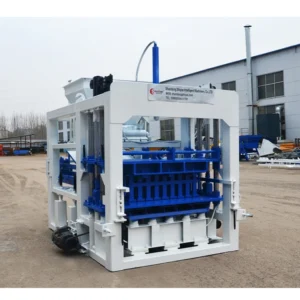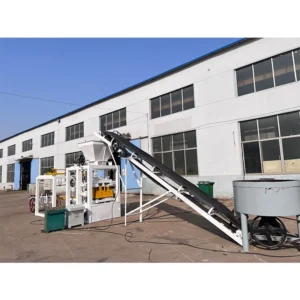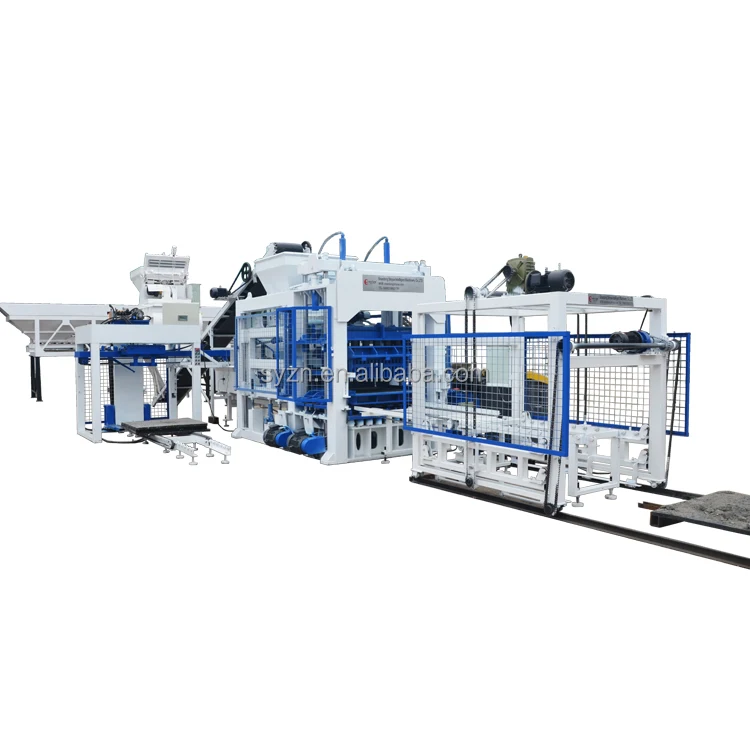
Matched Line Integration — Every station from pallet feed to stacking is specified alongside the QT10-15 press so cycle times align and the host machine is never left waiting.
Technical Specifications
| Parameter | Value |
|---|---|
| Model | QT10-15 Stationary Fully Automatic Hydraulic Concrete Block Making Machine |
| Product Type | Stationary Fully Automatic Hydraulic Concrete Block Making Machine |
| Control System | PLC control cabinet |
| Hydraulic System | Independent integrated hydraulic station |
| Vibration Mode | Vertical station mode resonance, automatic FM-AM |
| Mould Change | Simple replacement for multi-format production |
| Component List | Pallet feed machine, block making machine, storage hopper, conveyor, hydraulic unit, PLC control cabinet |
| Output Capacity (400×200×200mm hollow block) | 1800–2400 pcs/hour, 14400–19200 pcs/8hr (basis: 10 pcs/mould, 15–20s cycle) |
| Output Capacity (400×150×200mm hollow block) | 2160–2880 pcs/hour, 17280–23040 pcs/8hr (basis: 12 pcs/mould, 15–20s cycle) |
| Output Capacity (240×115×53mm solid brick) | 8928–11160 pcs/hour, 71424–89280 pcs/8hr (basis: 62 pcs/mould, 15–20s cycle) |
| Output Capacity (200×100×60mm paving block) | 5184–6480 pcs/hour, 41472–51840 pcs/8hr (basis: 27 pcs/mould, 20–25s cycle) |
| Output Capacity (225×112.5×60mm interlocking brick) | 4032–5040 pcs/hour, 32256–40320 pcs/8hr (basis: 24 pcs/mould, 20–25s cycle) |
| Cycle Time (hollow block) | 15–20s |
| Cycle Time (paving / interlocking block) | 20–25s |
| Automation Level | Fully automatic |
| Assembly State | Stationary |
| Warranty | 1 year for whole machine (excluding spare parts) |
| Rated Power | Confirm with manufacturer before order |
| Voltage & Frequency | Confirm before order |
| Overall Dimensions (L×W×H) | Confirm with manufacturer before order |
| Pallet Size | Confirm with manufacturer before order |
| Hydraulic Pressure | Confirm with manufacturer before order |
| Vibration Force | Confirm with manufacturer before order |
| PLC Language Options | Confirm with manufacturer before order |
Application Suitability
| Application | Material or Output |
|---|---|
| Hollow block production for commercial and residential wall construction | Crushed stone, sand, cement, fly ash blends |
| Solid brick manufacturing for load-bearing masonry | River sand, quarry dust, cement mixes |
| Paving block production for roads, parking areas and walkways | High-density aggregate and cement blends |
| Interlocking brick for retaining walls and landscape projects | Graded aggregate with cement binder |
| On-site block production for large housing developments | Locally sourced aggregate matched to regional supply |
| Multi-format concrete product plants adding new lines | Variable mix designs across block formats |
What "Cycles per Hour" Leaves Out About Stationary Block Machine Production Line Output
Real daily throughput depends on every station keeping pace with the press, not on the press alone.
A stationary block machine production line rated at a certain cycle count assumes the pallet feed, material delivery, and stacking stations can all keep up. When one upstream or downstream station runs slower, the press sits idle between cycles and actual output drops well below the quoted figure. The problem is rarely visible in a brochure — it only shows up on the first production shift [NEED_CITE: concrete block line throughput measurement standards]. Buyers who focus on press speed without verifying the full line sequence often discover the gap after commissioning, when the curing racks are only half full at the end of the day.
How Station Sequencing Prevents Press Idle Time
The QT10-15 operates as the central node in a stationary block machine production line that includes a pallet feed machine, storage hopper, conveyor, hydraulic unit, and PLC control cabinet. Each station receives its command from the same PLC sequence, so the pallet arrives at the press table only after the mould has completed its cycle and the previous block has cleared the stacking zone. This coordination means the press vibration and hydraulic compression phases are never interrupted by a missing pallet or an empty hopper, which is the most common cause of unplanned idle time on partially configured lines.
Where Bottlenecks Typically Hide in a Block Line
The storage hopper and conveyor are often the first stations to fall behind when a plant switches from hollow block to a denser paving format with a longer cycle. The mixer output may have been adequate for the lighter mix, but the heavier paving blend demands more material per cycle and the conveyor cannot deliver it fast enough. Downstream, the stacking station must clear finished blocks before the next pallet arrives, and if the curing rack handling is manual, operators become the pacing constraint [NEED_CITE: block plant automation level and throughput correlation]. Identifying these pinch points during the line layout phase — before equipment is built — is far less costly than retrofitting a faster conveyor or adding an automatic stacker after installation.
Vibration, Hydraulic Pressure, and What They Mean for Block Density
The QT10-15 uses vertical station mode resonance with automatic FM-AM vibration paired with an independent integrated hydraulic station. The vibration force drives aggregate particles into a dense arrangement inside the mould, while the hydraulic pressure holds the mould head down to prevent the mix from expanding during compaction. When these two forces are correctly matched to the buyer’s mix design and local aggregate gradation, the resulting block reaches the target compressive strength consistently across every pallet. If the hydraulic pressure is too low for a particular mix, the block surface may crack or crumble at the edges during demoulding. The automatic FM-AM feature adjusts vibration frequency to suit different mould formats, so switching from a hollow block mould to a paving block mould does not require manual tuning of the vibration motor.
The Cost of Ordering the Press Without the Line
When a buyer purchases only the QT10-15 press and sources supporting equipment separately, the risk of mismatched cycle times increases sharply. A pallet feed machine from one supplier may deliver pallets at a rate the press cannot accept, causing jams, while a conveyor from another supplier may run too slowly and starve the storage hopper. The PLC control cabinet on the QT10-15 is configured to manage the full component list as one system; introducing third-party stations with different signal protocols means the PLC cannot coordinate them, and each station must be operated manually [NEED_CITE: PLC integration requirements for multi-vendor concrete equipment]. The hidden cost is not just the idle press time — it is the extra labour needed to move pallets, feed material, and stack blocks by hand, which turns a fully automatic line into a semi-automatic one in practice.
Why Specifying the Full Line Here Matters
Every station around the QT10-15 is selected and configured as part of one matched system rather than assembled from separate catalogue pages. The line layout states which block format each capacity figure assumes, so a buyer comparing hollow block output to paving block output can see the cycle time and mould cavity count behind each number. The pallet size is confirmed against the buyer’s existing curing area and forklift capacity before production begins, preventing a situation where delivered pallets do not fit the curing racks. Voltage, frequency, and PLC display language are locked in during the quotation stage, so there is no commissioning delay waiting for a control cabinet rewire or a software language pack. Mould design covers the formats the buyer’s market actually sells, and custom mould drawings are available when standard formats do not match local building codes.
Documentation & Verification
- Line layout and capacity calculation stating the block format assumed for each output figure
- Machine specification sheet with hydraulic and electrical schematic
- Mould drawing and format list showing covered block sizes and pallet dimensions
- Voltage, frequency, and PLC control language confirmation record before production
- Factory test record on the buyer’s target block format before dispatch
- Packing photographs and customs documentation support for shipment
Installation, Commissioning & Support
- Foundation drawing provided for the QT10-15 stationary footprint and vibration load requirements
- Power supply specification confirmed for voltage, frequency, and dedicated circuit rating before shipment
- Machine shipped in dismantled modules with reassembly sequence documented for site crews
- PLC control cabinet commissioned on-site with parameter settings matched to the buyer’s mix design
- Operator training covers mould change procedure, pallet feed alignment, and daily hydraulic station checks
- Wear parts and mould replacement list supplied with part numbers for reordering
What to Include in Your Stationary Block Machine Production Line Inquiry
To size a stationary block machine production line accurately, share the block formats your market sells, the target daily output for each format, and the local aggregate types available for your mix. Confirm the voltage and frequency at your site, the PLC display language your operators need, and whether your curing area and forklift are already in place so the pallet size can be matched. If you have existing upstream or downstream equipment that must connect to the new line, include the model and capacity details so the station sequencing can account for it.
Frequently Asked Questions
Q: How are line station cycle times matched so the QT10-15 press is not left waiting between pallet feed, material delivery, and stacking?
A: Each station — pallet feed machine, storage hopper, conveyor, hydraulic unit, and stacking zone — is selected during the line layout phase so its individual cycle time is equal to or faster than the QT10-15 press cycle. The PLC control cabinet coordinates all stations in one sequence, and the capacity calculation document states the assumed block format behind each timing figure.
Q: Which supporting equipment stations are included in the quotation, and which are optional add-ons?
A: The standard quotation for the QT10-15 stationary block machine production line covers the pallet feed machine, block making machine, storage hopper, conveyor, hydraulic unit, and PLC control cabinet. Additional stations such as automatic stacking, curing rack handling, and cubing systems are available as configured add-ons based on the buyer’s automation level preference.
Q: How is the capacity figure calculated for each block format?
A: Each capacity figure is tied to a specific block size, mould cavity count, and cycle time. For example, the hollow block output is based on 10 cavities per mould with a 15–20 second cycle, while paving block output assumes 27 cavities with a 20–25 second cycle. The line layout document lists these assumptions so buyers can compare formats directly.
Q: What voltage, frequency, and PLC display language are configured before shipment?
A: Voltage and frequency are confirmed during the quotation stage to match the buyer’s site power supply, and the PLC display language is set before the control cabinet leaves the factory. This prevents commissioning delays caused by electrical mismatch or an interface the operators cannot read.
Q: What raw material feed configuration is needed to keep the storage hopper and conveyor matched to the press cycle rate?
A: The conveyor throughput and storage hopper capacity must deliver enough mixed material to fill every mould cavity within the press cycle time. The required configuration depends on the block format being produced and the density of the local aggregate blend, both of which are confirmed during the line layout phase.